
This comprehensive guide explains how forex scalping works and how traders can turn short-term setups into structured, testable trading systems. It covers continuation, breakout, and mean-reversion strategies, along with suitable timeframes, currency pairs, indicators, execution considerations, risk management, position sizing, backtesting, and performance measurement. The article emphasizes that successful scalping depends not just on entry signals, but on market conditions, trading costs, disciplined execution, and consistent testing.
Forex scalping attracts traders because it offers frequent opportunities and fast feedback. Instead of waiting several days for a large move to develop, a scalper tries to capture a smaller part of intraday price movement, often holding a position for only a few minutes.
The speed can make scalping look easier than longer-term trading. In practice, it creates a different set of challenges. Small targets leave little room for poor execution, transaction costs consume a larger share of each trade, and market conditions can change quickly.
This is where many discussions of forex scalping strategies become too narrow. An EMA crossover, RSI reading, breakout candle, or support-and-resistance pattern may identify a possible entry, but none is a complete strategy on its own.
A usable scalping strategy defines the market environment, setup, entry trigger, invalidation point, exit method, position-sizing process, and conditions that make the trade unsuitable. It also accounts for spread, commission, slippage, and whether the rules can be executed consistently.
The same setup can behave very differently as the market changes. An EMA pullback may work well during an orderly trend and struggle once price begins moving sideways. A breakout can look clean but become unattractive if the entry is late. A range strategy may produce several rotations before failing when price starts trending.
A useful scalp therefore sits at the intersection of market condition, setup quality, execution, cost, and risk.
This guide explains how forex scalping works, the main strategy families, suitable timeframes and market conditions, the role of indicators and execution, and how to turn an individual setup into a forex scalping trading system that can be tested objectively.
Key Takeaways
- A forex scalping strategy is a complete decision process, not merely an entry signal.
- Most scalping methods fit into three families: continuation, expansion, and reversion.
- Small targets make transaction costs and fill quality central to performance.
- The appropriate timeframe, pair, and session depend on the system being tested rather than on trade frequency alone.
- Indicators work best when each one has a defined role, such as direction, momentum, volatility, or location.
- Stops should reflect where the trade thesis becomes invalid; position size is calculated afterward from stop distance and planned risk.
- Scalping performance should be evaluated using net expectancy after costs rather than gross pips or win rate alone.
What Is a Forex Scalping Strategy?
Forex scalping is a short-term trading style designed to capture relatively small changes in currency prices. Positions may remain open for seconds or minutes, although some scalps last longer when the market develops more slowly.
The objective is usually to participate in one section of an intraday move rather than hold through an entire trend.
How Forex Scalping Works
A scalper might trade a pullback during an existing trend, a breakout from consolidation, a rejection from a range boundary, or a short burst of momentum after price clears an important level.
These situations look different on a chart, but each needs enough movement and enough structural clarity to justify the risk and trading costs.
Consider a five-minute EUR/USD chart where price touches a 50-period EMA. The touch itself provides little information.
The EMA may be rising while price forms higher highs and higher lows, or flat while price repeatedly crosses through it. The pullback may be orderly or the beginning of a deeper reversal. Resistance may be far enough away to support the trade or so close that little reward remains.
Context gives the signal meaning.
Scalping vs. Day Trading and Swing Trading
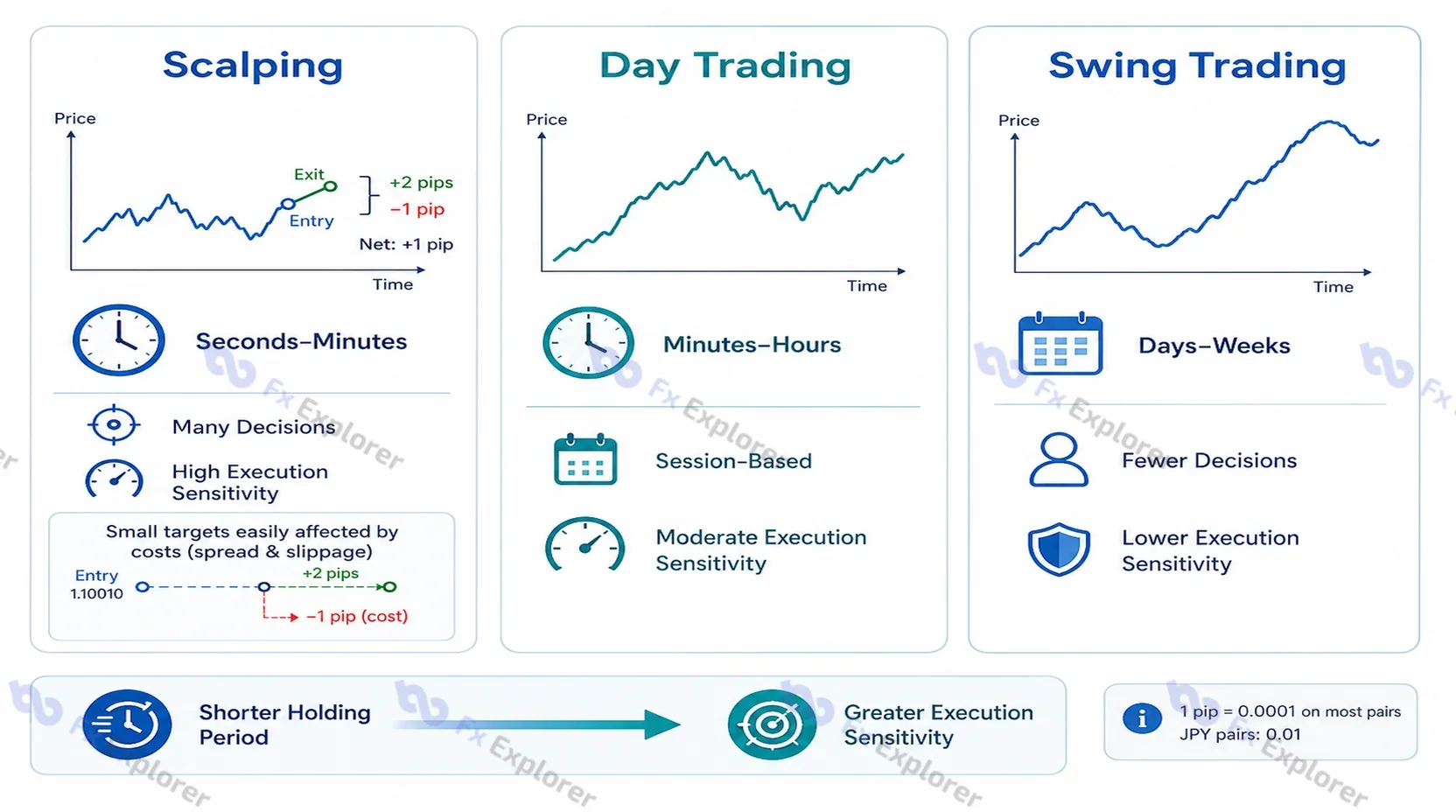
Scalping sits at the shortest end of active trading. Day traders usually hold positions longer and seek larger intraday moves, while swing traders may remain in trades for days or weeks.
The shorter holding period makes scalping especially sensitive to execution.
A swing trader targeting a large move may tolerate a slightly worse fill without changing the trade materially. A scalper targeting several pips may not. A wider spread, late entry, or modest slippage can remove a meaningful share of the expected reward.
A pip is the standard unit used to describe most forex price changes. For many currency pairs it corresponds to the fourth decimal place, while JPY pairs commonly use the second decimal place.
Scalping also concentrates more decisions into a short period. Several opportunities may appear within one hour, creating more chances to chase price, lower setup standards, or change risk after a loss.
More activity is useful only when decision quality remains consistent.
What Turns a Setup Into a Trading System?
A setup describes what may be happening in price. A system decides whether that situation deserves a trade and how the position will be managed.
A complete forex trading scalping strategy defines the required market condition, setup, entry trigger, invalidation point, exit logic, risk limits, and conditions that cancel the trade.
An EMA pullback becomes testable only when the trader specifies what qualifies as a trend, what confirms the pullback has ended, where the stop belongs, how the target is selected, and when the setup should be ignored.
The same applies to breakouts, momentum trades, ranges, and mean reversion.
Who Is Forex Scalping Best Suited To?
Scalping tends to suit traders who can concentrate intensely for defined periods, make decisions quickly, follow detailed rules, and accept frequent small losses without immediately changing the method.
It is less suitable for someone who cannot monitor the market during the trading window, dislikes rapid decision-making, or prefers a relatively passive style. Scalping requires active preparation, observation, and execution.
That does not make one trading style superior to another. It simply means scalping demands a particular workflow.
Why Forex Scalping Is More Difficult Than It Looks
Short holding periods do not remove uncertainty. They compress it.
Small Targets Magnify Trading Costs
Spread, commission, and slippage matter in every trading style, but their effect becomes proportionally larger as targets shrink.
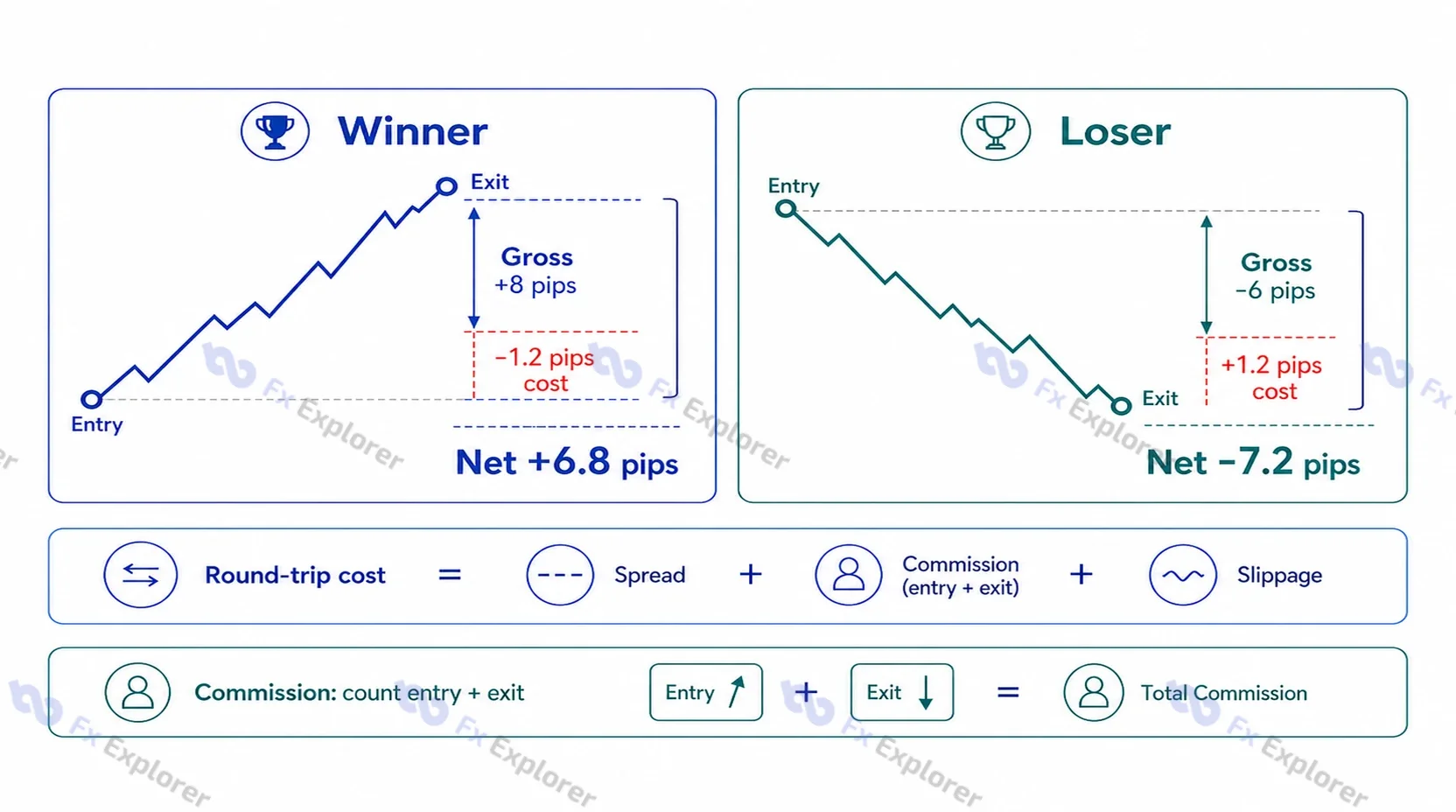
Suppose a strategy has historically produced an average gross winner of 8 pips and an average gross loser of 6 pips. If the average round-trip transaction cost is 1.2 pips, the approximate net winner becomes 6.8 pips, while the effective loss becomes about 7.2 pips when the same cost burden is included.
Costs should be compared on the same basis. If commission is quoted per side, both entry and exit costs need to be included when estimating round-trip performance.
The visible chart movement may still look attractive, but the economics are different. Net performance is what matters.
Late Entries Can Change the Trade
Entry quality becomes critical when the expected move is small.
Imagine a breakout that initially offers ten pips of room before the next resistance area. If price advances three pips before the order is filled, the structural stop may remain in the same area while the remaining potential reward falls to seven pips.
The setup can remain visually valid while the trade itself becomes materially worse.
Stop-loss execution also requires realistic assumptions. A stop defines the intended exit trigger, but fast conditions can create slippage, so the actual fill may occur beyond the requested stop price.
Decision Fatigue Builds Quickly
Scalpers repeatedly decide whether the market is trending or ranging, whether a setup is valid, whether the spread is normal, whether the entry is late, and whether sufficient target space remains.
Even when the strategy is understood well, that decision density can reduce concentration.
A smaller number of high-quality trades may provide better information than a session filled with marginal entries. There is no ideal number of scalps per day; trade count should emerge from the number of valid setups produced by the tested system rather than from a quota.
Before choosing a setup, the trader also needs conditions in which short-term execution is practical.
How Liquidity, Market Structure, and Execution Affect Forex Scalping
Scalping operates directly inside changing liquidity and volatility conditions.
Why Liquidity Matters
Liquid markets generally make it easier to transact without large changes in execution price. This can support tighter spreads and more consistent fills.
Thin conditions are different. Spreads may widen, price can move abruptly, and orders may fill farther from the intended level.
Liquidity also changes throughout the day. A pair can trade smoothly during its most active session and become less attractive during a quieter period.
High volatility should not be confused with high liquidity. Price can move very quickly while execution quality deteriorates.
Support, Resistance, and Short-Term Order Behavior
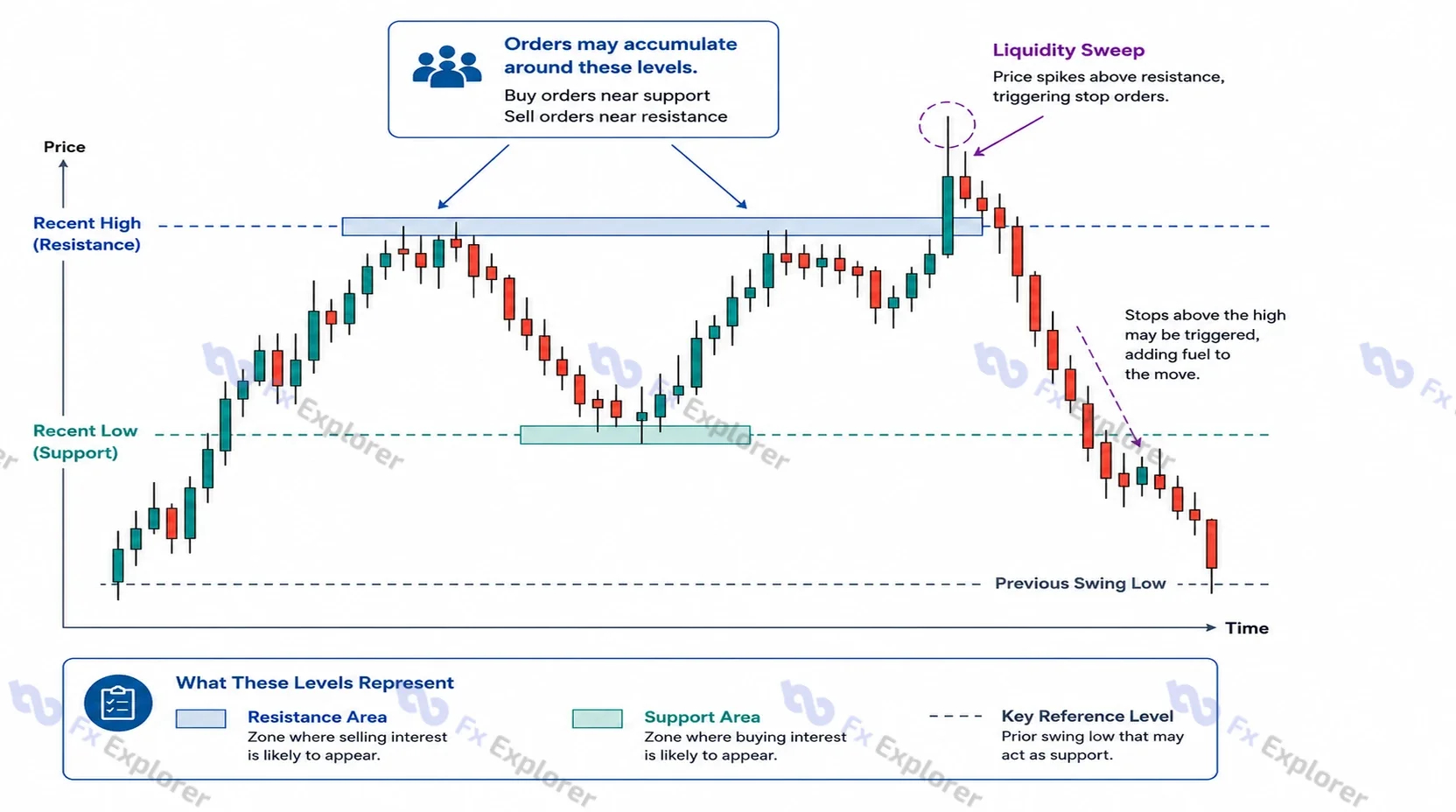
Recent highs, lows, session boundaries, and obvious support or resistance areas often attract trading activity.
Orders may accumulate around these levels, and stops beyond visible highs or lows can contribute to temporary acceleration when triggered.
The exact cause of a short-term move is rarely observable from a retail chart alone. A spike through resistance might involve new buying, short covering, stop activation, changing liquidity, or several factors at once.
Terms such as liquidity sweep can describe visible behavior, but they should not be treated as proof of the underlying cause.
Why False Breakouts Happen
A move beyond support or resistance does not guarantee continuation.
Price may break a level, attract breakout entries, and then return quickly to the previous range.
Waiting for a candle close, follow-through, or retest does not eliminate false breakouts. These filters simply make the method more selective.
The same caution applies to repeatedly tested levels. Multiple reactions can make support or resistance relevant, but repeated testing does not guarantee greater strength. Momentum, approach speed, and the broader market condition all affect the next reaction.
Levels are most useful as decision areas rather than predictions.
Execution Readiness Matters
Scalping leaves little room for operational mistakes.
Before relying on rapid execution, a trader should understand how the platform handles market orders, pending orders, stop-losses, trade modifications, and position size.
A wrong default lot size, duplicate order, delayed cancellation, or connection failure is an execution problem rather than a strategy problem.
Broker policies may also vary. Rapid trading, minimum holding periods, order handling, and other execution rules should be checked before using a scalping system live.
Observable factors such as effective spread, commission, slippage, fill quality, order reliability, and platform stability are more useful than relying solely on account-model labels.
Once execution conditions are acceptable, the next question is which type of market behavior the system is designed to trade.
The Three Main Forex Scalping Strategy Families
Before selecting a setup, classify the market.
Directional swing structure points toward continuation. Repeated rotation between horizontal boundaries suggests reversion. Shrinking ranges and reduced movement can create conditions for later expansion.
When none of these behaviors is clear, forcing a strategy usually lowers trade quality.
Continuation Scalping: EMA Pullbacks and Momentum
Continuation scalping attempts to join a move that is already underway.
In an uptrend, price may be producing higher highs and higher lows while remaining above a useful directional reference. In a downtrend, the structure is reversed.
Rather than entering after price becomes extended, the trader waits for a pause or retracement before looking for renewed movement in the original direction.
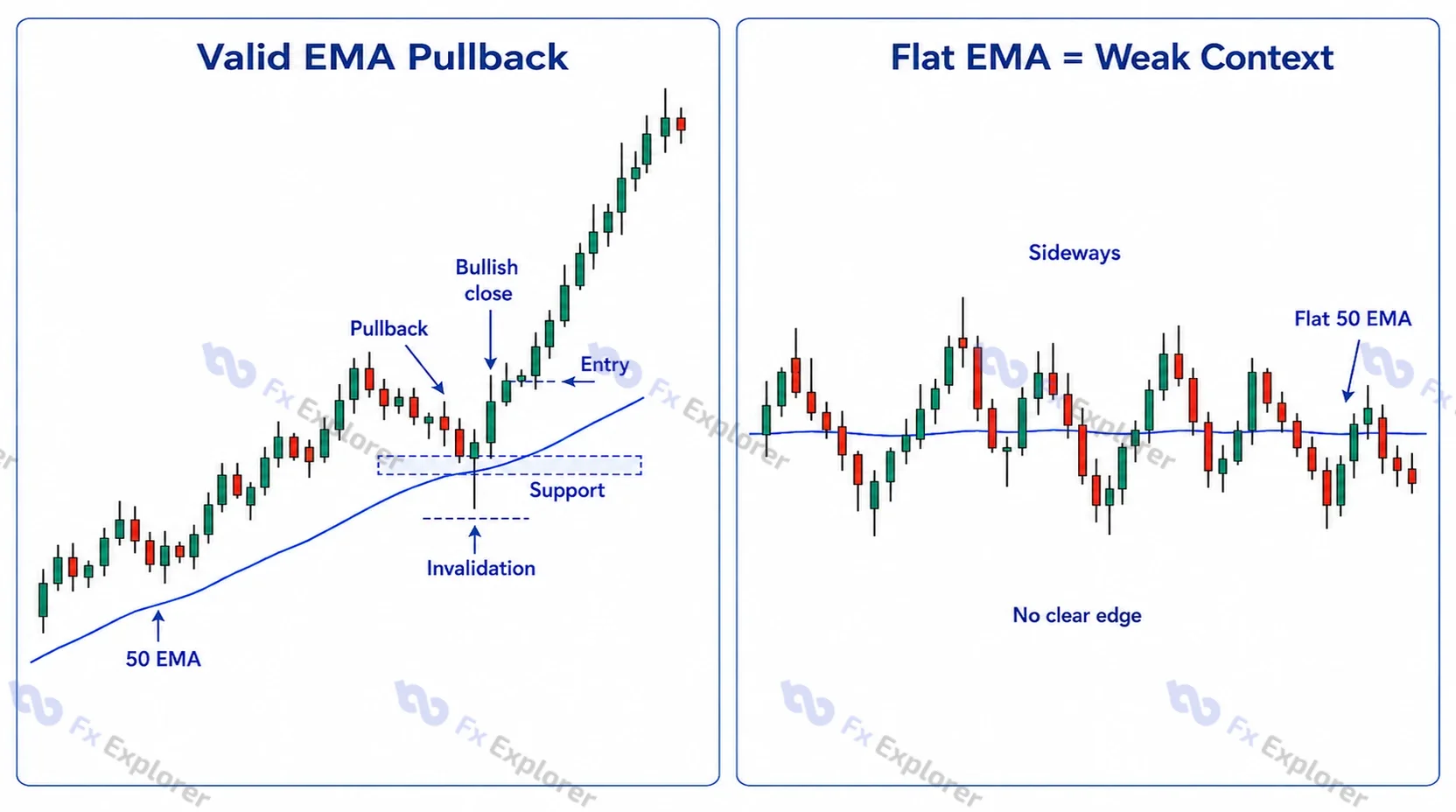
EMA pullback scalping: A 50-period EMA on a five-minute chart can help organize directional context. If price remains above a rising EMA while swing structure stays bullish, a pullback toward the average or nearby support may create an area of interest.
Touching the EMA is not enough.
Confirmation may come from a bullish close, rejection from the pullback area, or a break above minor resistance. The invalidation point generally sits below the swing structure that defines the setup.
The method loses usefulness when price becomes sideways. Repeated movement above and below a flat EMA suggests the directional condition has disappeared.
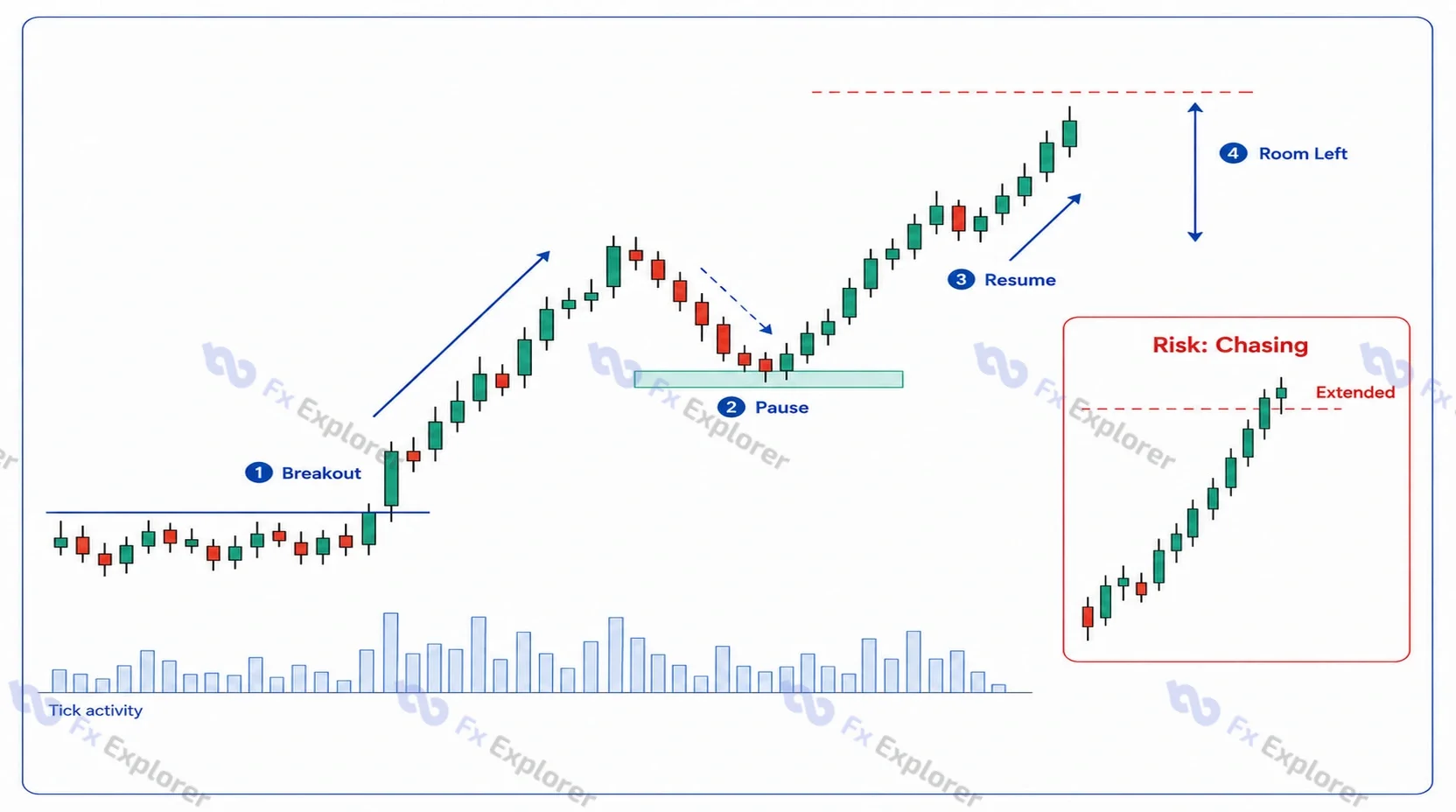
Momentum scalping: Momentum setups target stronger directional acceleration after a breakout, failed reversal, or renewed participation in an existing trend.
The main risk is chasing. Momentum becomes easiest to recognize after price has already moved substantially, exactly when the remaining reward may be shrinking.
A more controlled approach lets the initial acceleration occur, then waits for a shallow pullback, pause, or brief consolidation. Participation becomes relevant only if movement resumes and sufficient room remains before the next opposing level.
Where volume is used as context, spot forex traders should remember that the market is decentralized. Retail platforms often display tick activity or venue-specific volume rather than a single consolidated global figure.
Expansion Scalping: Breakouts and Breakout-Retests
Expansion scalping attempts to capture the transition from quiet price behavior into stronger movement.
The setup usually begins with consolidation, a narrow range, a session boundary, or another area where price has stopped progressing.
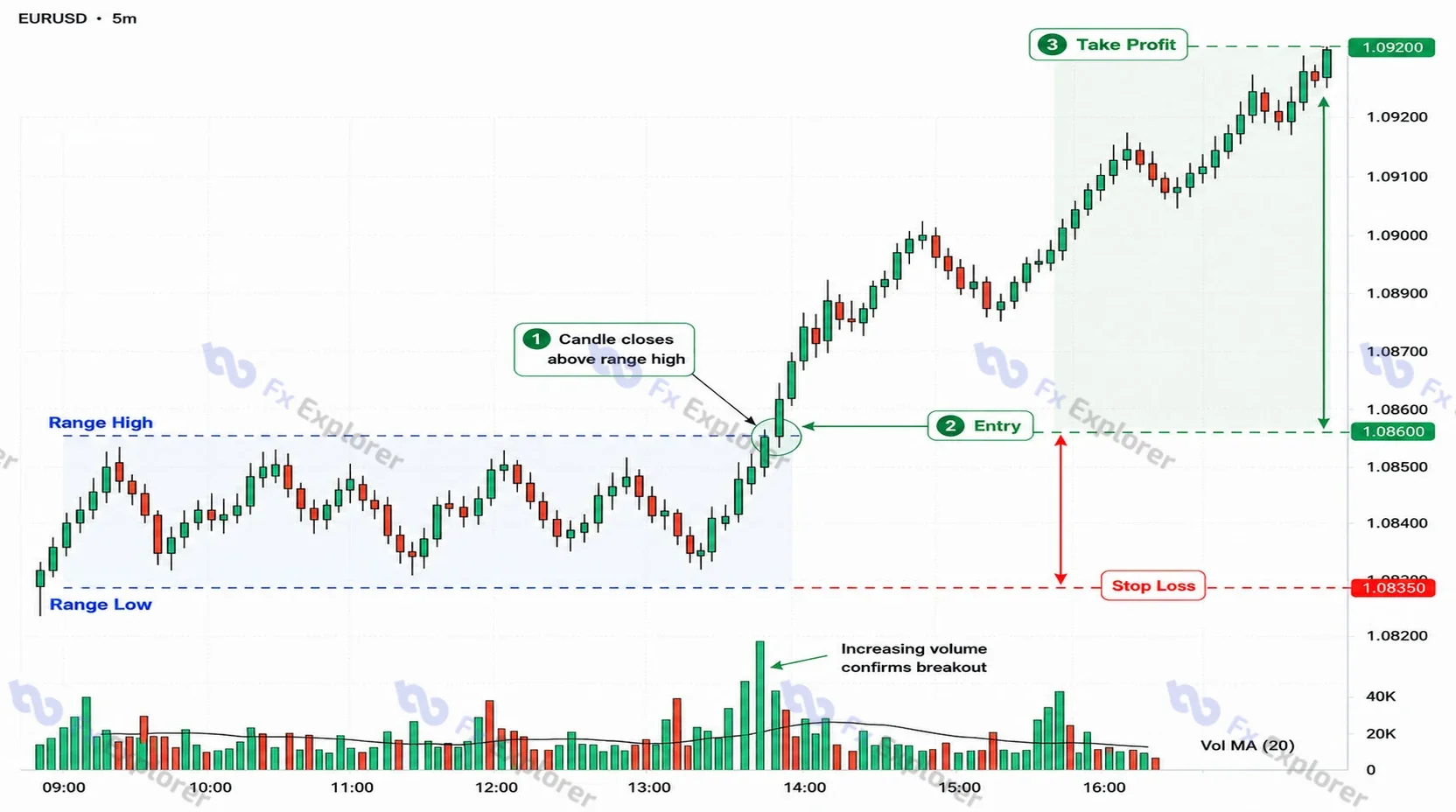
Breakout scalping: A basic breakout method may require a candle to close outside a defined range rather than merely spike beyond it. Some systems also require follow-through or a minimum amount of movement beyond the boundary.
False-breakout risk remains central. Price can move beyond the level, trigger entries, and quickly return to the prior range.
Available space matters as much as confirmation. A breakout directly into nearby resistance can be technically valid while still offering a weak trade profile.
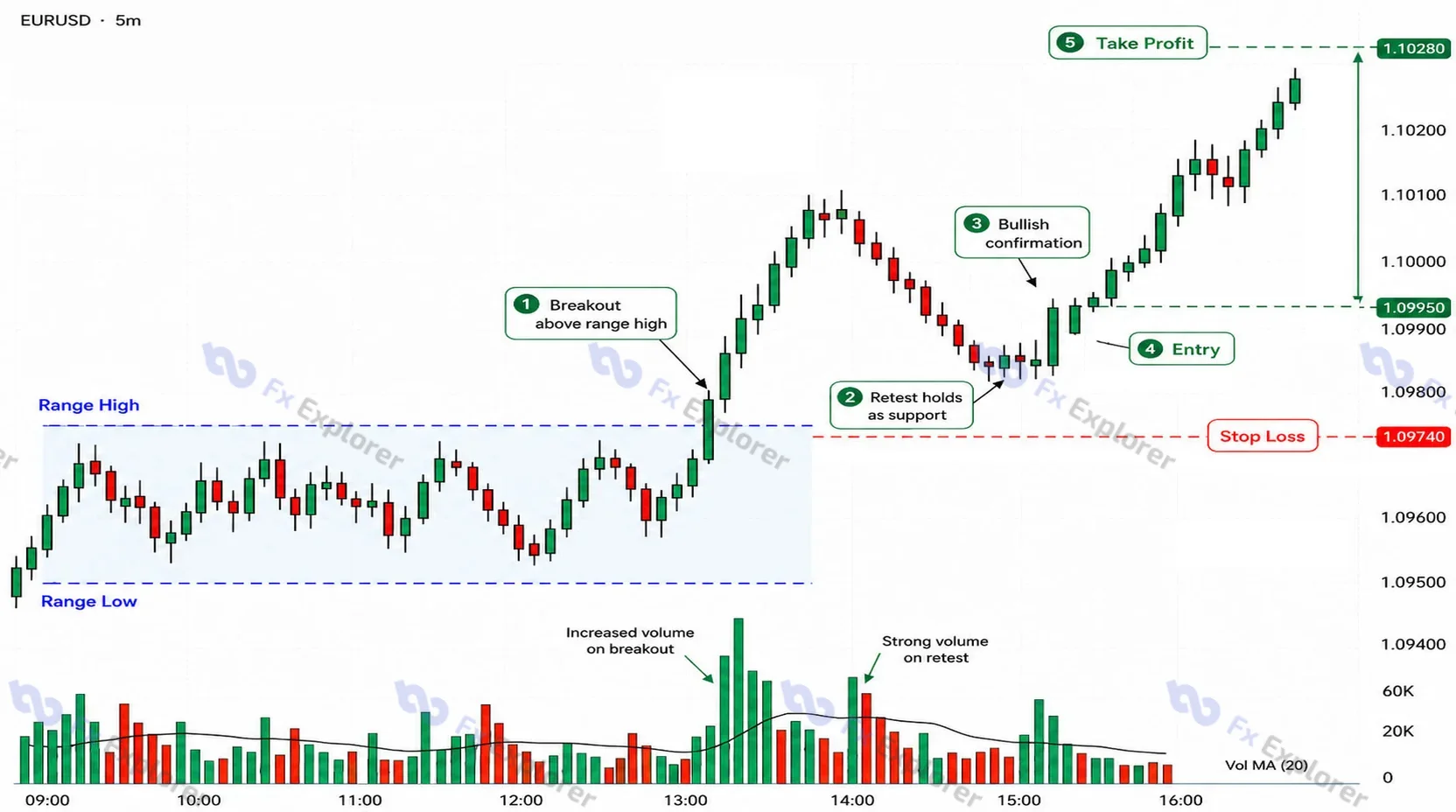
Breakout-retest scalping: A retest approach waits for additional structure.
Suppose resistance breaks. Instead of buying immediately, price is allowed to return toward the former resistance area. If the level begins acting as support and bullish confirmation appears, the trade may offer a clearer entry and invalidation point.
Some genuine breakouts never return.
Missing those trades is part of the method. Chasing them afterward changes the setup and usually worsens the entry.
Breakout-retest trading therefore gives up some opportunity frequency in exchange for greater selectivity.
Reversion Scalping: Ranges and Mean Reversion
Reversion strategies look for price to rotate back toward balance rather than continue moving directionally.
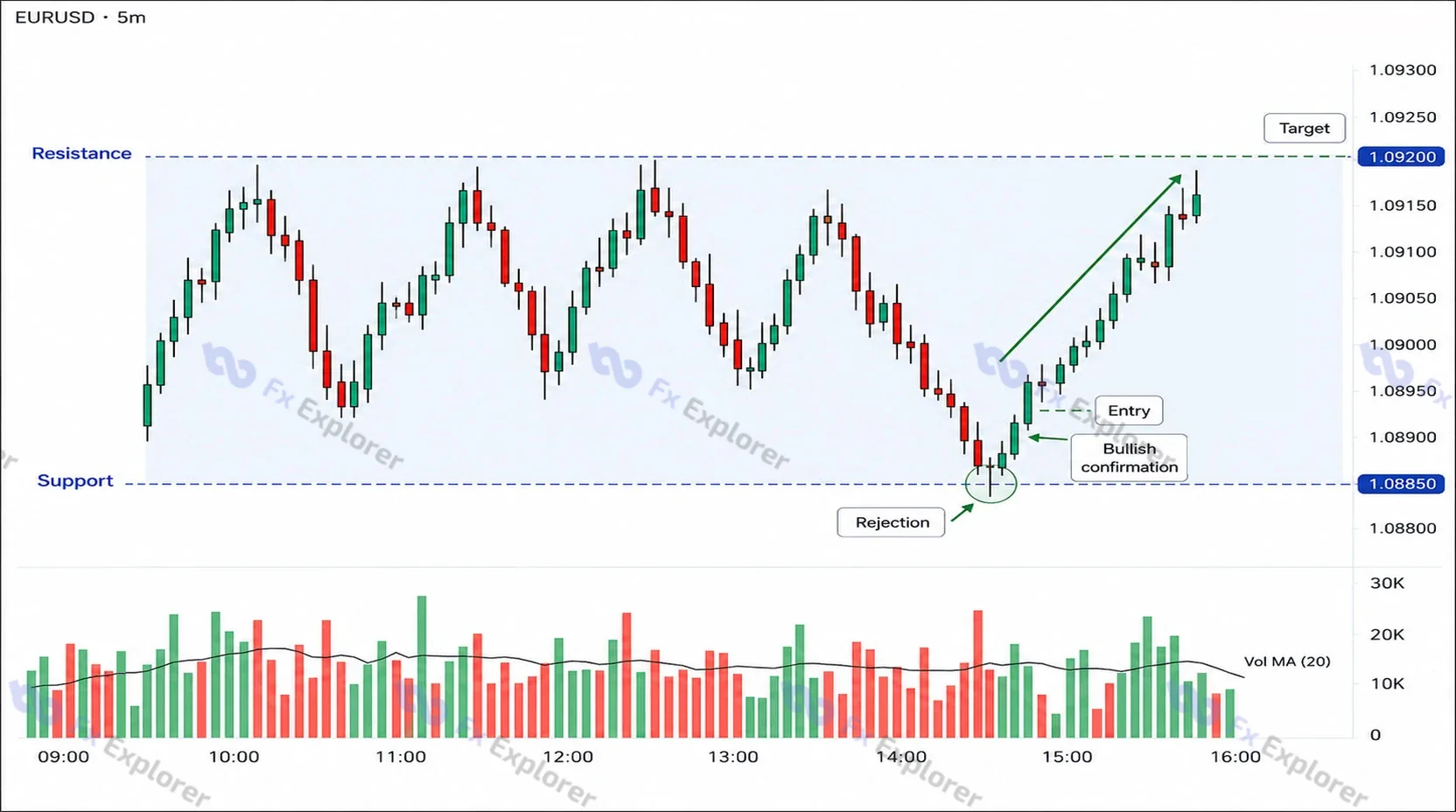
Range scalping: When price repeatedly moves between identifiable support and resistance, the trader looks for rejection near one boundary and a possible rotation toward the middle or opposite side.
The method depends on the range remaining intact. Once price breaks and begins holding outside the boundary, the original assumption has weakened.
Range width matters as well. A clean reaction can still be unattractive when the available movement is too small to pass the system's cost and risk filters.
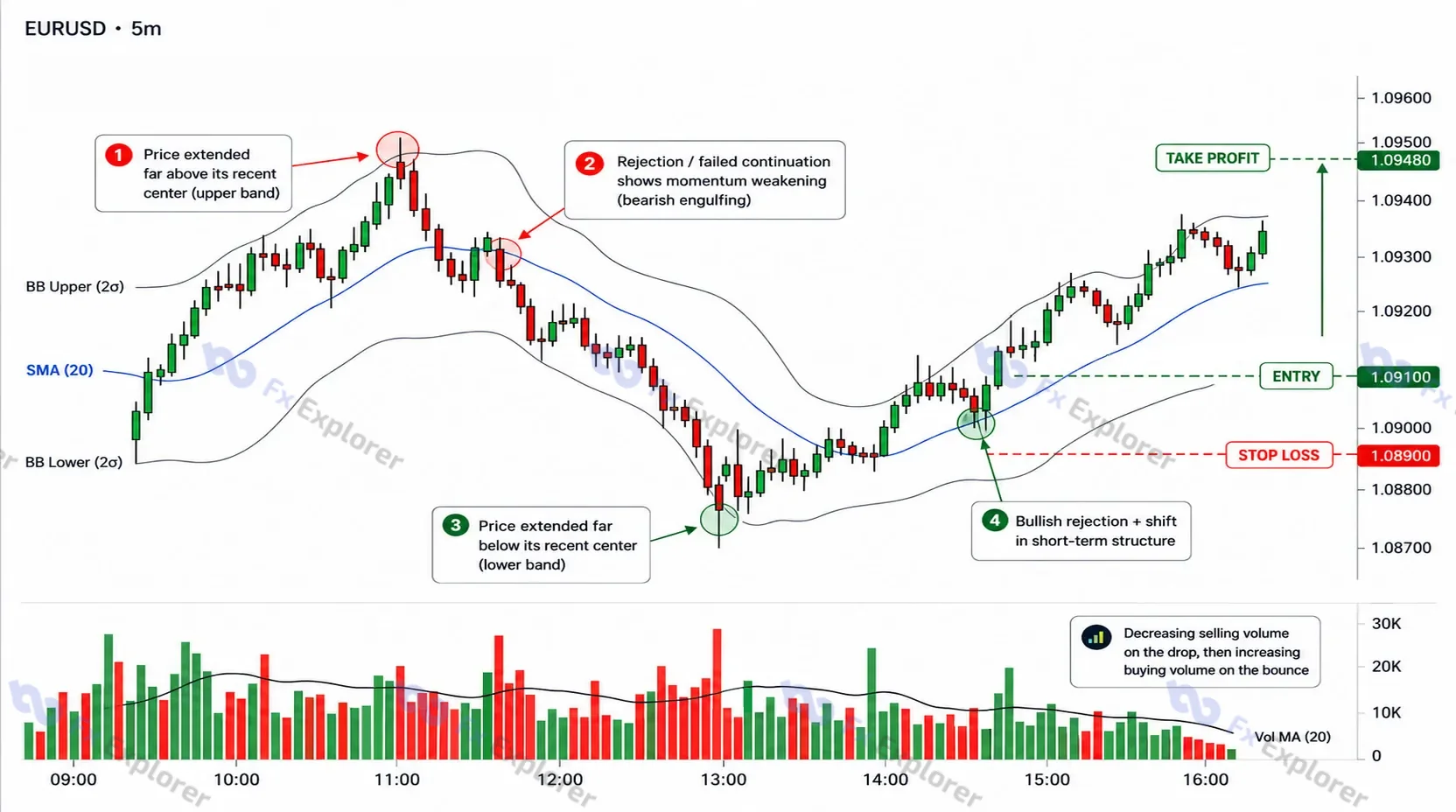
Mean-reversion scalping: Moving averages, Bollinger Bands, VWAP, or other references may help identify when price has moved unusually far from its recent center.
The challenge is separating temporary extension from genuine repricing.
A strong market can remain overbought or oversold for longer than expected. A stronger reversion setup therefore includes evidence that directional movement is weakening, such as rejection, failed continuation, or a shift in short-term structure.
Where Price Action, News, and Automation Fit
Price-action scalping is best viewed as an execution framework rather than a fourth strategy family.
A price-action trader may use swing structure, support and resistance, rejection candles, failed breaks, and retests to trade continuation, expansion, or reversion ideas without relying heavily on indicators.
News scalping is also a variation rather than a separate form of market behavior. Major economic releases can create rapid expansion, but they also bring wider spreads, unusual slippage, and less predictable fills.
Automated scalping changes execution rather than the source of the edge. Software can follow rules quickly and consistently, but automation cannot make a weak strategy strong. Backtests that assume unrealistic fills, fixed spreads, or perfect execution can also make an automated system appear far more robust than it is live.
Strategy choice becomes easier once the market behavior is clear. The next step is choosing a timeframe and trading environment in which that strategy can be executed consistently.
Forex Scalping Timeframes: 1-Minute vs. 5-Minute vs. 15-Minute
Timeframe choice affects opportunity frequency, market noise, and the size of relevant price structures.
1-Minute Forex Scalping
The one-minute chart provides the highest number of short-term observations.
That can suit experienced traders with highly specific execution rules, but the additional activity also brings more ordinary price fluctuation, temporary breaks, and rapid decisions.
Transaction costs become especially important because expected moves may be very small.
5-Minute Forex Scalping
The five-minute chart often provides a practical compromise between signal frequency and structure.
Pullbacks, ranges, and intraday support or resistance are generally easier to identify than on the one-minute chart while the trading style remains short-term.
This is why the worked example later uses five-minute EUR/USD.
15-Minute Forex Scalping
Fifteen-minute charts slow the process further.
Signals occur less frequently, but broader short-term structure can be clearer. Stop distances may also become larger because the relevant swings cover more price.
The fastest chart is useful only if its rules remain testable and executable.
Best Currency Pairs and Trading Sessions for Scalping
Pair and session selection influence spread, liquidity, volatility, and the types of setups likely to appear.
Currency Pairs Commonly Used for Scalping
EUR/USD is widely used because it often offers strong liquidity during European and U.S. hours.
GBP/USD can produce larger intraday movement but may also move faster and require different assumptions about stop size and slippage.
USD/JPY is active across several major sessions and may suit trend, momentum, range, or session-based approaches depending on the day's drivers.
Exotic pairs can produce larger nominal movement, but wider spreads and thinner liquidity often make small-target strategies harder to justify.
Pair selection should focus on tradable movement relative to cost rather than raw volatility.
London, New York, and Asian Sessions
London often brings increased participation in European currencies. Trend continuation, momentum, and breakout strategies may become relevant when directional structure develops.
New York can continue earlier European movement or create new direction around U.S. economic data and market activity. The London-New York overlap is frequently active, although higher activity can also make execution more sensitive.
Some pairs trade more quietly during Asian hours, while JPY-, AUD-, and NZD-related markets can be more active.
These are tendencies rather than fixed rules. Exact session times can shift relative to a trader's local clock because of daylight-saving changes, and broker or platform server time may differ from local time.
How Economic News Affects Scalping
Scheduled economic releases can override normal session behavior.
A system that is not designed for news should define its event filter before trading begins.
There is no universal requirement to avoid the market for exactly ten or fifteen minutes around every release. The appropriate buffer depends on the event, pair, strategy, and execution conditions observed during testing.
Widening a stop impulsively after volatility increases changes the original risk plan. If positions are allowed to remain open through scheduled news, that decision should already be part of the system.
For many scalpers, economic news is more useful as an environmental filter than as a signal.
Match the Strategy to the Volatility Regime
Volatility changes from one session and market regime to another.
A low-volatility environment may support some range strategies but leave breakout targets too small. Moderate volatility can provide cleaner continuation opportunities, while very high volatility may favor expansion at the cost of wider stops and less predictable fills.
ATR can help compare current movement with the pair's recent behavior, but universal thresholds should be avoided.
With pair, session, and volatility defined, indicators can be used for what they do best: organizing context rather than generating an entire trading system.
Best Indicators and Technical Tools for Forex Scalping
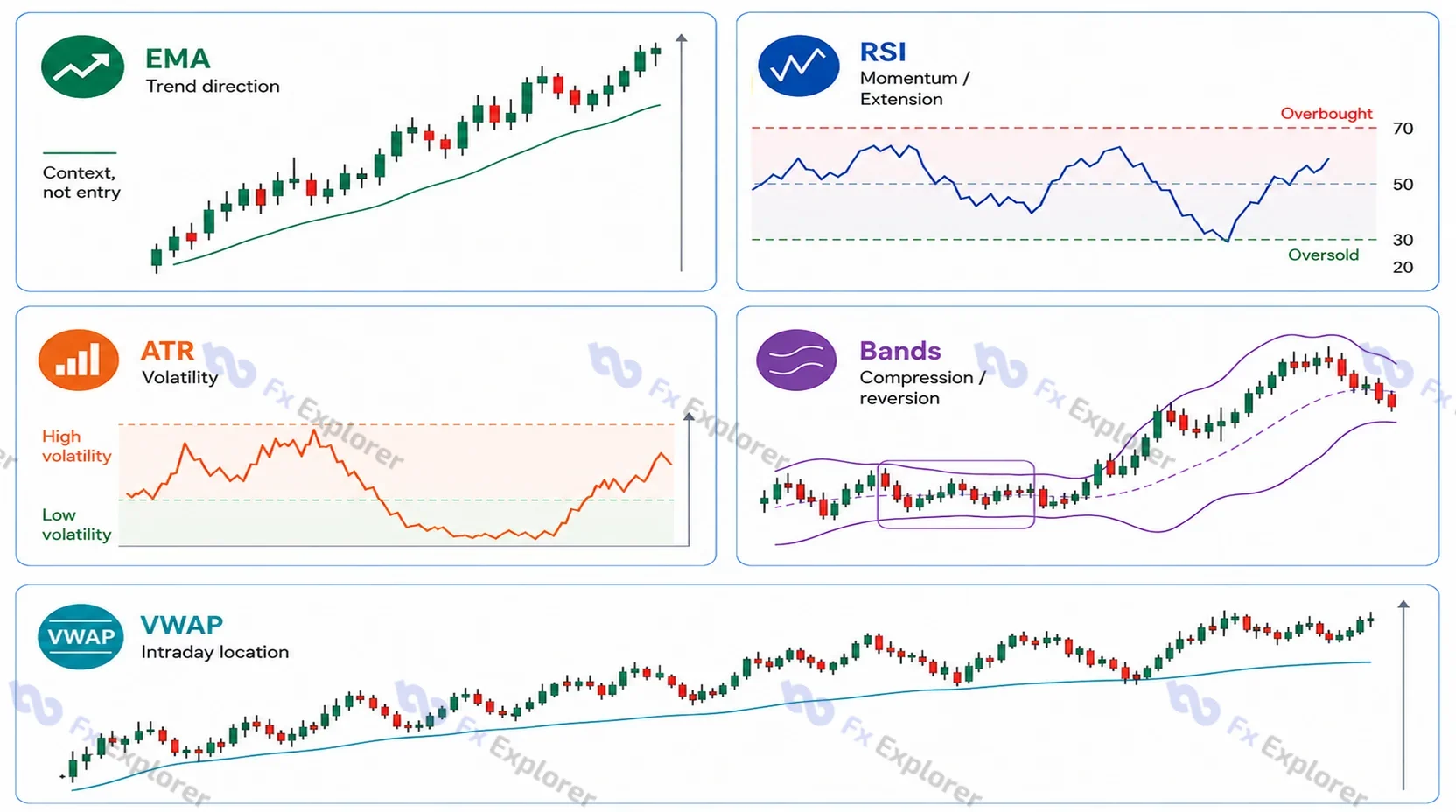
There is no single best indicator for every scalping strategy. Indicators are most useful when each answers a specific question.
EMA for Trend Direction
An exponential moving average can provide a quick view of directional bias.
A rising EMA combined with bullish swing structure can support continuation analysis. A flat EMA with price repeatedly crossing it describes a different market.
The moving average provides context, not an automatic entry.
RSI for Momentum and Extension
RSI helps describe whether momentum is strengthening, weakening, or becoming stretched.
Overbought does not automatically mean sell, and oversold does not automatically mean buy. Strong trends can remain extended for longer than expected, so RSI is more useful alongside market structure.
ATR for Volatility
ATR measures recent price movement.
For scalpers, it can help determine whether the market is moving enough to support the expected target and whether stop distances are reasonable for current conditions.
Universal ATR thresholds should be avoided. Testing should establish which volatility conditions fit the pair, session, and strategy.
Bollinger Bands for Compression and Reversion
Bollinger Bands can make volatility compression, expansion, and price extension easier to visualize.
A band touch is not a complete signal. The bands become useful when connected to a defined hypothesis, such as compression before a breakout or temporary extension within a range.
VWAP for Intraday Location
VWAP can act as an intraday location reference.
Because spot forex is decentralized, VWAP on a retail platform is feed-dependent and does not represent every global FX transaction.
Its value lies in providing context from the platform's available data, such as whether price remains above an intraday reference during a bullish trend.
Avoid Indicator Overload
A clean system might use an EMA for direction, ATR for volatility, and price structure for location.
Adding several moving averages or oscillators that answer nearly the same question can slow decisions rather than improve them.
Timeframes and indicators provide context. The next task is turning those inputs into fixed, testable rules.
How to Build a Forex Scalping Trading System
A strategy becomes easier to evaluate when its rules are narrow enough to produce comparable trades.
How to Scalp Forex Step by Step
A minimum viable system should specify:
- the currency pair and trading session;
- the execution timeframe;
- the required market condition;
- the setup and entry trigger;
- the invalidation point;
- the exit method;
- the maximum risk;
- the conditions that cancel the trade.
The value of this structure is consistency. If the pair, timeframe, indicator settings, and entry logic change after every losing trade, there is no stable process left to evaluate.
Define the Entry and Invalidation Separately
The setup identifies a possible opportunity. The trigger confirms that the system is ready to participate.
Invalidation defines where the original idea no longer makes sense.
Once that point is known, stop distance can be measured and position size calculated.
Calculate Position Size From Risk
The sequence is:
Suppose a USD 10,000 account risks 0.5%, or USD 50, on a EUR/USD trade with an eight-pip stop.
If one standard lot has an approximate pip value of USD 10 for that account and pair:
So:
Pip value varies with the pair, account currency, and trade size, so the actual calculation should use the correct value for the instrument being traded.
Choose the Exit Before Entry
Targets can be based on nearby structure, previous highs or lows, or a tested reward-to-risk method.
Some systems also use time-based exits. If historical review shows that valid scalps normally begin moving within a small number of candles, a trade that remains stagnant well beyond that window may no longer deserve the same capital commitment.
Such a rule should come from testing rather than impatience.
Match the Order Type to the Strategy
Market orders prioritize execution but may experience slippage.
Limit orders prioritize price but may never fill, or may fill as the setup begins failing.
Stop-entry orders can fit breakout strategies but may also activate during temporary level breaks.
Order type should be defined before price begins moving rather than selected in response to urgency.
Use a Simple Session Workflow
A practical routine can be divided into three stages.
Before the session, review the economic calendar, pair, market condition, volatility, spread, and maximum risk.
During the session, take only setups that match the written rules and avoid changing stops or targets impulsively.
After the session, record execution quality, rule adherence, trading costs, and mistakes that deserve later review.
With those rules defined, the framework becomes easier to understand through a single worked trade.
Practical EUR/USD Five-Minute Scalping Example
Market Condition and Setup
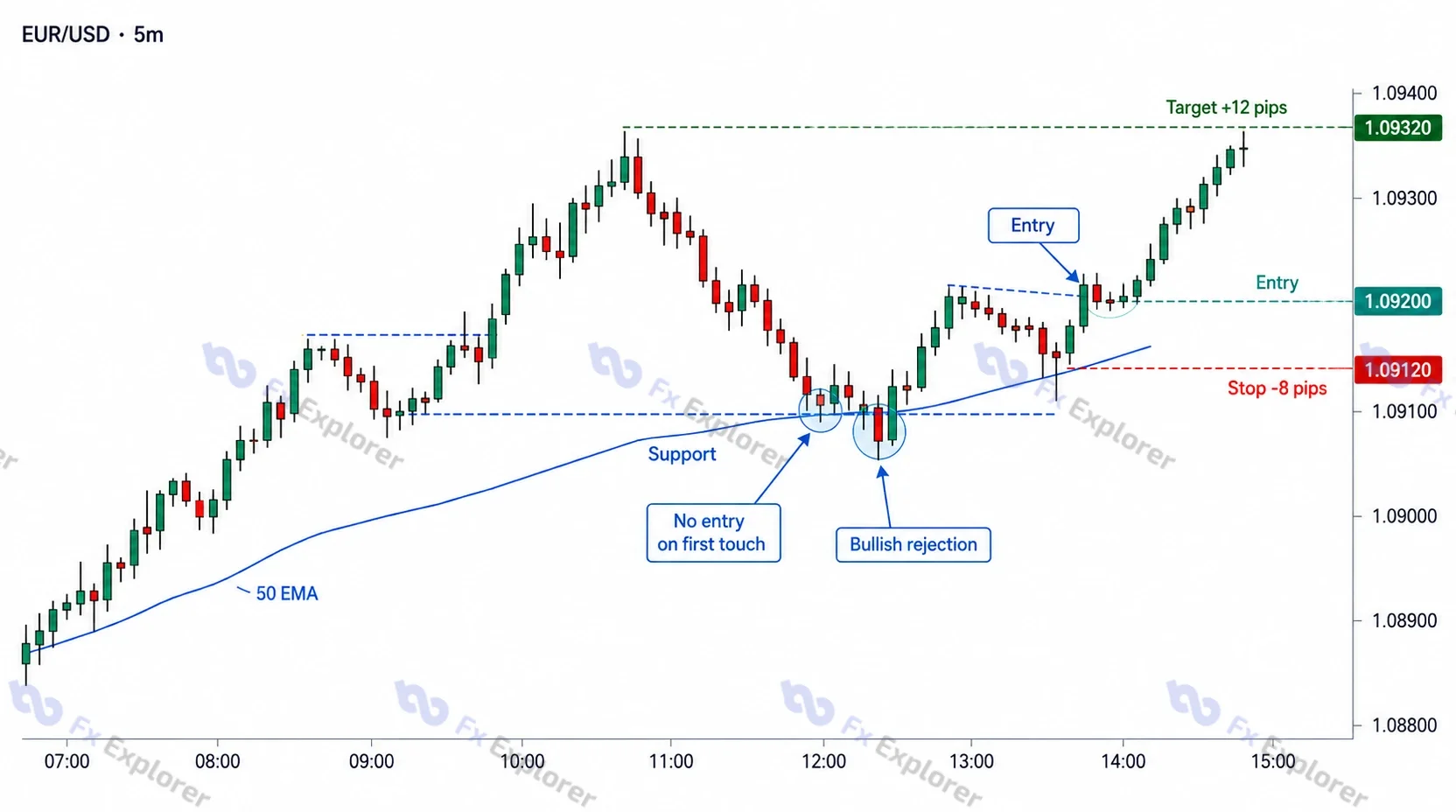
EUR/USD enters an active London-session period above a rising 50 EMA. Recent swing lows are moving higher, and price has not been repeatedly crossing through the moving average.
After printing another short-term high, price begins retracing toward the EMA and an intraday support area created by earlier resistance.
No entry occurs on the first touch.
The pullback remains orderly rather than accelerating sharply lower, preserving the bullish structure.
Entry Confirmation and Invalidation
A five-minute candle rejects the support area and closes bullish. Price then moves above a minor lower high formed during the retracement.
That break provides the entry trigger.
The most recent swing low sits eight pips below the intended entry. A sustained move through that low would weaken the continuation thesis, making it the logical invalidation point.
Position size follows from this stop distance and the account's predefined risk.
Target and Cost Filter
Suppose the next meaningful resistance is twelve pips above the intended entry.
That twelve-pip distance is the gross chart opportunity. Normal transaction costs still need to be incorporated before deciding whether the trade profile remains acceptable.
Entry timing can change the calculation quickly.
If price moves four pips before the order is placed, the same structural stop may remain below while only eight pips of gross room to resistance remains. The EMA pullback still exists visually, but the available trade has deteriorated.
When the Setup Should Be Skipped
The trade is rejected if a major economic release is close, spreads become abnormal, the pullback breaks bullish structure, or the entry becomes so late that insufficient target space remains.
Once the position is open, management follows the written rules.
A stop hit is accepted as a failed setup. A target reached is handled according to the exit plan. If testing supports a time-based rule and price stalls beyond the normal development window, the trade may be reassessed according to that rule.
The EMA is only one part of the process.
Market condition leads to the setup. The setup leads to confirmation. Invalidation determines the stop. The stop determines position size. The remaining opportunity determines whether the trade deserves capital.
A clear entry process still needs limits on how much damage one trade - or one difficult session - can cause.
Risk Management for Forex Scalpers
Trade risk limits the damage from one invalid idea. Session risk limits the damage from a sequence of trades or deteriorating decision quality.
Stop Placement Should Follow Invalidation
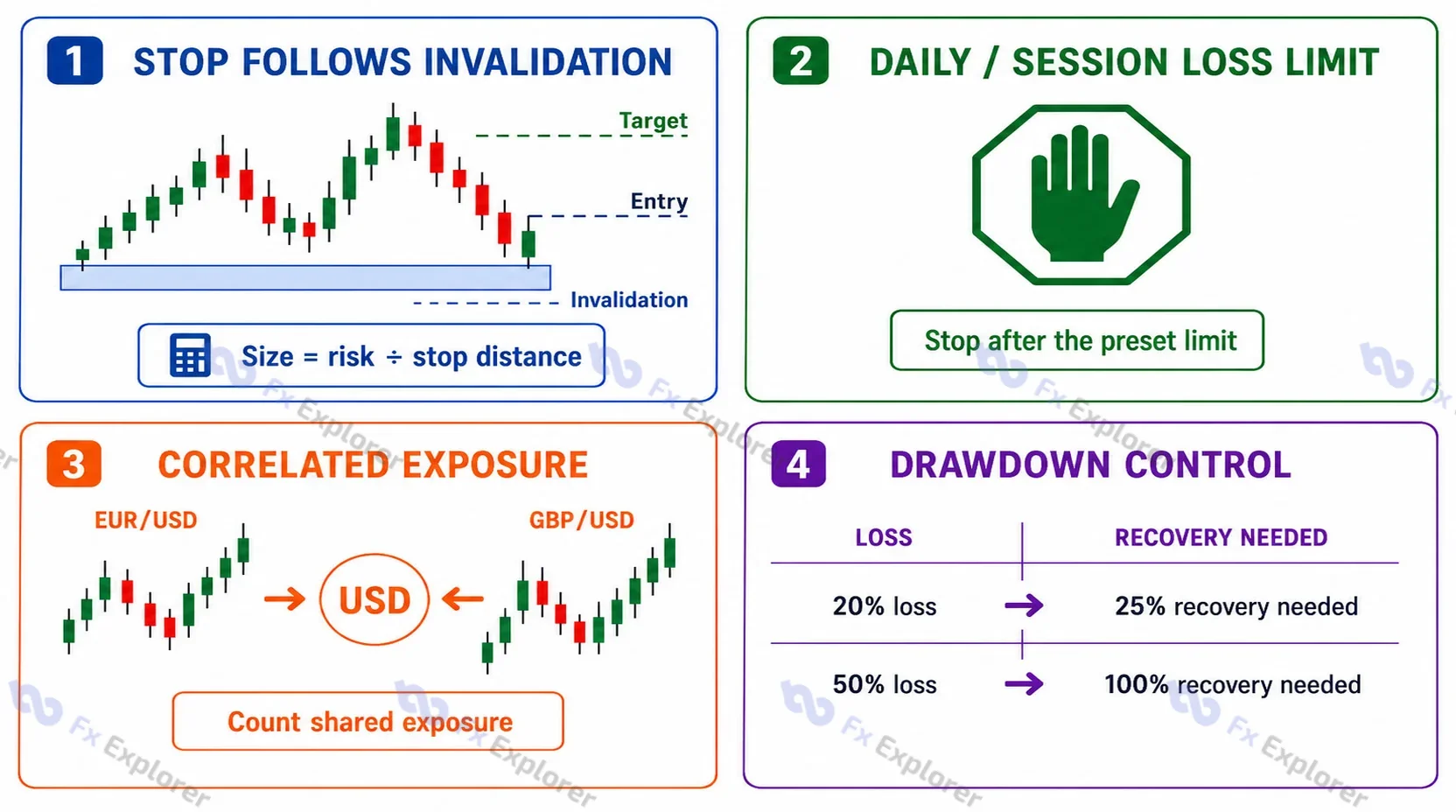
A stop should represent the point where the trade thesis has become meaningfully weaker.
Choosing a lot size first and then forcing the stop into a convenient monetary distance reverses that logic.
Structural invalidation comes first. Position size adapts to it.
Daily Loss Limits and Revenge Trading
Another trade may appear within minutes of a loss.
That makes recovery trading unusually easy to justify. A predefined daily or session risk limit can prevent an ordinary losing period from turning into a sequence of emotionally motivated positions.
There is no single percentage suitable for every account. The limit needs to be chosen in advance and applied consistently.
Correlated Currency Exposure
Several open positions do not always represent independent ideas.
EUR/USD and GBP/USD may both be responding to the same U.S. dollar move. Holding both can increase exposure to one underlying view rather than diversify risk.
Total account risk across correlated positions therefore matters more than the number of open tickets.
Why Drawdown Control Matters
Losses become progressively harder to recover from as drawdown deepens.
A 20% account decline requires a 25% gain on the reduced balance to recover. A 50% decline requires a 100% gain.
Scalping can generate many trades quickly, so preventing oversized or emotionally driven losses is more important than maximizing opportunity count.
Risk limits protect capital; testing determines whether the strategy deserves that capital in the first place.
How to Test a Forex Scalping Strategy
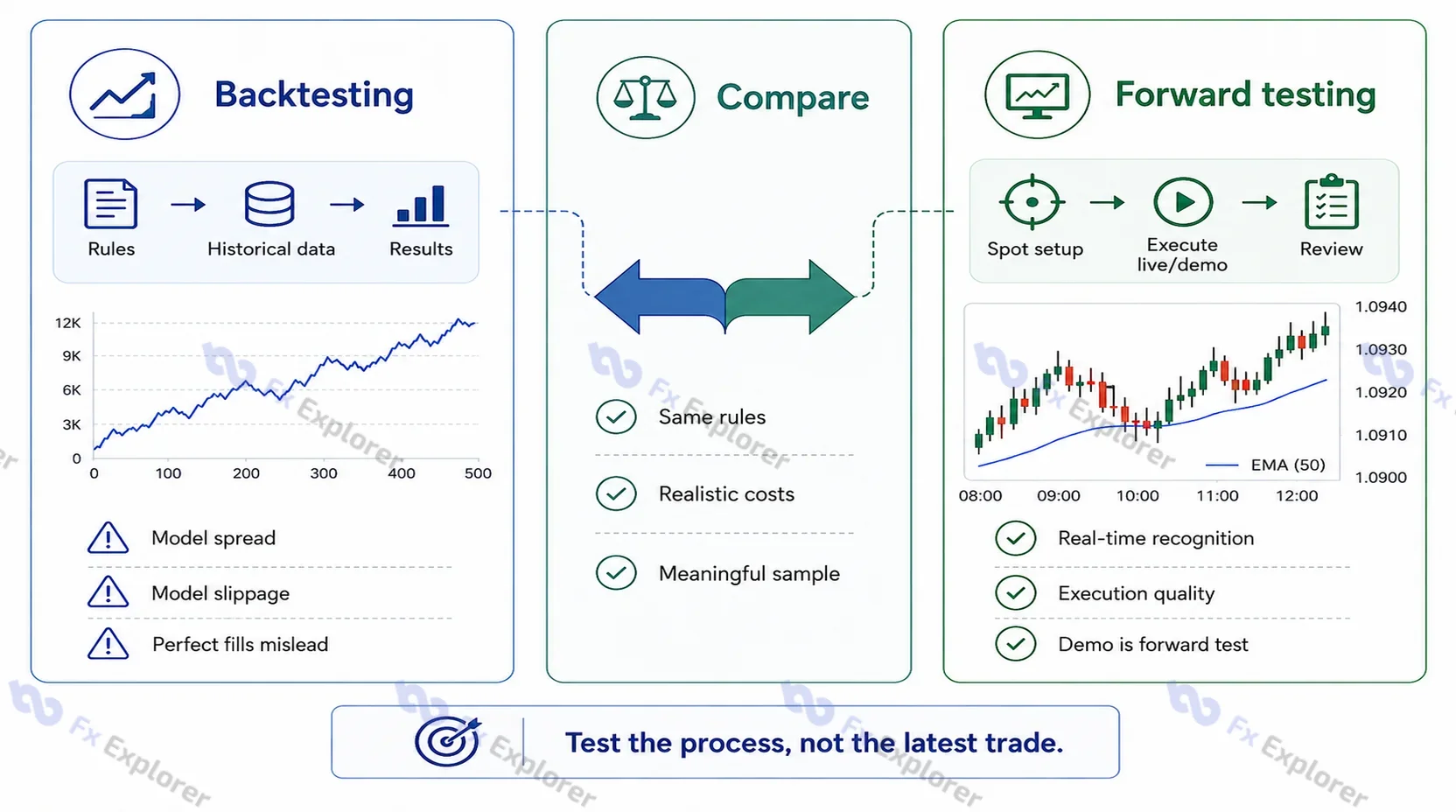
A strategy should be evaluated over a meaningful sample rather than judged from its latest win or loss.
Backtesting Forex Scalping Strategies
Backtesting applies written rules to historical market data.
The method is valuable, but scalping creates additional difficulties because ordinary candle data may not reproduce historical spread changes, intrabar movement, slippage, latency, or changing liquidity accurately.
A test that assumes perfect fills can make a small-target strategy appear much stronger than it would be in practice.
Cost and execution assumptions should resemble the intended trading environment as closely as possible.
Forward Testing and Demo Trading
Forward testing applies the rules to current market conditions.
A demo account can reveal whether setups are easy to recognize in real time and whether entries, stops, and exits can be executed as written.
Very small live testing may later reveal additional issues such as emotional pressure and differences in actual fills.
A demo account is forward testing, not backtesting.
How Many Trades Are Enough?
There is no universal sample size that proves a system is robust.
Fifty to one hundred trades can provide an initial diagnostic, but the evidence required depends on trade frequency, variance, market conditions, and the size of the apparent edge.
A method tested only during one clean trending period has not necessarily been tested across the environments it will encounter later.
Avoid Over-Optimizing the Strategy
Changing EMA periods, ATR thresholds, session windows, and entry rules until historical results appear almost perfect can produce an overfit system.
A stronger method should tolerate modest changes in assumptions.
If performance disappears when costs rise slightly or an indicator setting changes by a small amount, the apparent edge may be fragile.
Compare Changes Properly
Strategy improvements should be evaluated against the previous version rather than judged from a handful of recent trades.
If a new entry filter is added, compare both versions across similar historical and forward-testing conditions. Determine whether the filter improves net expectancy, reduces poor trades, or simply lowers frequency without improving overall results.
Testing produces data. The next step is deciding whether that data reflects a useful edge.
How to Measure Forex Scalping Performance
Calculate Net Trading Expectancy
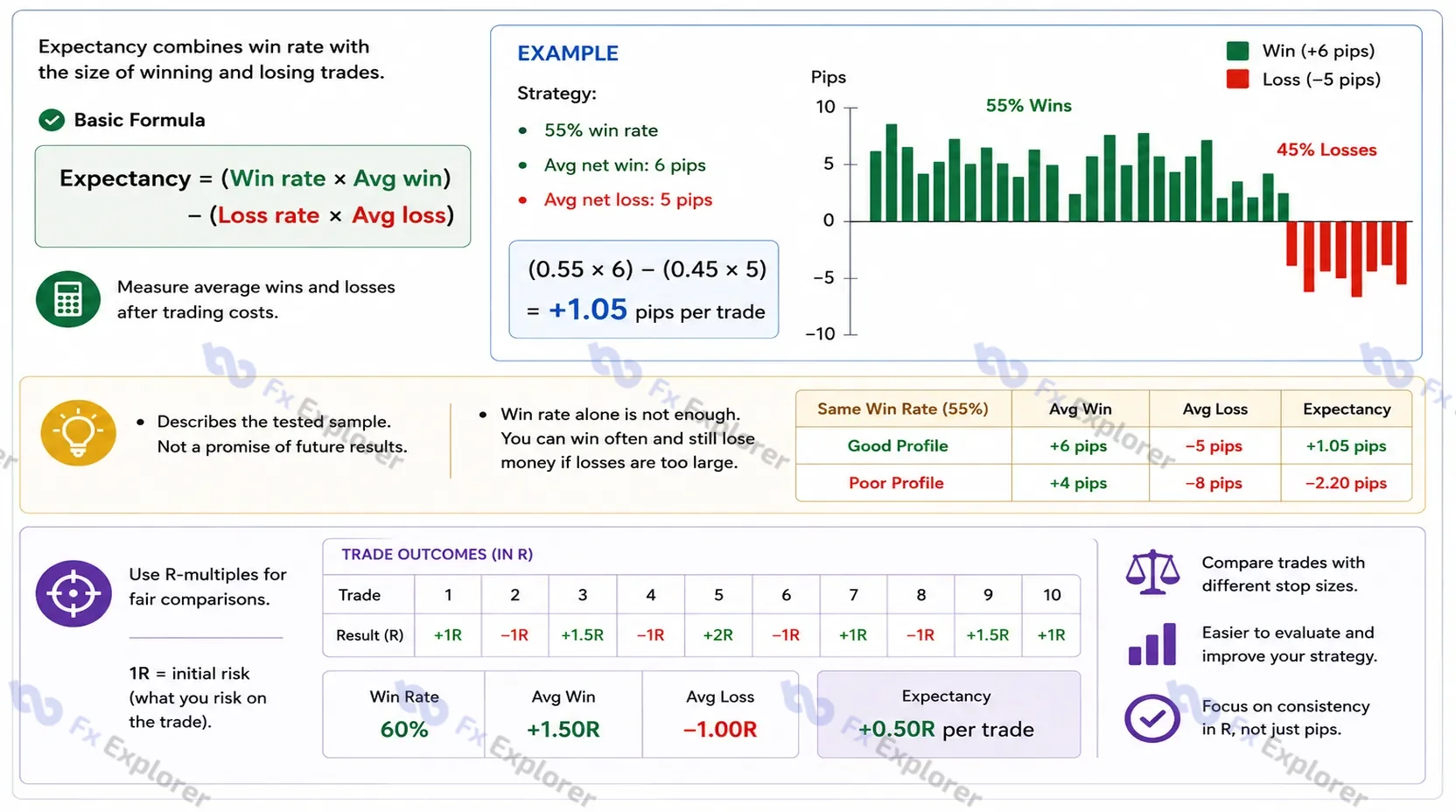
Expectancy combines win rate with the size of winning and losing trades.
The basic formula is:
Average wins and losses should be measured after trading costs whenever possible.
Suppose a strategy has a 55% win rate, an average net winner of 6 pips, and an average net loser of 5 pips:
That figure describes the tested sample. It does not guarantee future performance.
It also shows why win rate alone is insufficient. A strategy can win frequently and still lose money if its average losses are too large.
For comparisons across different pairs or stop sizes, performance can also be tracked in R-multiples, where 1R represents the amount initially risked. This makes trades with different stop distances easier to compare on a common basis.
Keep a Forex Scalping Journal
A useful journal records enough information to separate strategy behavior from execution errors.
Useful metrics include average net win, average net loss, win rate, expectancy, profit factor, average spread, average slippage, holding time, performance by setup and session, and the frequency of rule violations.
The journal is valuable because individual trades rarely reveal those patterns on their own.
Separate Strategy Losses From Execution Mistakes
A valid setup that reaches its planned stop is a normal strategy loss.
A late entry taken outside the rules is different.
If both are classified simply as losing trades, the trader may change the strategy when the actual problem is execution discipline.
Diagnose Losing Streaks Before Changing the System
Losses may cluster for different reasons.
A continuation strategy may be operating in a range. One setup may be underperforming. Entries may be consistently late. Position sizing may have become inconsistent.
Each problem requires a different response.
Changing rules after every losing trade makes the actual source harder to identify.
Many problems revealed by a journal eventually lead back to a small set of recurring scalping mistakes.
Common Forex Scalping Mistakes
Chasing and Revenge Trading
A missed breakout can create immediate pressure to enter before the opportunity disappears.
Yet each additional pip of movement can reduce the remaining reward while leaving the logical invalidation point unchanged.
Revenge trading develops just as quickly. A loss may be followed by another possible setup within minutes, making it easy to justify increasing size or lowering standards.
The next trade still has to meet the same rules as the previous one.
Overtrading and Using Too Many Setups
Trading EMA pullbacks, RSI reversals, breakouts, momentum moves, and ranges under loosely defined conditions may generate activity but little comparable data.
Marginal trades also add transaction costs and decision fatigue.
A narrower system is easier to evaluate and improve.
Ignoring Costs and Market Conditions
Gross pips can make a short-term strategy look substantially stronger than its net performance.
The same setup can also behave very differently in a trend, range, or volatility expansion.
Performance should therefore be reviewed in the environment the method was designed for and with realistic cost assumptions.
Indicator Overload and Random Rule Changes
Several indicators providing similar information can slow decisions and create contradictory signals.
Constantly changing rules after losses creates another form of noise.
A simpler system with clearly assigned indicator roles and stable rules produces cleaner evidence about what is actually working.
Those rules also need a clear point at which the trading session itself should end.
When to Stop Scalping for the Day
Stopping rules work best when they are decided before emotional pressure develops.
A trader may end the session when:
- the predefined daily risk limit has been reached;
- repeated rule violations are occurring;
- spreads or execution quality have deteriorated materially;
- concentration has declined enough to affect decisions;
- the maximum session duration or trade count supported by the system has been reached.
A particular number of consecutive losses does not prove that the strategy has stopped working.
Likewise, continuing because the next trade "feels" more likely to win is not a measurable rule.
Objective limits reduce the number of decisions that must be invented during a difficult session.
Conclusion
Forex scalping is often presented as a collection of fast entry techniques, but a useful short-term trade requires much more than a signal.
The market environment must suit the strategy. The setup needs a clear trigger and invalidation point, execution costs must leave enough usable reward, and position size should reflect predefined account risk.
Testing determines whether those rules deserve confidence.
Historical review shows how the method behaved in previous conditions, while forward testing reveals whether the same process can be executed consistently in real time. Expectancy and journaling help distinguish normal strategy losses from execution mistakes.
For someone comparing forex scalping strategies, the most productive next step is usually to stop collecting setups and start testing one well-defined method. Evaluate it across a meaningful sample, include realistic costs, observe how it behaves in different market regimes, and change the rules only when the data provides a clear reason.
Treating scalping as a disciplined, testable process does not guarantee profitability. It does provide a stronger basis for deciding whether a short-term trading system has a sustainable edge.
FAQ
What Is a Forex Scalping Strategy?
A forex scalping strategy is a structured short-term method for trading relatively small currency-price movements. It defines the market condition, setup, entry trigger, invalidation point, exit rules, risk limits, and execution assumptions rather than relying on an entry signal alone.
How Do You Scalp Forex?
Forex scalping usually involves choosing a liquid pair and suitable session, identifying the market condition, waiting for a predefined setup, entering after the required trigger, calculating position size from the structural stop and planned risk, and exiting according to written rules.
Is Forex Scalping Profitable?
Forex scalping can be profitable for some traders, but profitability is not guaranteed. A method needs positive expectancy after spreads, commissions, slippage, and losses, and its rules must remain executable under real market conditions.
What Is the Best Forex Scalping Strategy?
There is no universal best method. Continuation strategies fit directional markets, breakout approaches depend on expansion, and range or mean-reversion methods require more balanced conditions. The relevant strategy is the one designed for the market behavior currently present.
What Timeframe Is Best for Forex Scalping?
One-minute, five-minute, and fifteen-minute charts are all used. One-minute charts provide more opportunities but more noise, five-minute charts often balance structure and frequency, and fifteen-minute charts offer cleaner context with fewer signals.
Which Indicators Are Best for Forex Scalping?
EMA, RSI, ATR, Bollinger Bands, and VWAP are commonly used, but none is a complete strategy. Their value comes from defined roles such as trend direction, momentum, volatility, compression, or intraday location.
Which Currency Pairs Are Best for Scalping?
Major pairs such as EUR/USD, GBP/USD, and USD/JPY are commonly used because they often provide strong liquidity during active sessions. The best choice depends on spread, volatility, execution quality, and whether the pair fits the tested system.
Can Beginners Use Forex Scalping Strategies?
Beginners can study scalping, but it is a demanding style. Understanding spreads, leverage, order types, position sizing, execution, and risk management should come before meaningful live risk because small errors can materially affect short-term trades.
Can Automated Forex Scalping Strategies Work?
Automation can improve execution speed and rule consistency, but it cannot create an edge by itself. Automated systems still require realistic cost assumptions, robust testing, risk controls, and monitoring as market conditions change.

Nella Spencer
Nella Spencer is a financial analyst and reviewer specializing in online brokers and trading platforms. Her work focuses on broker comparisons, pricing and fees, regulatory standards, and platform reliability. She helps readers understand complex financial services information through clear, structured, and practical analysis.