
Discover what really makes a forex strategy consistently profitable. This guide compares popular trading strategies, explains risk management and testing, and shows how traders can build a repeatable system that fits different market conditions and trading styles.
The best forex strategy for consistent profits is not a secret indicator, a perfect entry signal or a setup that wins every week. In real trading, consistency comes from a complete system: a tested edge, defined risk, realistic costs, disciplined execution and regular review.
That may be less exciting than a promise of the “most profitable forex strategy,” but it is far more useful. A setup can look impressive on a chart and still fail once spread, slippage, drawdown, missed trades, emotional decisions and changing market conditions are included. A simple strategy with clear rules can be more practical than a complex one if the trader can test it, execute it and survive its normal losing periods.
This guide explains what makes a profitable forex trading strategy more likely to remain usable over time. It covers the main strategy families, how they fit different market conditions, how trading styles affect execution, how to test a strategy properly and how to avoid common mistakes when searching for the best forex strategy for consistent profits.
Key Takeaways
- No forex strategy can guarantee consistent profits. The practical goal is to build and test a repeatable process with positive expectancy.
- A strategy is more than an entry signal. It also needs market context, invalidation, exits, position sizing, cost assumptions and review rules.
- Win rate alone is misleading. Average win, average loss, drawdown, profit factor, trading costs and execution quality matter just as much.
- Different strategies suit different conditions. Trend-following, breakouts, mean reversion, momentum and macro-aware approaches do not perform equally in every market.
- The best strategy for one trader may be unsuitable for another because of time availability, patience, execution speed, risk tolerance and discipline.
- A weak period is not automatically strategy failure. Normal drawdown, execution errors and genuine edge deterioration should be reviewed separately.
What Does “Consistent Profits” Mean in Forex?
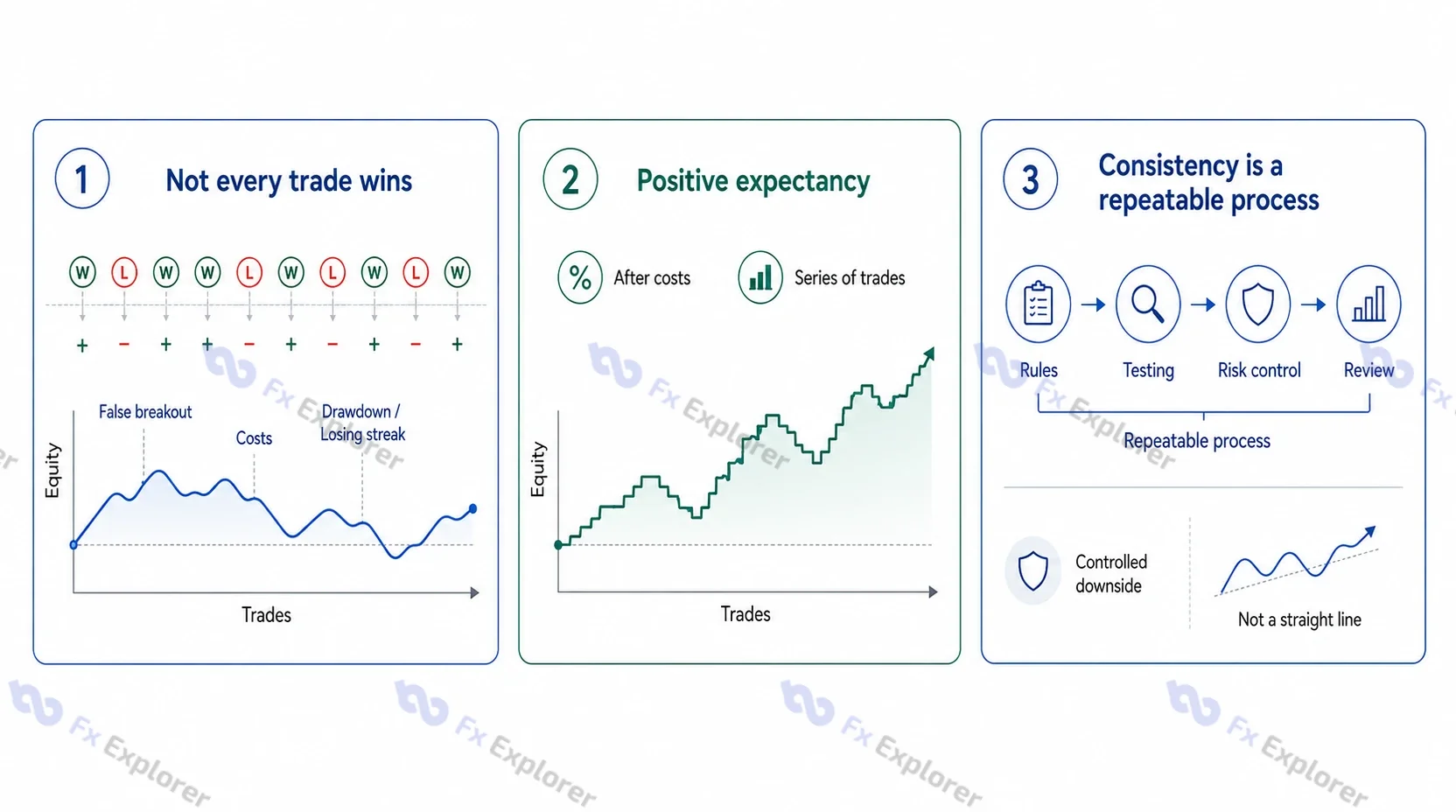
Consistent profits do not mean winning every trade, every day or every week. Even a well-designed forex strategy can experience losing trades, false breakouts, poor fills, quiet periods and drawdowns.
A more realistic definition is that a strategy has shown the ability to produce a positive result over a meaningful series of trades after costs, while keeping losses small enough for the trader to continue following the rules.
Consistency and profitability are related, but they are not identical. A strategy can be profitable over time but emotionally difficult because it has long losing streaks or deep drawdowns. Another strategy can feel consistent because it produces many small wins, yet still be fragile if one large loss removes weeks of gains.
Smooth equity growth should not be assumed. Consistent profits do not mean monthly income, no losing weeks or a balance curve that rises in a straight line. The more practical goal is a process with positive expectancy, controlled downside and rules the trader can still follow during uncomfortable periods.
A trader who makes money from a few random trades has not necessarily found a profitable forex strategy. A trader who can define rules, test them across different conditions, survive losses and repeat the process without emotional rule changes is much closer to building consistency.
Is There a Most Profitable Forex Strategy?
There is no single most profitable forex strategy for every trader, pair, timeframe and market condition.
A trend-following strategy may work well when a currency pair is moving directionally, then perform poorly in a choppy range. A range strategy may collect gains while support and resistance hold, then suffer when a genuine breakout begins. A scalping strategy may look attractive before costs, then lose its edge once spread and slippage are included.
This is why “most profitable forex strategy” is a risky phrase when used without context. Profitability depends on the exact rules, pairs traded, timeframe, market regime, spread, commission, slippage, swap, risk per trade, position sizing, execution quality and sample size.
Which forex strategy can I define, test, execute and review consistently under the conditions I actually trade?
That shift matters. It moves the focus away from finding a perfect setup and toward building a trading process that can be measured.
Strategy vs. System: Why Setups Alone Are Not Enough
Many traders call an entry idea a strategy. For example, “buy when price breaks resistance” or “sell when the fast moving average crosses below the slow moving average.” Those are setups, not complete systems.
A complete forex trading system answers several questions before the trade is opened:
- What market condition must exist?
- What exactly creates an entry?
- Where is the idea invalidated?
- How is the target or exit defined?
- How much is risked?
- How are spread and slippage included?
- When should the trade be skipped?
- How will results be reviewed?
An indicator is not a complete strategy either. A moving average, RSI signal, MACD crossover, Bollinger Band touch or Fibonacci level can support a trading plan, but none of them automatically creates a profitable forex trading strategy. Each still needs context, entry rules, invalidation, exits, position sizing and testing.
The entry is only one part. A trader can have a sensible entry and still lose money by using stops that are too tight, targets that are unrealistic, position sizes that are too large or rules that change after every losing trade.
A consistently profitable forex strategy needs structure around the setup. Without that structure, the trader is not really testing a strategy. They are reacting to charts.
Why Win Rate Alone Does Not Make a Strategy Profitable
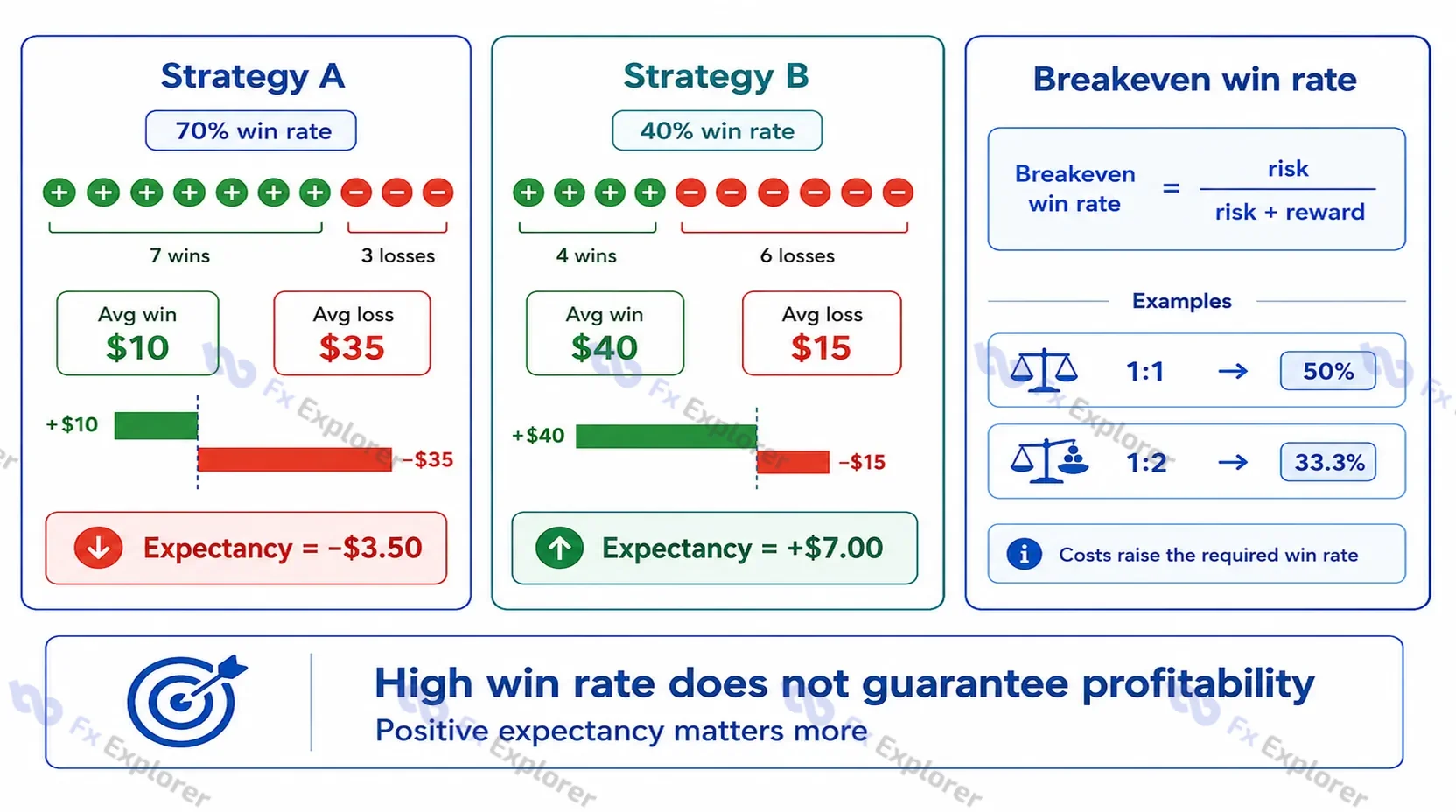
A high win rate feels attractive, but it does not prove that a strategy is profitable. A system can win often and still lose money if the losing trades are much larger than the winners.
A simple expectancy formula is:
Suppose Strategy A wins 70% of the time. Its average win is $10, but its average loss is $35. Before costs, its expectancy is:
Despite winning most trades, the strategy loses on average.
Now suppose Strategy B wins only 40% of the time. Its average win is $40, and its average loss is $15. Before costs, its expectancy is:
This strategy loses more often than it wins, but the larger average winners make it profitable before costs.
Risk-reward also affects the breakeven win rate:
If a strategy risks 1 unit to make 1 unit, it needs to win 50% of trades before costs to break even. If it risks 1 unit to make 2 units, the breakeven win rate drops to about 33.3% before costs. Once spread, slippage and commission are included, the required win rate rises.
The useful goal is not the highest win rate. It is positive expectancy that remains positive after realistic costs, losses and execution conditions.
Metrics That Matter More Than Hype
A profitable forex trading strategy should be judged by measurable performance, not by how impressive it looks in one example.
These numbers should not be treated as permanent truths. A strategy that performed well in one period can weaken later. Still, metrics provide a stronger foundation than claims that one setup is always the most profitable forex trading strategy.
The Four Parts of a Consistently Profitable Forex Strategy
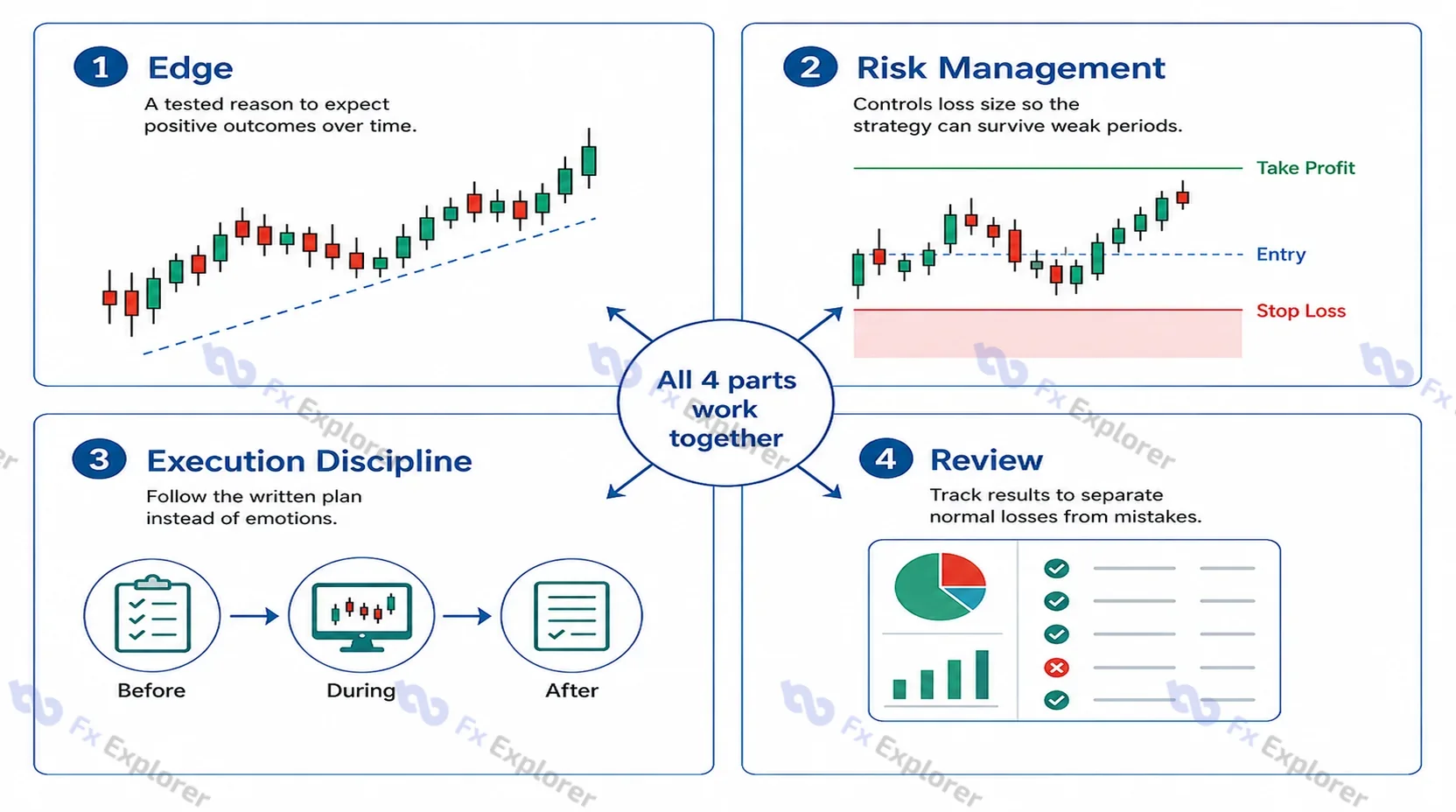
A strategy designed for consistency needs four connected parts: edge, risk management, execution discipline and review. If one part is missing, the method becomes fragile.
1. Edge
An edge means the strategy has a reason to perform better than random decisions over a large enough sample. The edge may come from trend continuation, range behavior, momentum, volatility expansion, price rejection at important levels or macro conditions.
An edge does not mean certainty. It means that, under defined conditions, the strategy has historically produced outcomes that justify the risk after costs.
2. Risk Management
Risk management decides whether the strategy can survive its normal losses. This includes stop placement, position size, risk per trade, maximum daily or weekly loss, maximum open exposure and rules for correlated positions.
A profitable setup can become dangerous if the trader risks too much. Losing streaks are normal. The strategy must be sized so that a weak period does not force the trader to abandon the plan or damage the account severely.
3. Execution Discipline
Execution discipline means following the written rules before, during and after the trade.
Before entry, the trader checks whether the setup, market condition, risk and cost assumptions are valid. During the trade, the position is managed according to the original plan rather than fear or excitement. After the trade, the trader reviews whether the rules were followed and whether the outcome was normal for the method.
A strategy cannot be judged fairly if it is not executed consistently. Many traders blame the strategy when the real problem is that they changed the rules during the trade.
4. Review Process
Markets change, and traders repeat mistakes. A review process helps separate normal losses from process errors.
A journal should record the pair, timeframe, setup, entry, stop, target, position size, expected cost, actual result and whether the rules were followed. Screenshots before and after the trade can reveal patterns that a written note misses.
Without review, a trader may keep repeating the same error while believing the strategy itself is the problem.
Forex Strategy Families vs. Trading Styles
Before comparing profitable forex trading strategies, it helps to separate strategy family from trading style.
A strategy family describes the logic behind the trade. Examples include trend-following, pullback trading, breakout trading, range trading, momentum and macro-aware trading.
A trading style describes how the trader participates. Examples include scalping, day trading, swing trading and position trading.
The same strategy family can appear in different styles. A breakout trader might scalp a short-term session range, day trade a London-session breakout, swing trade a daily consolidation break or position trade a major macro-driven trend. Separating the two prevents confusion and makes the strategy easier to test.
Best Forex Strategy Types for Different Market Conditions
The best forex strategy for consistent profits depends heavily on the market environment. No strategy family performs equally well in every condition.
The table is a guide, not a ranking. The most profitable forex strategy for one trader may be unsuitable for another if the costs, timeframe, discipline requirements or drawdowns do not fit.
Widely Used Forex Strategy Families
The following strategy families are commonly discussed because they reflect recurring ways traders try to participate in currency movement. Each can be useful in the right environment, but each also needs rules, testing and risk control.
Trend-Following Strategy
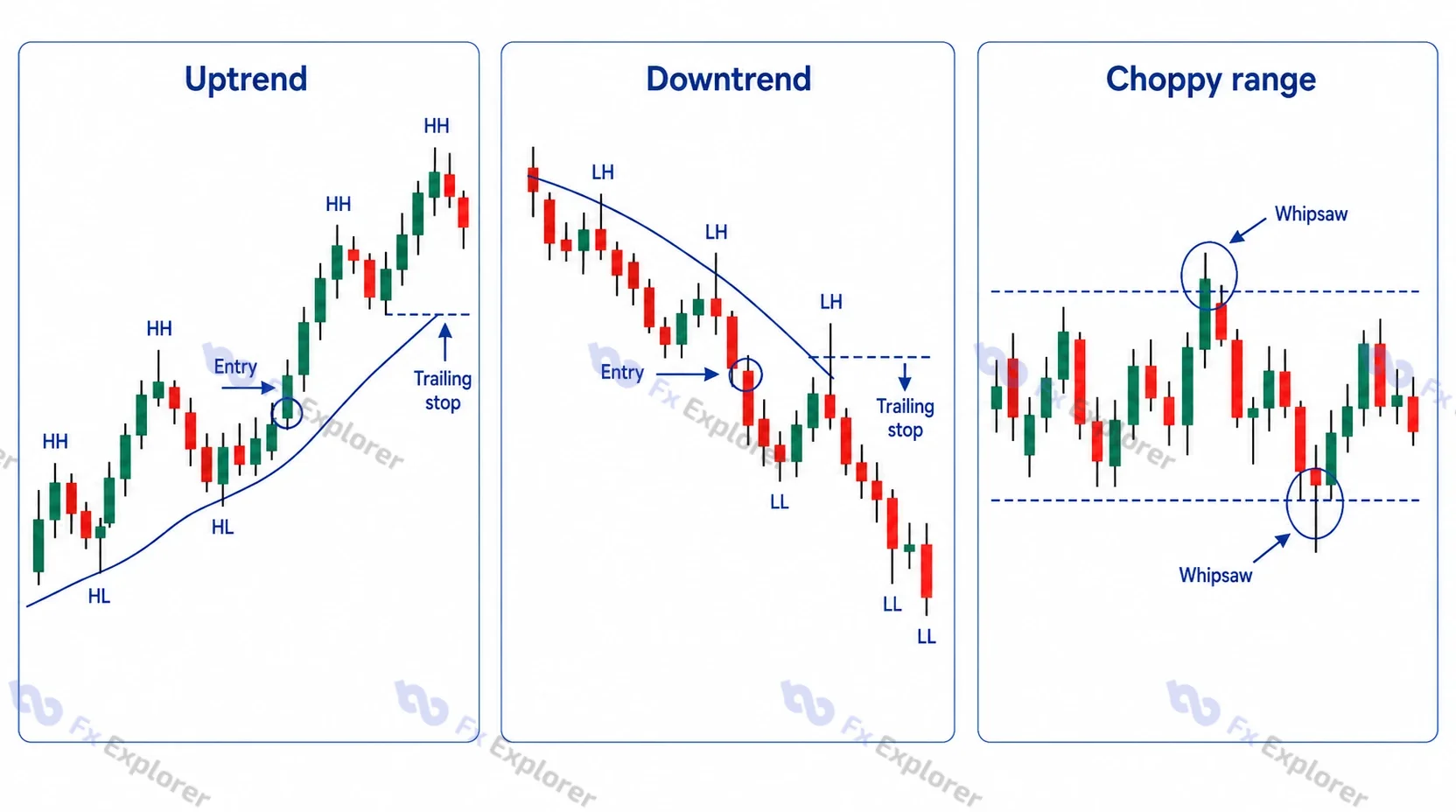
Trend following attempts to trade in the direction of an established move. The trader looks for evidence that the market is making higher highs and higher lows in an uptrend, or lower highs and lower lows in a downtrend.
Currency markets can trend strongly when interest-rate expectations, economic surprises or risk sentiment support directional movement. Trend-following strategies may use moving averages, trendlines, market structure, breakouts or trailing stops.
Their main weakness is choppy price action. During sideways periods, the trader may enter late and then get stopped as price reverses inside the range.
Trend following should be treated as a practical strategy family, not as a guarantee. It needs a market-condition filter, a clear stop rule and enough patience to allow winners to develop.
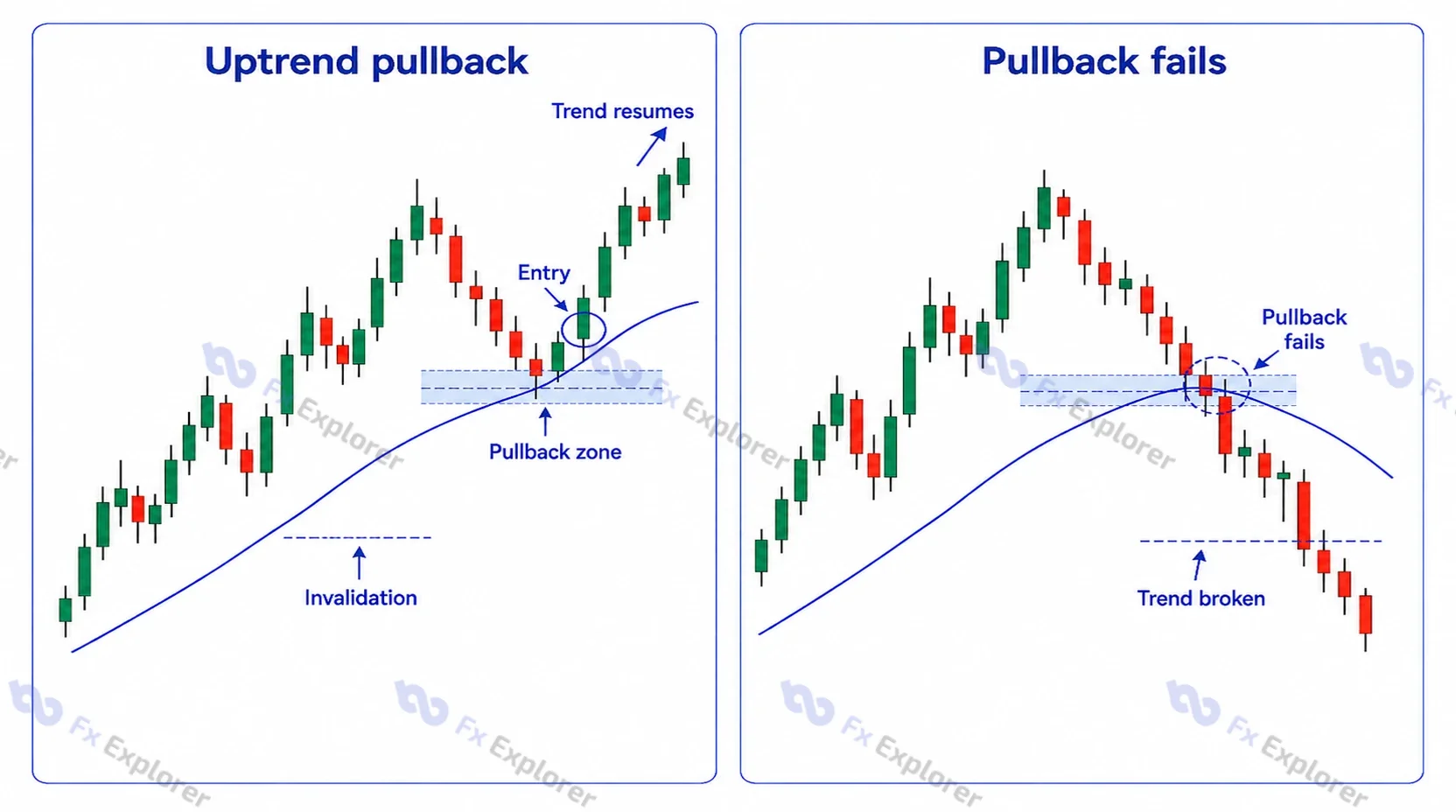
Pullback Trend Strategy
A pullback trend strategy is a more selective version of trend following. Instead of entering after a strong move has already extended, the trader waits for price to retrace within the broader trend.
In an uptrend, price may pull back toward a moving average, previous support or a higher-low area. The trader then looks for evidence that the pullback is ending and the trend may resume.
This approach can create a more favorable entry than chasing price after a large move. It also gives the trader a clearer invalidation point, such as the recent swing low in an uptrend or swing high in a downtrend.
The risk is that a pullback can become a full reversal. A trader must define where the trend idea is no longer valid instead of assuming every dip is a buying opportunity or every bounce is a selling opportunity.
Moving-Average or EMA Strategy
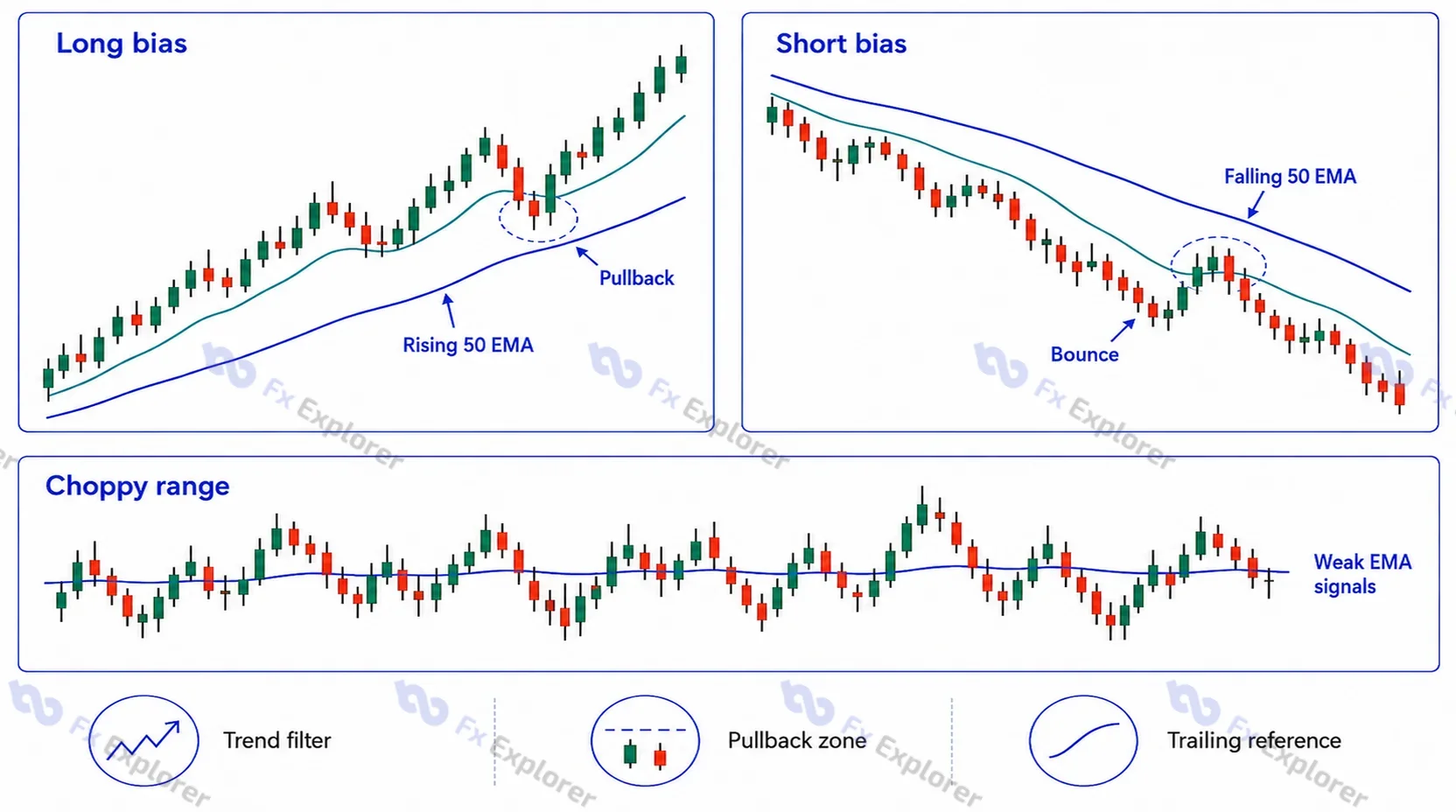
Moving-average strategies are among the most familiar forex methods. A trader may use an exponential moving average to define trend direction, identify pullback zones or create entry filters.
For example, a strategy might look for long trades only when price is above a rising 50-period EMA and short trades only when price is below a falling 50-period EMA. A faster moving average may help identify momentum, while a slower average defines broader direction.
Moving averages are useful because they create objective structure. They can help with trend filtering, pullback identification, trailing references or exit conditions.
Their weakness is that they lag price and often produce poor signals in sideways markets. A moving-average strategy becomes more useful when it is combined with market structure, clear invalidation and cost-aware testing.
Breakout Strategy
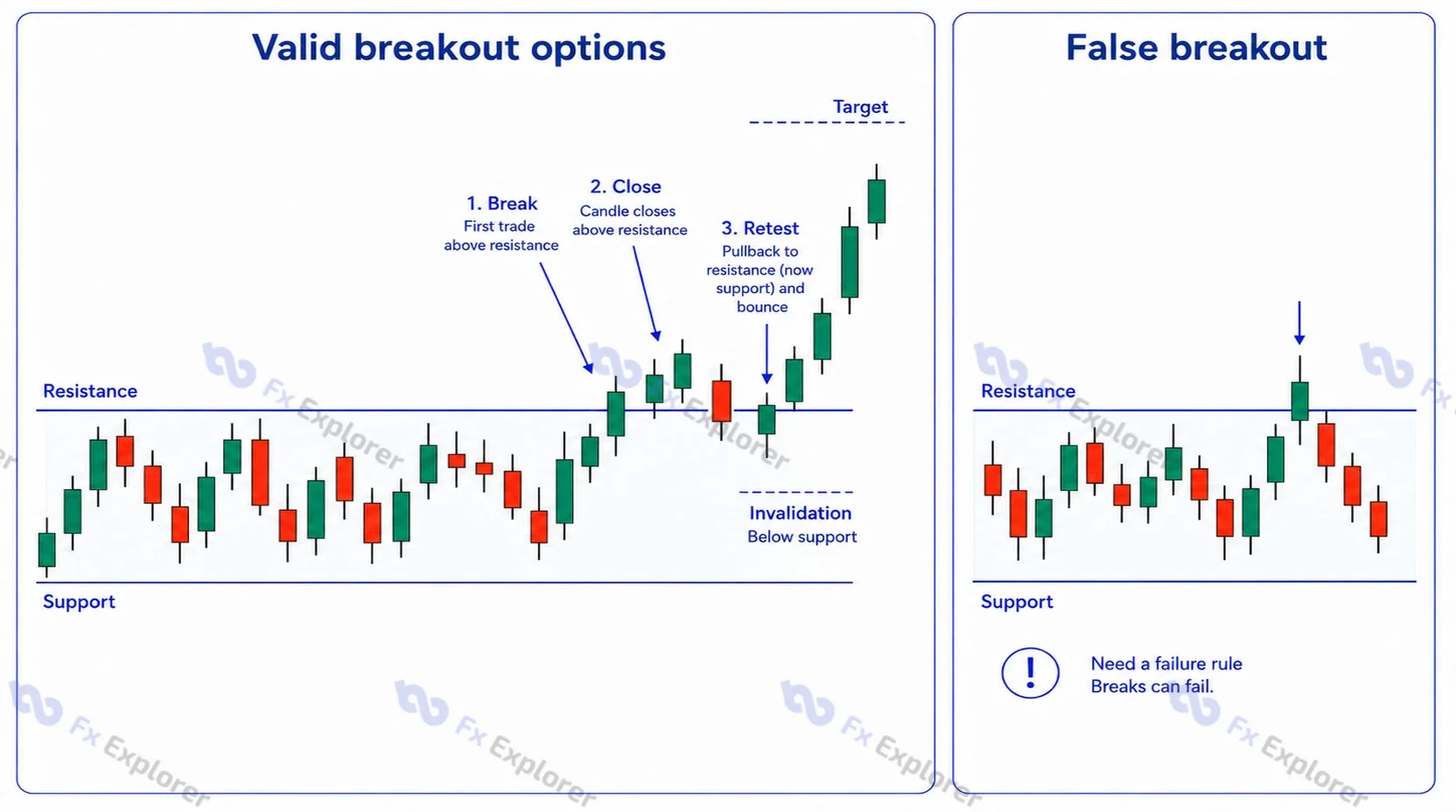
A breakout strategy attempts to enter when price moves beyond a range, consolidation, trendline or key support/resistance level.
Breakout trading can be effective when price leaves compression and begins a directional move. It is often used after rectangles, triangles, session ranges or major horizontal levels.
The main risk is the false breakout. Price may move beyond the level, trigger entries and then return into the previous structure. This is especially important around news, low-liquidity periods or obvious levels where many orders may be clustered.
A breakout strategy should define whether entry occurs on an intrabar break, a candle close or a break-and-retest. It should also define when the breakout has failed. Without those rules, the trader may chase price after the best risk-to-reward has already passed.
Range Trading and Mean-Reversion Strategy
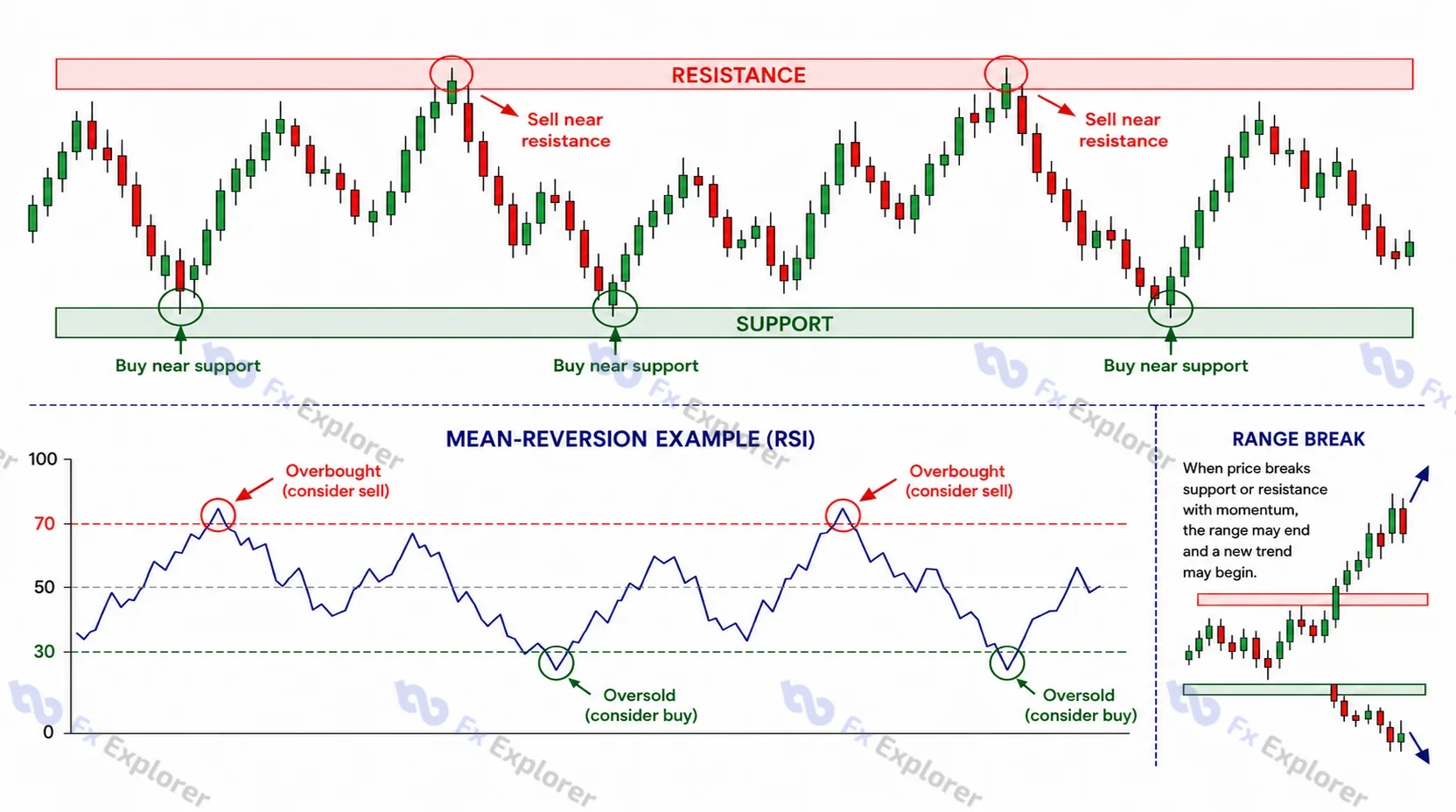
Range trading looks for opportunities when price rotates between support and resistance. Mean reversion is related: it assumes price may return toward an average or central value after moving too far in one direction.
These strategies can be useful when a currency pair lacks directional momentum. The trader may buy near support, sell near resistance or use an indicator to identify stretched conditions.
The weakness appears when the range breaks. A method that repeatedly buys lows and sells highs can suffer when a real trend begins. For that reason, a range strategy needs a clear invalidation rule and should not assume support or resistance will hold forever.
Range trading is best suited to stable, sideways conditions. It becomes less attractive during strong trends, major news repricing or expanding volatility.
Support-and-Resistance Price-Action Strategy
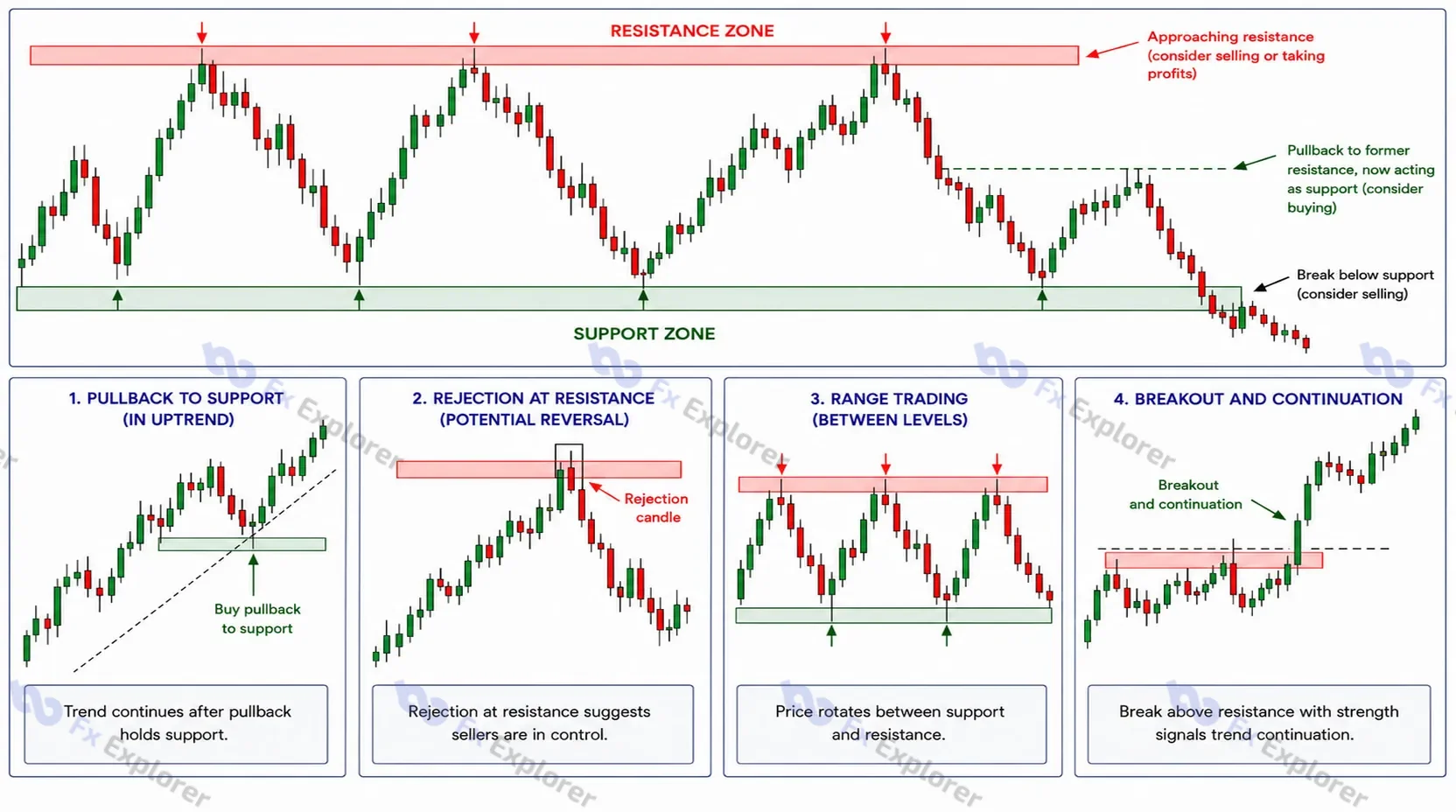
Support and resistance strategies use previous reaction areas, swing highs, swing lows, range boundaries and trend structure to plan trades. They are widely used because they focus on price itself rather than relying entirely on indicators.
This approach is broad. It can support trend trades, range trades, breakouts or reversals. A trader might buy a pullback to former resistance that now acts as support, or avoid a long trade because price is approaching a major resistance zone.
The strength of price action is flexibility. The weakness is subjectivity. Two traders can draw levels differently, especially when the chart is messy.
To become a testable strategy, price-action trading needs objective rules. The trader should define which levels matter, how confirmation is judged, where invalidation sits and when a trade is skipped.
Momentum Strategy
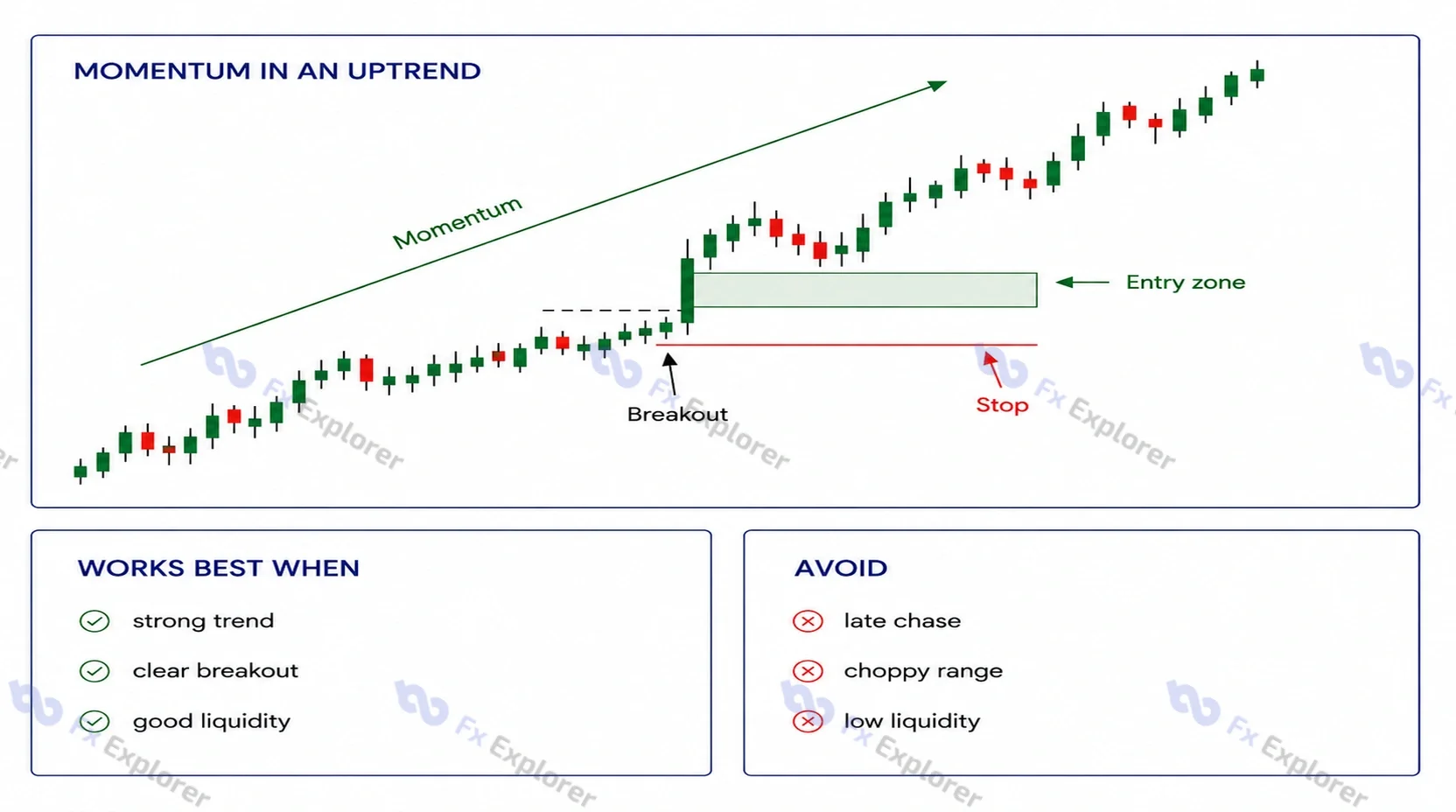
Momentum strategies aim to trade strong directional pressure. The trader may enter after a sharp move, a strong candle close, a break of structure or confirmation from a momentum indicator.
Momentum can work when price acceleration reflects genuine participation. It may appear after economic releases, central-bank repricing, breakouts or strong trend continuation.
The danger is chasing an exhausted move. By the time the trend looks obvious, the distance to a valid stop may be too wide and the remaining reward may be limited.
Momentum can be powerful, but it is not the same as buying because price has already risen or selling because price has already fallen. It needs strict rules for entry timing, stop placement and when not to enter.
Fundamental or Macro-Aware Strategy
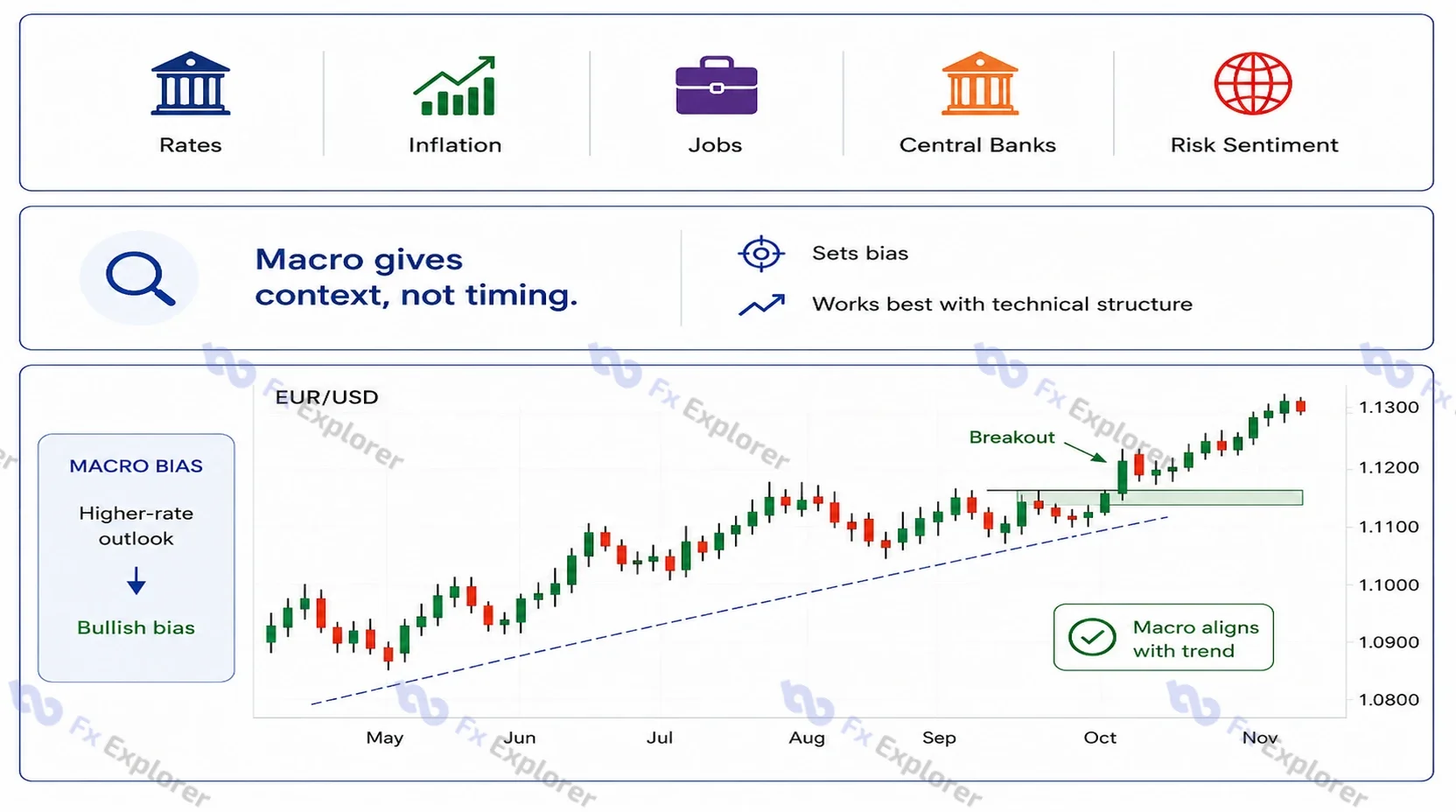
A macro-aware forex strategy considers economic and policy drivers such as interest-rate expectations, inflation, employment data, central-bank guidance, fiscal conditions and risk sentiment.
Currencies often move when markets reassess the relative outlook for two economies or central banks. A macro view can help explain why a currency is trending or why a technical breakout may have stronger context.
However, fundamentals do not remove timing risk. A trader can have the right broad view and still enter too early, use too much leverage or ignore an important technical level.
For most retail traders, macro analysis is best used as context or a filter unless they have a clearly defined fundamental strategy with risk rules.
Carry Trade
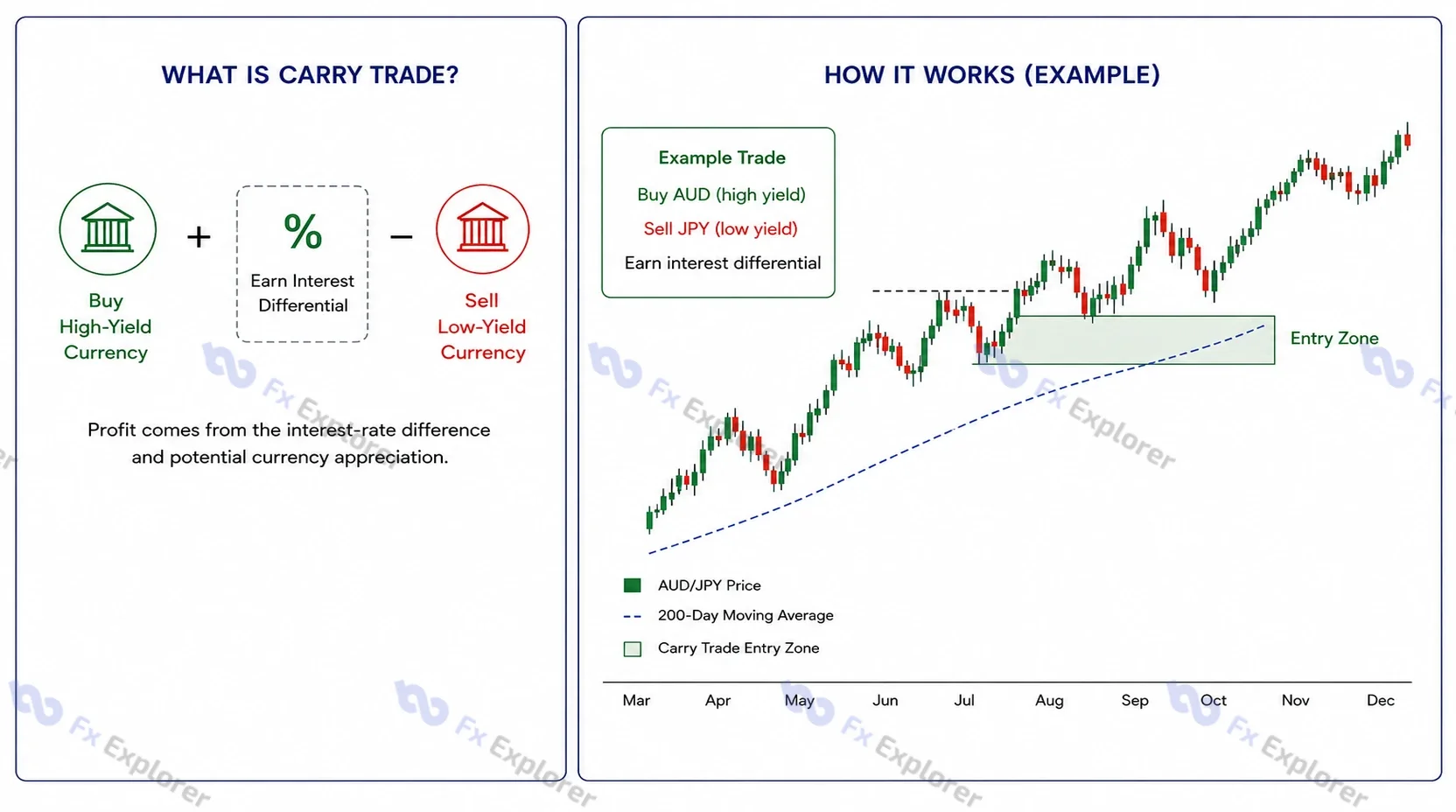
The carry trade is a longer-term strategy based on interest-rate differentials. A trader may buy a higher-yielding currency and sell a lower-yielding currency, aiming to benefit from the interest differential while also managing exchange-rate risk.
It is a well-known forex strategy, but it is not a low-risk income method. Currency moves can easily overwhelm the interest earned, especially during risk-off periods when investors exit higher-yielding currencies. Leverage can magnify losses quickly.
Carry trades should be discussed as a longer-horizon concept, not as the best forex strategy for consistent profits. They require attention to trend, volatility, central-bank expectations and position size.
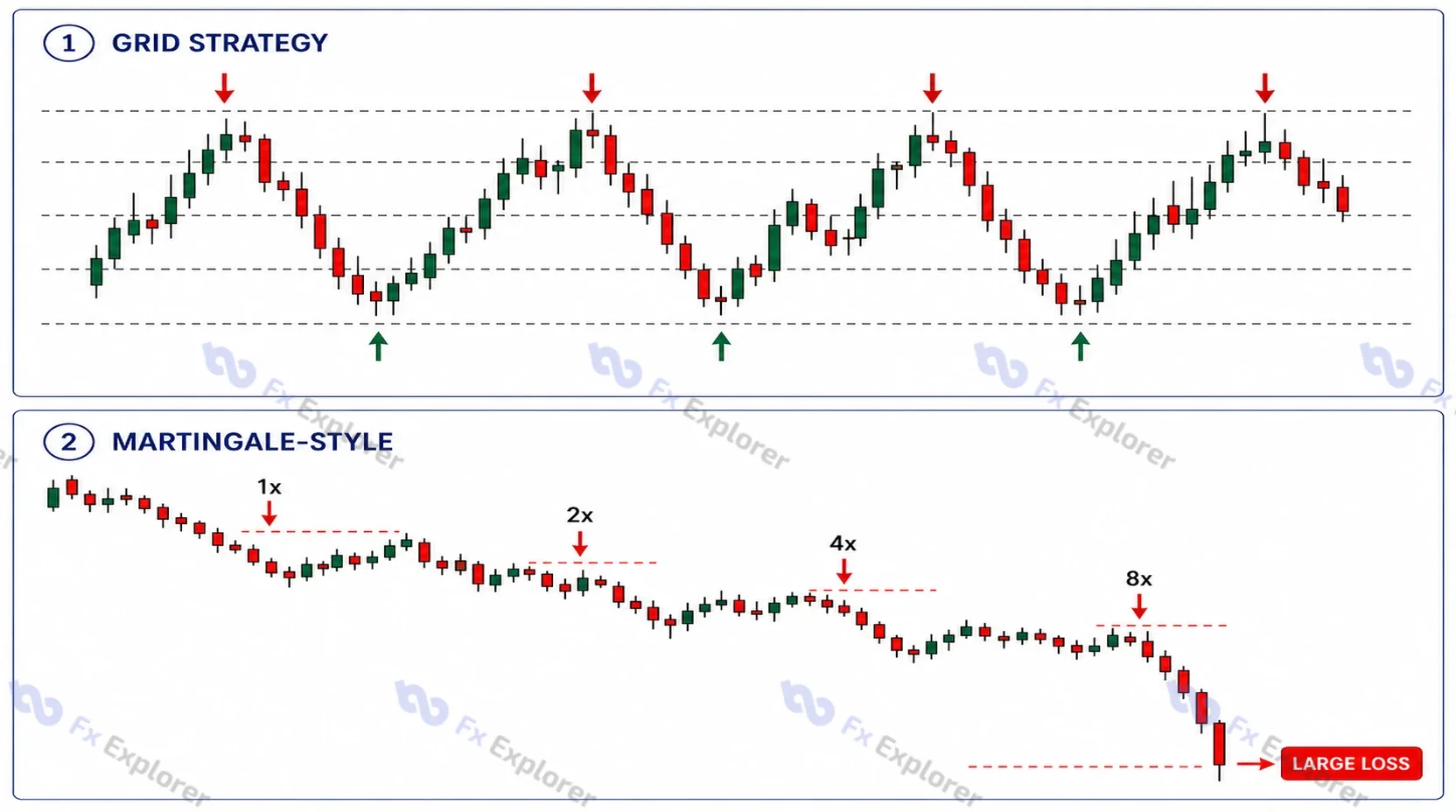
Grid and Martingale-Style Strategies
Grid and martingale-style strategies often appear in searches for very profitable forex strategies because they can look attractive during favorable market conditions. A grid may place repeated buy and sell orders at set intervals. A martingale approach increases position size after losses in an attempt to recover when price reverses.
These methods can carry severe risk. They may produce many small wins before one large move creates a major loss. Increasing exposure during adverse movement can quickly become dangerous, especially with leverage.
They should not be presented as recommended paths to consistent profits. If mentioned, they belong in a cautionary context: traders may encounter them, but unmanaged grids and martingale sizing can hide risk until market conditions change.
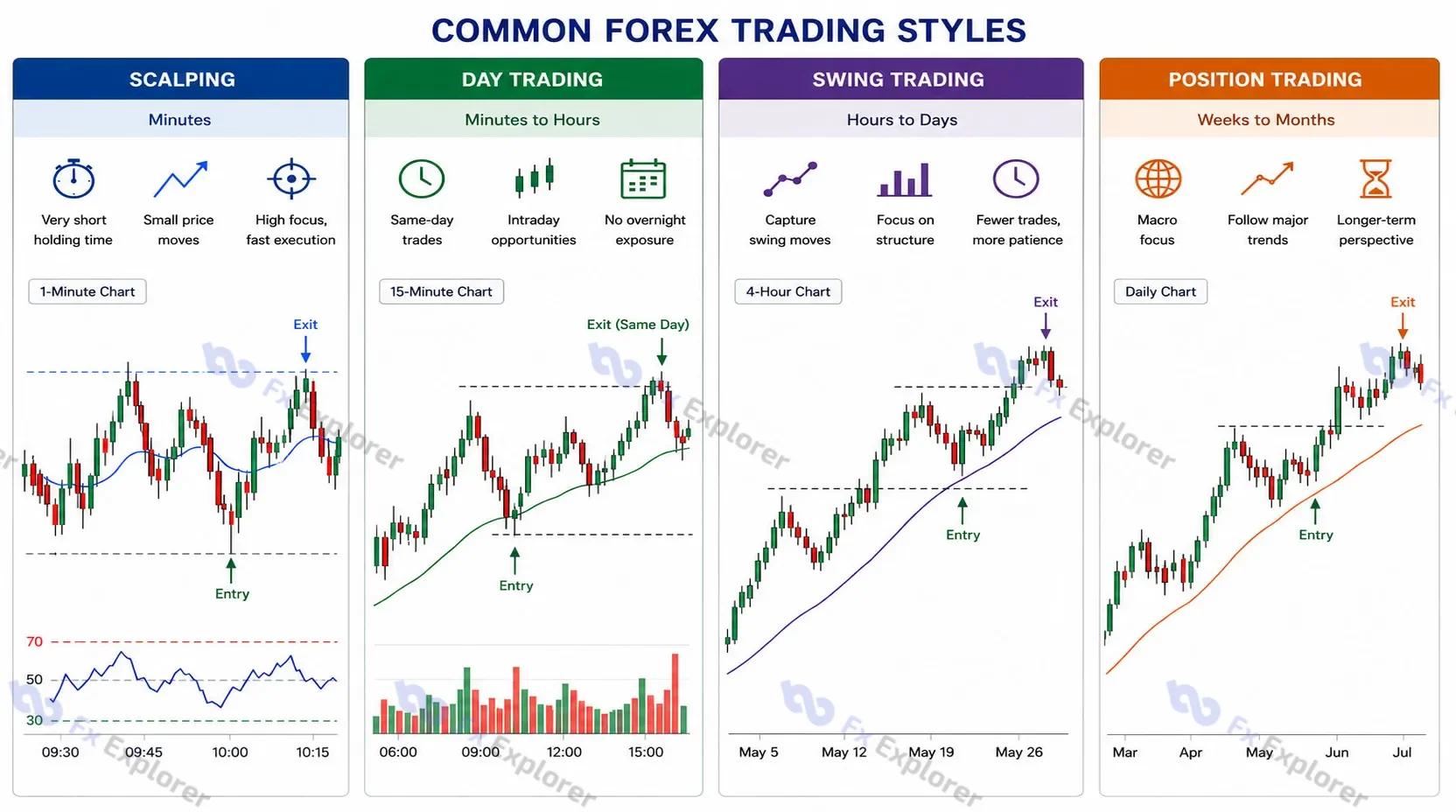
Common Forex Trading Styles
Trading style affects how often a trader participates, how long trades are held and how much execution pressure the strategy creates. The style should match the trader’s schedule and temperament, not just the appeal of frequent trades or large targets.
Scalping
Scalping aims to capture small moves, often over minutes. It is not automatically beginner-friendly or consistently profitable.
Because targets are small, scalping is highly sensitive to spread, slippage, commission and execution speed. A strategy that looks profitable before costs can become unprofitable after only a small increase in trading expenses.
Scalping also requires fast decisions and strong discipline. Overtrading, hesitation, platform mistakes and emotional reactions can quickly damage results.
It may suit active traders with low costs, strong focus and tested rules, but it is unsuitable for traders who cannot monitor the market closely.
Day Trading
Day trading usually involves opening and closing positions within the same trading day. It sits between scalping and swing trading: trades may last minutes or hours, but the trader typically avoids overnight exposure.
This style may suit traders who can monitor active sessions but do not want to hold positions after the day ends. Day trading can use trend, breakout, pullback, range or momentum logic.
Its main challenge is decision frequency. The trader must manage intraday noise, scheduled news, spreads and the temptation to overtrade. A day trading strategy should define the trading session, maximum number of trades, news rules and conditions for stopping after a loss limit.
Swing Trading
Swing trading holds trades for longer than scalping or most day trading, often from several hours to several days. It usually focuses on larger price swings, broader market structure and fewer trades.
This style may suit traders who cannot watch charts all day. Because targets and stops are often larger, spread may be less significant as a percentage of the expected move. However, swing trades may face overnight risk, swap costs and wider drawdowns.
Swing trading can use trend-following, pullback, breakout, range or macro-aware methods. It is better understood as a timeframe and trade-management style rather than one specific setup.
Position Trading
Position trading is a longer-term style that may hold trades for weeks or months. It often relies more heavily on macro themes, interest-rate expectations, larger trend structure and patience.
This approach can reduce the pressure of constant intraday decisions, but it introduces other challenges. Stops are usually wider, positions may experience large open profit fluctuations, swap costs can matter, and the trader must tolerate long periods without action.
Position trading is not simply “easy long-term trading.” It requires clear thesis invalidation, conservative sizing and the discipline to avoid reacting to every short-term fluctuation.
How to Choose the Right Forex Strategy
A strategy should fit both the market and the trader. A profitable method on paper can fail if the trader cannot execute it in real time.
Scalping may suit someone who can focus intensely during active sessions, make quick decisions and trade with very low costs. Day trading may suit someone who can be present during active market hours and wants trades closed before the day ends. Swing trading may suit someone with a job or limited screen time, while position trading may suit someone who prefers longer-term themes and fewer decisions.
The same logic applies to strategy families. Trend-following may suit a patient trader who can sit through pullbacks and losing streaks. Mean reversion may suit someone who prefers defined ranges and quicker exits, but only if they can accept that ranges eventually break.
A trader should choose a strategy by asking:
- Can I observe the market when this strategy gives signals?
- Are the required decisions realistic for my schedule?
- Can I tolerate its normal drawdown?
- Are the stops and position sizes suitable for my account?
- Do the expected targets remain meaningful after costs?
- Can I follow the rules after several losses?
The best forex strategy for consistent profits is often the one the trader can execute cleanly, not the one that looks most impressive in hindsight.
Should You Use One Strategy or Multiple Strategies?
Using more than one strategy can make sense, but only when each method has its own rules, conditions and performance record. Mixing untested setups usually creates confusion rather than diversification.
For example, a trader might use a trend-pullback strategy during directional conditions and a range strategy during sideways conditions. That can be reasonable if the trader has clear rules for identifying each environment and does not switch methods simply because the last trade lost.
The danger is random rotation. A trader takes a breakout trade, loses, then switches to mean reversion. After another loss, they add a momentum indicator. Soon there is no stable system to test.
Multiple strategies should be treated as separate systems. Each needs its own journal, sample size, risk limits and review process.
A Practical EMA Pullback Strategy Example
The following example is not a recommendation or a claim that this is the most profitable forex trading strategy. It shows how a simple idea can be turned into testable rules.
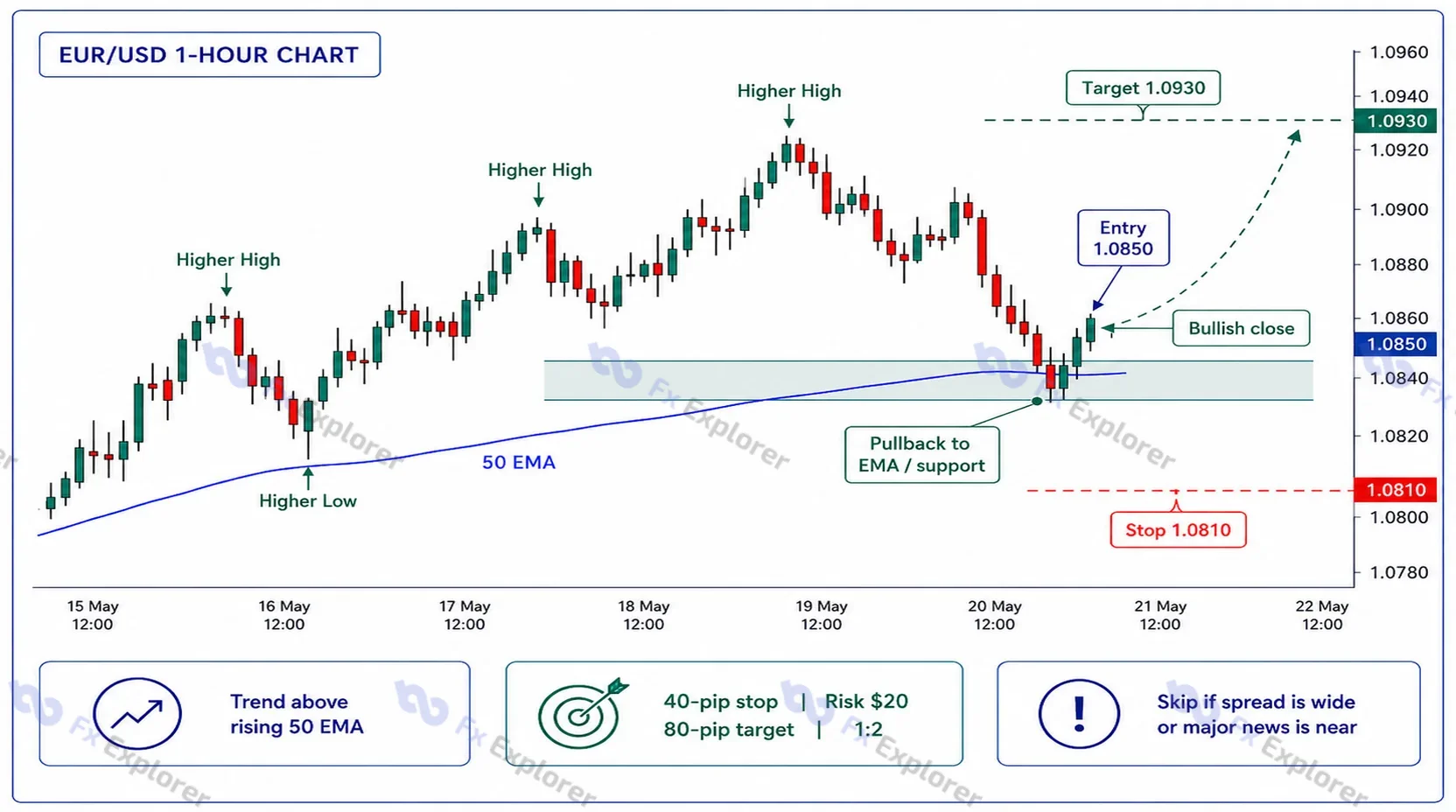
Assume a trader wants to build an EMA pullback strategy on EUR/USD using the one-hour chart. The idea is to trade in the direction of an established trend and enter after a pullback rather than chasing an extended move.
A basic rule set might look like this:
- Trade long only when price is above a rising 50-period EMA and the recent swing structure shows higher highs and higher lows.
- Wait for price to pull back toward the EMA or a nearby prior support area.
- Enter only if price forms a bullish close back in the trend direction.
- Place the stop below the recent swing low that would invalidate the pullback idea.
- Set the first target near the previous swing high or at a predefined multiple of risk.
- Risk only a fixed percentage or fixed cash amount per trade.
- Skip the trade if the stop distance is too wide, major news is imminent or the target is too close after spread and slippage.
Now suppose EUR/USD is in an uptrend on the one-hour chart. Price is above a rising 50-period EMA, recent swings show higher highs and higher lows, and price pulls back toward the EMA near a previous support area.
The trader enters after a bullish candle closes back in the trend direction. The invalidation point is below the recent swing low. If the entry is at 1.0850 and the stop is at 1.0810, the stop distance is 40 pips.
If the trader is willing to risk $20 on the trade, the position size must be calculated so that a 40-pip loss, plus expected costs, stays near that risk amount. A possible target might be the previous swing high near 1.0930, creating an 80-pip target before costs. That is roughly a 1:2 risk-reward plan.
The trade should still be skipped if the spread is unusually wide, a high-impact news release is imminent or the previous high is too close to justify the risk. The setup matters, but the full plan decides whether the trade is worth taking.
Testing should answer whether the trend filter reduces weak trades, whether the entry is too early or too late, whether the target is realistic, how often price reaches the target before the stop and whether the average winner remains large enough after costs.
The strategy may also need a market-condition filter. If EUR/USD is sideways and repeatedly crossing the EMA, the method may produce poor signals. A rule might therefore require the EMA to slope clearly or require recent swing structure to confirm the trend.
The example shows the real lesson: a strategy becomes useful only when its rules are specific enough to test and repeat.
How to Test a Profitable Forex Strategy Properly
Testing should not be designed to prove that a strategy works. It should be designed to discover how the strategy behaves.
Backtesting applies the rules to historical data. Forward testing applies the same rules to new data as it unfolds. Demo testing helps the trader practice execution without financial risk. Small-size live testing then reveals practical differences that demo conditions may not fully capture, such as slippage, emotional pressure, missed trades and changes in execution quality.
This difference between tested performance and actual live performance is the execution gap. A strategy can look profitable in historical results but produce weaker live outcomes if fills are worse, spreads widen, the trader hesitates or valid trades are skipped.
A useful testing process includes:
- Define the strategy rules before looking at the result.
- Specify the market condition required.
- Define entry, stop, target and trade-management rules.
- Include spread, commission, slippage and swap where relevant.
- Test a meaningful sample across the actual pair and timeframe.
- Keep losing trades and ambiguous examples in the sample if they meet the rules.
- Measure expectancy, drawdown, profit factor and recovery time.
- Forward test the same rules without changing them after every loss.
- Practice execution in demo, then move to very small live size only if the process remains stable.
A simple strategy maturity ladder is:
The most common testing mistake is hindsight adjustment. A trader sees that a historical trade failed, then decides the setup “was not valid.” If that exclusion was not part of the original rules, it makes the backtest unreliable.
Another mistake is testing too small a sample. Ten or twenty trades can be useful for learning, but they are not enough to prove that a strategy is consistently profitable. The weaker and noisier the edge, the more data is needed.
Over-optimization is another danger. A trader may adjust moving-average periods, stop distances, filters and target rules until the strategy fits past data almost perfectly. That can create the illusion of precision while reducing the chance that the system works on new market data.
A strategy should also be tested by pair and session. A method that works on EUR/USD during liquid hours may not behave the same way on a wider-spread pair or during quiet periods.
Scheduled news should also be part of the testing rules. Some traders avoid high-impact releases unless news volatility is part of the strategy. Others use news as context but not as an entry trigger. Either choice can be valid, but it should be defined before the trade.
How Much Risk Per Trade Is Sensible?
There is no universal risk percentage that fits every trader. The correct amount depends on account size, strategy drawdown, stop distance, confidence in the tested edge and the trader's ability to handle losses.
Many traders use small fixed-risk amounts per trade because losing streaks are normal. Risking too much can make even a profitable strategy difficult to follow.
The position-size process should start with the invalidation point, not with the desired lot size:
If the stop needs to be 40 pips away and the trader is willing to lose only $20, the position size must be small enough that a 40-pip loss stays within that amount after costs. If the minimum trade size makes that impossible, the trade should be skipped or the account structure reconsidered.
Total exposure also matters. A trader may think they are risking 1% per trade, but if they open several positions that all depend on the same currency direction, the combined exposure can be much larger than it appears.
Consistent profits require survival first. A strategy cannot compound if the account is damaged by a position size that was too large for its normal losing streak.
Normal Drawdown vs. Strategy Failure
A weak period does not automatically mean a strategy has stopped working. Every real method has drawdown, losing streaks and trades that fail even when the rules were followed.
The key question is whether current performance is still within the range that testing and live records suggest is normal. If a strategy has historically experienced six-loss streaks, a four-loss streak may be uncomfortable but not unusual. If the trader changes rules after the fourth loss, they may damage the method before there is evidence that it has failed.
A possible strategy failure deserves closer attention when losses exceed expected drawdown, the market condition has changed materially, execution costs are consistently higher than assumed, or the same setup type begins failing in a way not seen during testing.
After a losing streak, the first step is not to add another indicator or double the next position. A better process is to pause, review execution, compare the results with expected drawdown, check whether the correct market condition was present and confirm whether the rules were followed.
Sometimes the correct action is to keep trading the plan at normal or reduced size. Sometimes it is to pause the strategy and collect more data. The least useful response is emotional strategy drift, where rules are changed repeatedly without a structured review.
Why Profitable Forex Strategies Stop Working
A strategy that worked in the past can weaken later. This does not always mean the original idea was bad. Market behavior changes, and trader execution can change too.
One common reason is market regime change. A trend strategy may perform well during strong directional movement, then lose repeatedly when the pair enters a range. A range strategy may work for weeks, then fail when volatility expands and price breaks out.
Trading costs can also change. Wider spreads, worse fills or higher slippage can damage strategies with small targets. This is especially important for scalping and short-term breakout methods.
Overfitting is another problem. A strategy may be adjusted so closely to past data that it captures historical noise rather than a durable edge. It then performs poorly on new data.
Trader behavior can also weaken a strategy. This includes skipping valid trades after losses, entering early, moving stops, closing winners too soon or adding extra filters that were never tested.
This is a form of strategy drift. The trader begins with a defined method but gradually changes entries, exits, filters or risk rules in response to recent outcomes. After enough changes, the trader is no longer following the strategy that was tested.
Sometimes the issue is strategy crowding or obvious levels. If too many traders focus on the same entry area, false breaks and liquidity grabs may become more common. This does not make the strategy useless, but it may require more careful confirmation and risk control.
The solution is not to abandon a method after every weak period. The solution is to compare current results with the strategy's expected drawdown and failure behavior. If performance is still within tested expectations, discipline may be required. If the market environment has changed materially, rules may need structured review rather than emotional adjustment.
When to Pause or Reduce a Strategy
A strategy does not always need to be modified when performance weakens. Sometimes it should be paused, reduced in size or monitored until conditions become clearer.
Pausing can be appropriate when spreads are consistently wider than the strategy assumed, a major news period is distorting normal behavior, the market condition no longer matches the strategy, or the trader is no longer following rules because of fatigue or frustration.
Reducing size can also be sensible during a review period. It allows the trader to keep collecting live data without taking the same level of financial or emotional risk.
The important distinction is between pausing deliberately and quitting impulsively. A planned pause has criteria: what triggered it, what will be reviewed and what conditions must return before the strategy is resumed. An emotional pause usually happens after losses and is followed by random rule changes or a search for a new strategy.
Common Mistakes When Searching for the Most Profitable Forex Strategy
The search for a very profitable forex strategy often leads traders into the same traps.
The first mistake is expecting a strategy to remove uncertainty. Every strategy loses. A method that cannot tolerate losses is not a strategy; it is a hope that the market will cooperate.
Another mistake is copying indicator settings without understanding the logic behind them. A moving-average crossover, RSI signal or breakout rule may look clear, but the trader still needs to know which market condition it is meant for and where the trade becomes invalid.
Many traders also ignore costs. This is especially damaging when testing scalping or small-target strategies. A method that makes three pips before costs may not survive a one-pip spread and slippage.
Some traders change rules too often. After a few losses, they add another indicator. After a missed winner, they remove a filter. After a large loss, they tighten stops. This constant adjustment prevents the trader from collecting meaningful data.
A more dangerous mistake is increasing risk to recover losses. Martingale thinking, revenge trading and oversized positions can destroy an account faster than a weak strategy.
Finally, traders often judge reliability from screenshots or short winning streaks. A real evaluation needs many trades, full cost assumptions and a record of both good and bad periods.
A Practical Checklist Before Using Any Forex Strategy
Before trusting a strategy, the trader should be able to answer a few direct questions.
- What market condition does this strategy need?
- What exactly creates an entry?
- Where is the setup invalidated?
- How is the target or exit defined?
- How much is risked per trade?
- Are spread, slippage, commission and swap included?
- Has the strategy been tested on the actual pair and timeframe?
- What drawdown and losing streak should be expected?
- Can the rules be followed without constant adjustment?
- What conditions require standing aside?
If these questions cannot be answered, the strategy is not ready. It may be an idea worth studying, but it is not yet a complete trading plan.
Conclusion
The best forex strategy for consistent profits is not the strategy with the most exciting name, the highest claimed win rate or the cleanest example chart. It is the method that can be defined, tested, executed and reviewed without relying on luck or emotional rule changes.
Trend-following, pullback, breakout, range, momentum, price-action and macro-aware strategies can all be useful in the right conditions. None of them is universally best. Each needs a market context, a clear entry, a defined invalidation point, realistic targets, controlled position size and honest performance review.
The setup matters, but the system around the setup matters more. A trader searching for the most profitable forex strategy should focus less on finding a perfect signal and more on building a process that survives costs, drawdowns, losing streaks and changing market conditions.
Consistency in forex is not created by avoiding uncertainty. It is created by managing uncertainty with rules that can be tested, followed and improved through review.
FAQ
What is the best forex strategy for consistent profits?
The best forex strategy for consistent profits is a tested system with positive expectancy, controlled risk and clear execution rules. It is not one universal setup. A strategy must match the trader's timeframe, market condition, costs, account size and discipline.
What is the most profitable forex strategy?
There is no single most profitable forex strategy for all traders. Trend-following, pullback, breakout, mean-reversion, momentum and macro strategies can all be profitable under the right conditions. The important question is whether the rules have been tested after costs and whether the trader can execute them consistently.
Can a forex strategy be consistently profitable?
A forex strategy can be consistently profitable over a series of trades if it has a tested edge, realistic costs, controlled risk and disciplined execution. That does not mean it will win every trade or avoid drawdowns. Losses are part of any real strategy.
Which forex strategy is best for beginners?
Beginners usually benefit from simple, rule-based strategies that are easy to test and review. A basic trend-pullback or support-and-resistance strategy may be easier to understand than scalping, grid trading or complex indicator combinations. Simplicity does not guarantee profit, but it makes mistakes easier to identify.
Is scalping or swing trading more profitable?
Neither is automatically more profitable. Scalping offers more frequent trades but is highly sensitive to spread, slippage and execution speed. Swing trading usually produces fewer trades with larger stops and targets, but it can involve overnight risk. The better choice depends on the trader's schedule, costs, discipline and tested results.
Is day trading or position trading better in forex?
Neither is universally better. Day trading may suit traders who can monitor active sessions and want to avoid overnight exposure. Position trading may suit traders who prefer longer-term themes and fewer decisions. The better choice depends on timeframe, risk tolerance, costs, patience and whether the strategy has been tested.
Can I combine multiple forex strategies?
Multiple strategies can be combined only if each has separate rules, conditions, risk limits and records. Randomly switching between strategies after losses creates confusion. A trader should know which market condition activates each method and should review each one separately.
How long should I test a forex strategy before using it live?
There is no universal number, but a few trades are not enough. A strategy should be tested across a meaningful sample, different market conditions and the actual pair and timeframe intended for trading. Forward testing, demo execution and very small live testing can reveal issues that a historical backtest may miss.
How do I know if a forex strategy works?
A strategy should have clear rules, a meaningful sample of backtested and forward-tested trades, positive expectancy after costs, acceptable drawdown and evidence that the trader can execute it without rule changes. A few winning trades are not enough.
What win rate is good for a forex strategy?
A good win rate depends on average win and average loss. A 40% win-rate strategy can be profitable if winners are much larger than losers. A 70% win-rate strategy can lose money if the losses are too large. Expectancy is more important than win rate alone.
Are moving-average strategies profitable in forex?
Moving-average strategies can be useful when they define trend direction, pullbacks or exits clearly. They often struggle in choppy ranges because moving averages lag price. Their profitability depends on the exact rules, market condition, costs and testing.
Should I use indicators or price action?
Both can be useful. Indicators can make rules more objective, while price action can help interpret structure and context. The best choice is the one that can be defined, tested and executed consistently. Adding more tools does not automatically improve a strategy.
Are grid and martingale strategies good for consistent profits?
Grid and martingale strategies can appear profitable during favorable periods, but they can accumulate large losses when price keeps moving against the positions. They should be treated as high-risk approaches, not reliable shortcuts to consistent profits.
What should I do after a losing streak?
A losing streak should trigger review, not panic. Check whether the trades followed the rules, whether the market condition matched the strategy, whether costs changed and whether the drawdown is within tested expectations. Avoid increasing risk or changing rules impulsively.

Amelia Benedetti
Amelia Benedetti is a forex broker reviewer focused on clear, practical evaluations of online trading platforms. She analyzes broker fees, regulation, account types, trading tools, execution quality, and user experience to help traders compare providers more confidently. Her reviews emphasize transparency, platform reliability, usability, and trader protection, offering balanced insights for both beginners and experienced traders.