
Learn the fundamentals of forex trading with this practical beginner-friendly guide. Discover how currency pairs, pips, lots, spreads, charts, leverage, margin, order types, and position sizing work, while gaining a clear understanding of the risks and costs involved. The guide also covers popular forex trading styles, risk-management techniques, trading plans, demo accounts, broker selection, common beginner mistakes, and important scam warning signs. With practical examples and a step-by-step approach, it is designed to help new traders understand how the forex market works and prepare for trading responsibly before risking real money.
Forex trading gives individuals access to a global market in which currencies are constantly bought and sold. Opening an account and viewing a chart is easy, but that accessibility can hide how much a beginner must understand before risking money. Every trade involves two currencies, a bid and ask price, a position size, trading costs, margin requirements and a defined possibility of loss.
This guide explains those elements in a practical order. By reading it from beginning to end, you will gain a complete working understanding of how forex trading operates, how to read forex charts, how orders and leverage work, how traders control risk and how to prepare for a first trade without confusing access with readiness.
The goal is education, not a promise of profit. Forex trading can produce losses quickly, especially when leverage is used carelessly. A sensible beginner first learns how the market and platform work, then tests a written process and only later considers a small live position using money that is genuinely affordable to lose.
Key Takeaways
- Forex trading involves buying one currency while selling another through a currency pair, so every position depends on the relative movement of two currencies.
- Beginners should understand quotes, pips, lot sizes, pip value, order types, leverage, margin and trading costs before risking real money.
- Leverage reduces the margin needed to open a position, but it does not reduce the amount gained or lost for each pip of movement.
- A stop should mark where the trade idea becomes invalid. Position size should then be calculated so the potential cash loss remains within the chosen limit.
- Scalping, day trading, swing trading and position trading describe different holding periods and operating demands; they are not complete strategies by themselves.
- A responsible beginner moves from education to testing, demo practice and small live exposure using capital that is affordable to lose.
What Is Forex Trading?
Forex trading is the act of speculating on changes in the exchange rate between two currencies. Every trade involves buying one currency and selling another through a pair such as EUR/USD.
The foreign exchange market exists because businesses, governments, banks, investors and individuals need to convert one currency into another. A company may need euros to pay a supplier, an investment fund may hedge an overseas holding, and a traveler may exchange domestic currency for spending abroad.
Retail traders participate because they expect one currency to strengthen or weaken relative to another. A trader who buys EUR/USD expects the euro to rise against the US dollar. A trader who sells the pair expects the euro to fall relative to the dollar.
Retail forex trading is not always the same as physically exchanging money. Depending on the account, product and jurisdiction, a trader may use a rolling over-the-counter forex position, a contract that tracks a currency pair, a spread-based derivative, a future or another currency-linked instrument. These structures can differ in settlement, financing, leverage, counterparty exposure and account protections.
Before trading, a beginner should know exactly what product the account provides. The word “forex” describes the underlying currency market, but the legal and operational structure of a retail trading product can vary considerably.
How Forex Trading Works
Currency Pairs and Exchange Rates
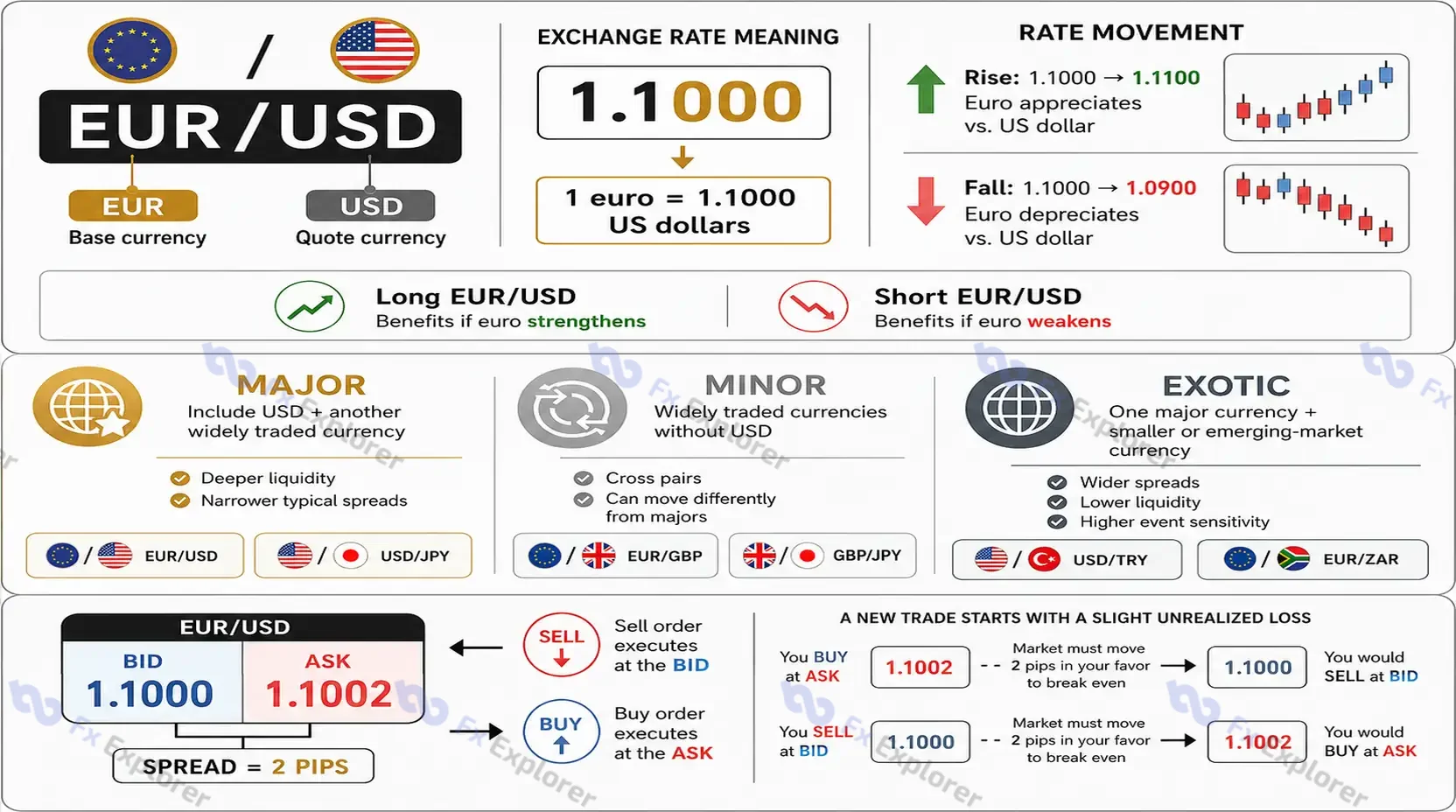
A currency pair contains a base currency and a quote currency. In EUR/USD, EUR is the base currency and USD is the quote currency. A price of 1.1000 means one euro is worth 1.1000 US dollars.
If EUR/USD rises from 1.1000 to 1.1100, the euro has appreciated relative to the dollar. If it falls to 1.0900, the euro has depreciated relative to the dollar. The movement always describes a relationship between two currencies. The euro can strengthen against the dollar while weakening against the pound at the same time.
Going long means buying the pair because a rise is expected. Going short means selling the pair because a decline is expected. A long EUR/USD position benefits when the euro strengthens relative to the dollar, while a short position benefits when the euro weakens.
Major, Minor and Exotic Currency Pairs
Currency pairs are often grouped by liquidity and the currencies involved. Major pairs contain the US dollar and another widely traded currency. They usually attract substantial market activity and often have narrower typical spreads than less liquid pairs.
Minor or cross pairs combine widely traded currencies without the US dollar. Their behavior can differ considerably from major pairs, and some crosses move more sharply or carry wider spreads.
Exotic pairs combine a major currency with the currency of a smaller or emerging economy. They can involve wider spreads, larger financing charges, reduced liquidity and more abrupt reactions to political or economic developments. The same nominal lot size can therefore create very different practical risk across different pairs.
Bid, Ask and Spread
A forex quote normally shows two prices. The bid is the price at which a sell order can usually be executed, while the ask is the price at which a buy order can usually be executed. The difference between them is the spread.
If the bid is 1.1000 and the ask is 1.1002, the spread is two conventional pips. A new trade generally begins with a small unrealized loss because it opens at one side of the quote and would close at the other. The spread is therefore part of the cost of trading, not merely a display feature.
Market Structure, Participants and Trading Sessions
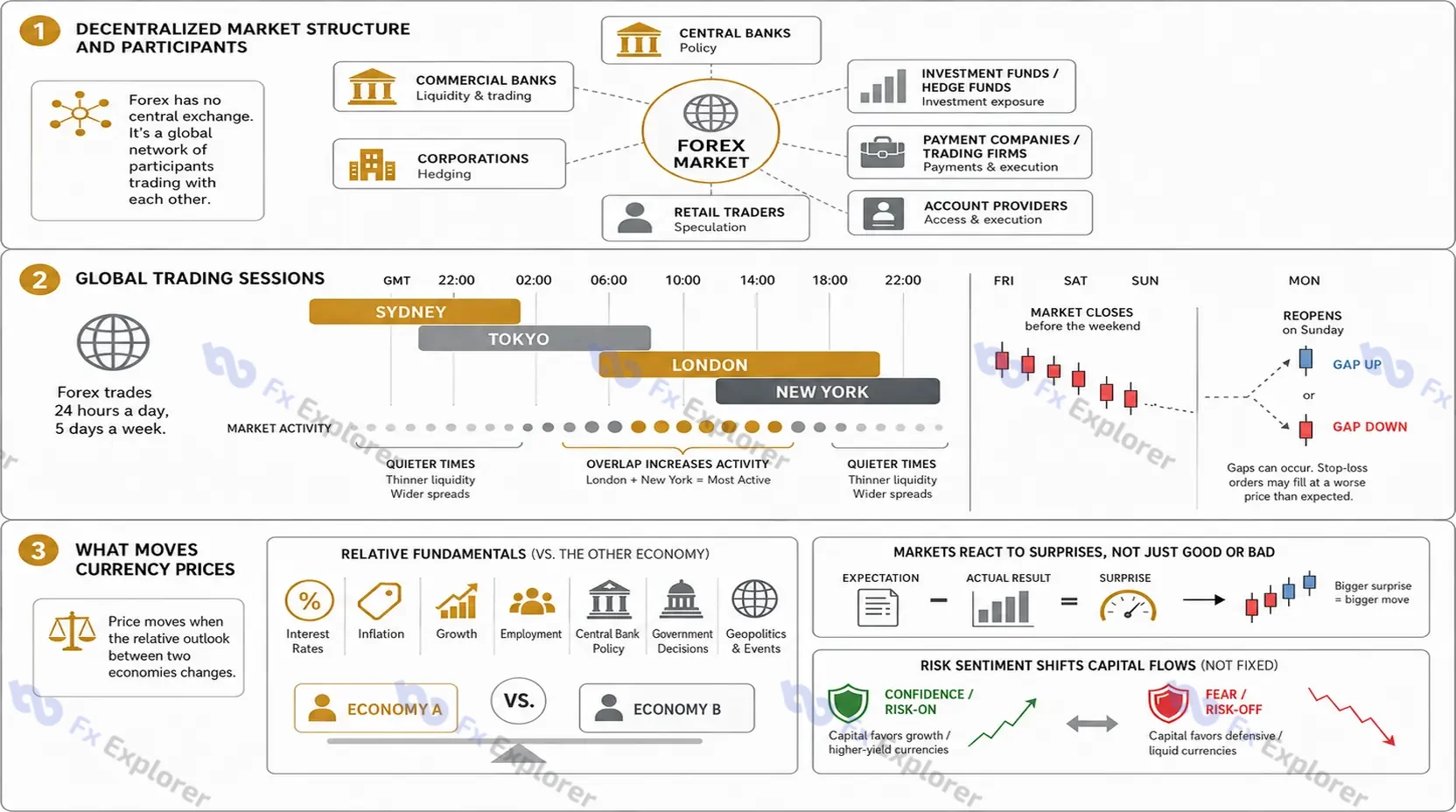
The forex market is not one centralized exchange with a single global order book. Much of it operates through a network of banks, financial institutions, trading venues and counterparties. Participants include central banks, commercial banks, corporations, investment funds, hedge funds, payment companies, trading firms, account providers and individual traders.
These participants trade for different reasons. A central bank may respond to inflation or financial instability. A corporation may hedge foreign revenue. An investment fund may adjust international exposure. A retail trader may speculate on a movement lasting minutes, days or weeks.
Forex trading runs across the working week because major financial centers open and close in different time zones. The market is commonly described through the Sydney, Tokyo, London and New York sessions.
Activity often increases when sessions overlap. The London and New York overlap is especially active for many major pairs because European and North American participants are trading at the same time. Higher activity can improve liquidity, but it can also create faster movement around economic announcements.
Quieter periods may bring slower price action, thinner liquidity and wider spreads. “Open 24 hours” does not mean every pair trades under equally favorable conditions throughout the day.
Retail forex normally closes before the weekend and reopens when the new week begins. If important events occur while the market is closed, price may reopen above or below the previous closing level. A stop-loss can then execute at a worse price than requested.
What Moves Currency Prices?
Currency prices move as market participants reassess the relative outlook for two economies. Interest rates, inflation, growth, employment, central-bank policy, government decisions and geopolitical events can all change expectations.
The market often reacts to the difference between an announcement and what traders had already anticipated. A currency can fall after apparently positive news when the result is weaker than expected or when traders had already positioned for an even stronger outcome.
Risk sentiment also matters. During periods of confidence, investors may favor currencies associated with growth or higher yields. During periods of fear, they may move toward currencies and assets perceived as more liquid or defensive. These relationships are not permanent, which is why simple rules such as “good data always strengthens a currency” are unreliable.
Essential Forex Terminology for Beginners
A beginner does not need to memorize every platform term at once, but several concepts must be understood before an order is placed.
Pips, Points, Lots and Pip Value
A pip is a conventional unit used to describe a price change. For many currency pairs, one pip is the fourth decimal place. A move from 1.1000 to 1.1001 is one pip. For many yen-denominated pairs, a pip is commonly the second decimal place.
A pipette is one-tenth of a pip. On a five-decimal quote, the fifth decimal place often represents a pipette. Platforms may also use the word point for the smallest displayed price increment. On a five-decimal EUR/USD quote, one point may equal 0.00001, meaning ten points equal one conventional pip. This distinction matters when a platform expresses stop distances or order restrictions in points rather than pips.
A lot represents a quantity of the base currency. A standard lot commonly represents 100,000 units, a mini lot 10,000 units, a micro lot 1,000 units and a nano lot 100 units. Not every account offers all four sizes.
Pip value is the cash effect of a one-pip movement. For many USD-quoted pairs in a USD account, a 1,000-unit position is worth about $0.10 per pip, while a 10,000-unit position is worth about $1 per pip. The actual value can change with the pair, account currency and exchange rate.
Illustrative values for many USD-quoted pairs in a USD account. Actual values vary by pair and account currency.
Account-Currency Conversion
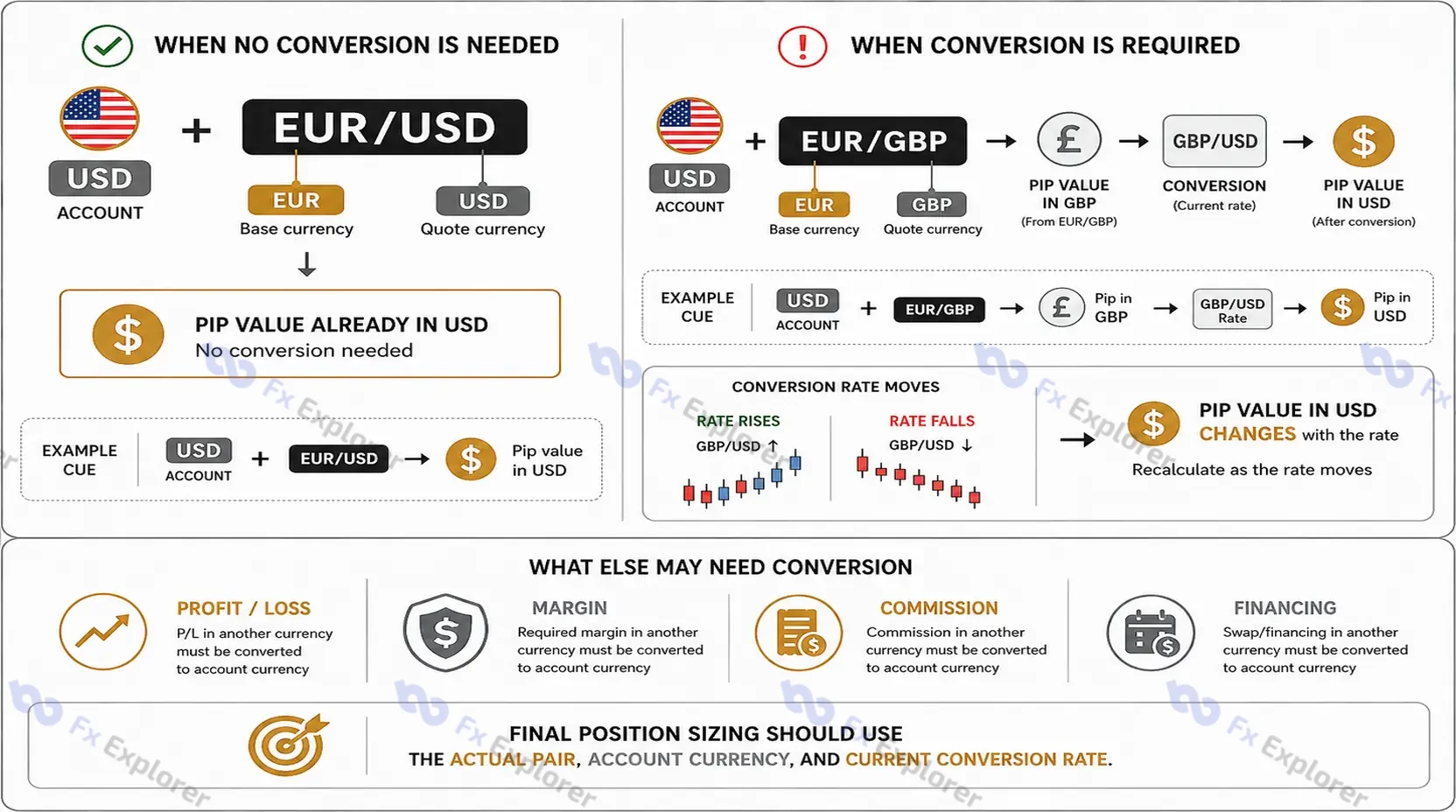
Pip-value calculations are simplest when the account currency matches the pair’s quote currency. In a USD account, the pip value of EUR/USD is already expressed in US dollars because USD is the quote currency.
A pair such as EUR/GBP works differently. Its pip value is first expressed in pounds. A USD account must then convert that value into dollars using the relevant exchange rate. The result can change as the conversion rate moves.
Profit, loss, margin, commission and financing may also require conversion when they are denominated in another currency. The effect may be small on a very small trade, but it becomes more important as volume, trading frequency or currency movement increases. Final position sizing should therefore use the actual pair, account currency and current conversion rate.
Balance, Equity and Margin
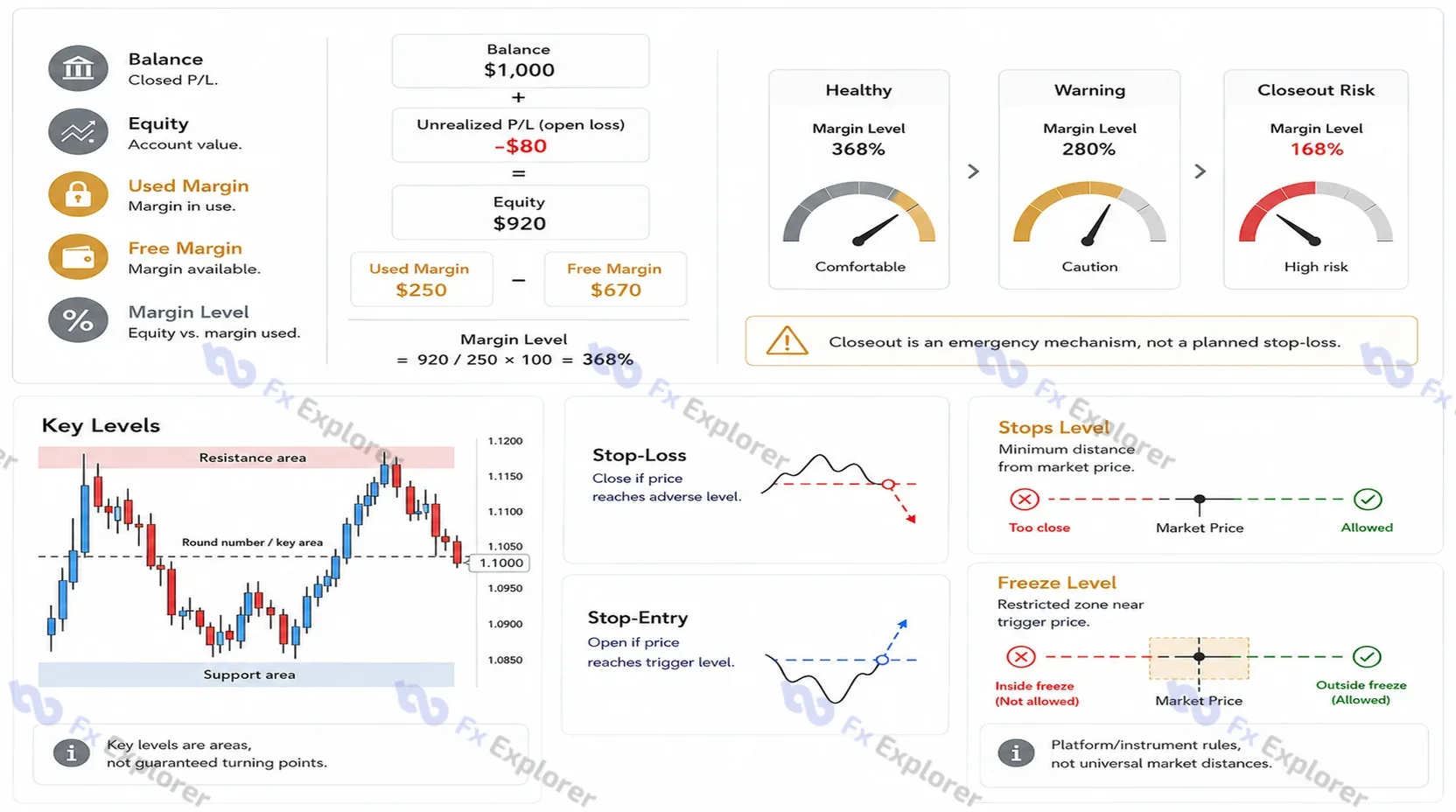
Balance is the account value after closed profits, losses, deposits and withdrawals have been recorded. Equity adds the unrealized result of open positions to the balance. A profitable open trade raises equity; a losing open trade reduces it.
Margin is the amount of equity reserved to support an open position. It is not a trading fee and it is not necessarily the maximum possible loss. Used margin is already committed, while free margin is the amount still available to absorb losses or support additional exposure. Margin level compares equity with used margin and may fall as open losses grow.
A margin warning or automatic closeout can occur when equity falls toward an account-defined threshold. Closeout is an emergency mechanism, not a substitute for a planned stop-loss.
Key Levels, Stops Level and Freeze Level
Key levels are price areas that may attract attention because the market has reacted there before or because many participants are likely to be watching them. They can include support and resistance zones, recent swing highs and lows, previous session highs and lows, round numbers and breakout or retest areas.
A key level should be treated as an area rather than a guaranteed turning point. Price can reverse, pause, break through or move unpredictably around it.
A stop-loss is an instruction intended to close an existing position when price reaches a defined adverse level. A stop-entry order is different: it attempts to open a new position after price reaches a specified level.
Some platforms also define a stops level, which is the minimum permitted distance between the current market price and certain pending orders, stop-losses or take-profit levels. A freeze level is a distance inside which specified trade operations may be restricted, such as modifying or cancelling an order close to its trigger price. These are platform and instrument rules, not universal market distances.
How Beginners Read and Analyze the Forex Market
How to Read Forex Charts
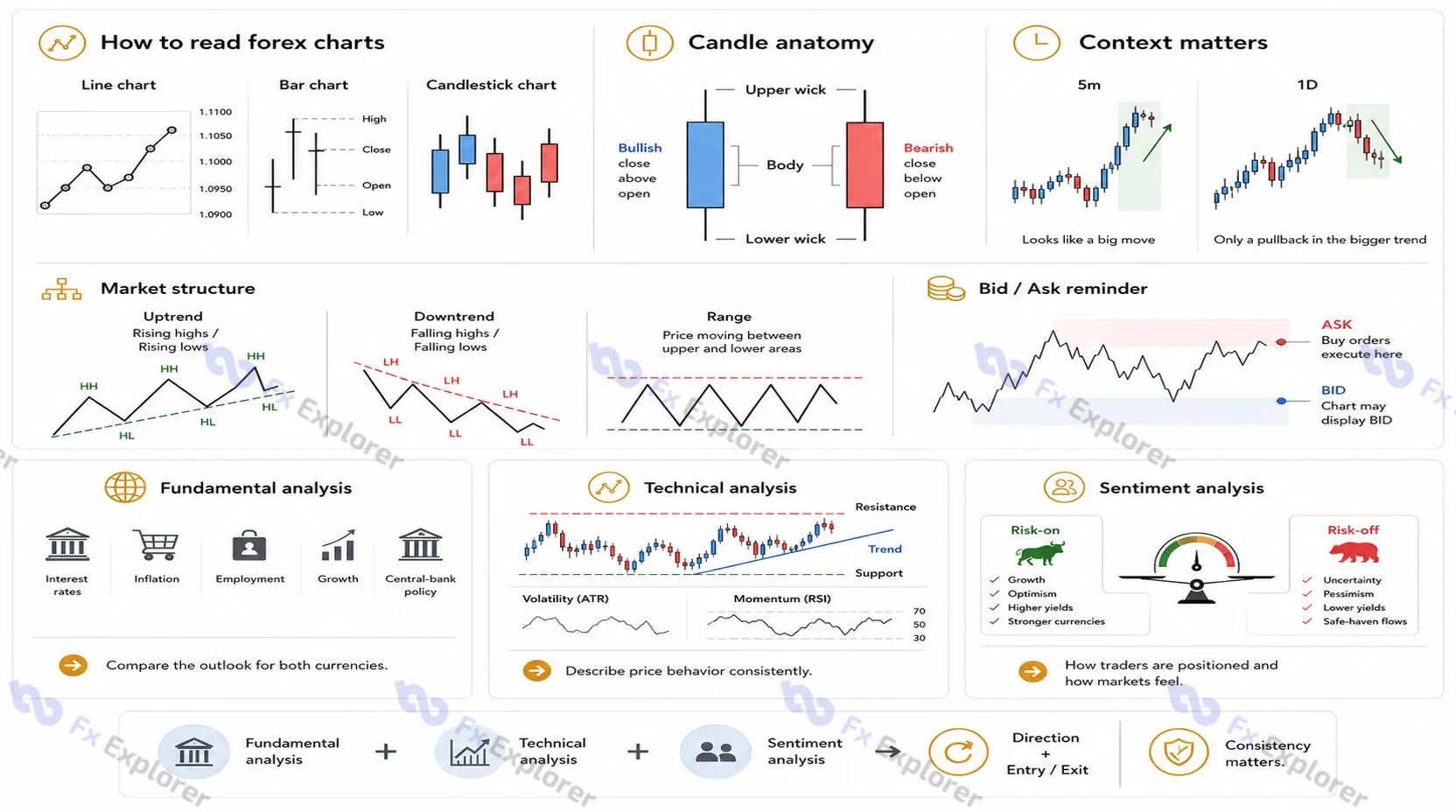
A forex chart shows how the price of a currency pair has changed over time. The horizontal axis represents time and the vertical axis represents price.
The selected timeframe determines what each bar or candle represents. A one-hour candle summarizes one hour of price activity, while a daily candle summarizes one trading day according to the platform’s settings. A move that looks significant on a five-minute chart may be only a small pullback on a daily chart, so context matters.
A line chart usually connects closing prices and provides a simple view of direction. A bar chart shows the open, high, low and close for each period. A candlestick chart displays the same information in a more visual form.
The candle body represents the distance between the opening and closing prices. The upper wick shows the highest price reached during the period, and the lower wick shows the lowest. A bullish candle closes above its opening price; a bearish candle closes below it.
Beginners should avoid treating one candle as a complete signal. A candle becomes meaningful only in relation to the surrounding trend, volatility and nearby levels.
An uptrend generally forms rising swing highs and rising swing lows. A downtrend generally forms falling swing highs and falling swing lows. A range forms when price repeatedly moves between upper and lower areas without maintaining a clear direction.
Many retail charts display the bid price by default, while buy orders execute at the ask. This can make an order appear to trigger before the visible chart reaches the selected level. Understanding which price is displayed and which price activates each order prevents unnecessary confusion.
Fundamental Analysis
Fundamental analysis examines economic and policy factors such as inflation, interest rates, employment, economic growth and central-bank decisions. A fundamental trader compares the likely outlook for both currencies in the pair rather than judging one economy in isolation.
Technical Analysis
Technical analysis studies price behavior. It can include trends, support and resistance, chart structure, volatility, momentum and indicators. Technical tools do not predict the future with certainty; they provide a consistent way to describe current and historical price action.
Sentiment Analysis
Sentiment analysis considers how traders and investors are positioned and whether the market is generally seeking or avoiding risk. The same economic release can produce different reactions depending on existing expectations and crowd positioning.
A trader may combine these approaches. A broader economic view may determine the preferred direction, while chart structure helps define an entry and exit. The important requirement is consistency. Constantly changing the method after a few trades makes meaningful evaluation almost impossible.
Forex Trading Styles for Beginners
Trading style describes the typical holding period, frequency and pace of a method. Scalping, day trading, swing trading and position trading are not complete strategies by themselves. They are broad ways of organizing time and exposure.
Scalping involves holding positions for seconds or minutes and attempting to capture small movements. Because targets are usually modest, spreads, commissions, slippage and execution speed can have a large effect. Scalping can look simple because trades are brief, but its pace and cost sensitivity make it demanding.
Day trading generally means opening and closing positions within the same trading day. It reduces regular overnight exposure, but it still requires careful control of intraday news risk, spread changes and decision fatigue.
Swing trading aims to capture movements lasting several days or weeks. Swing traders often use wider stops and place fewer trades, but they accept overnight financing, gaps and unexpected news while the position is open.
Position trading uses a longer horizon, sometimes weeks or months. Decisions may be based on major economic themes or long-term trends. The wider stops and longer holding periods can require more capital and greater tolerance for temporary adverse movement.
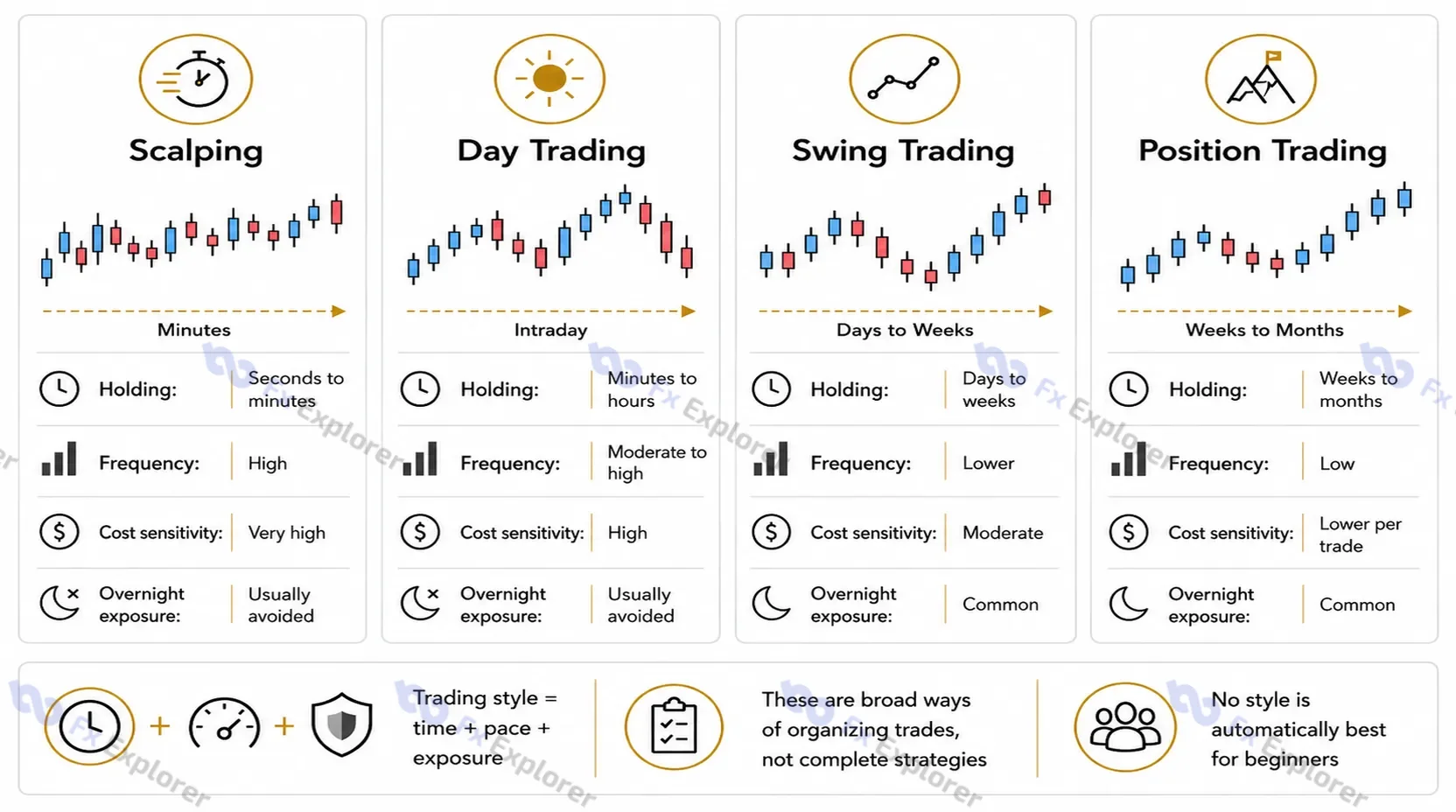
No style is automatically best for beginners. A suitable choice depends on available time, account size, cost sensitivity, emotional temperament and willingness to hold through overnight events. A beginner should understand the differences before choosing one general approach, but should not attempt to learn several complete systems at once.
How Forex Orders Work
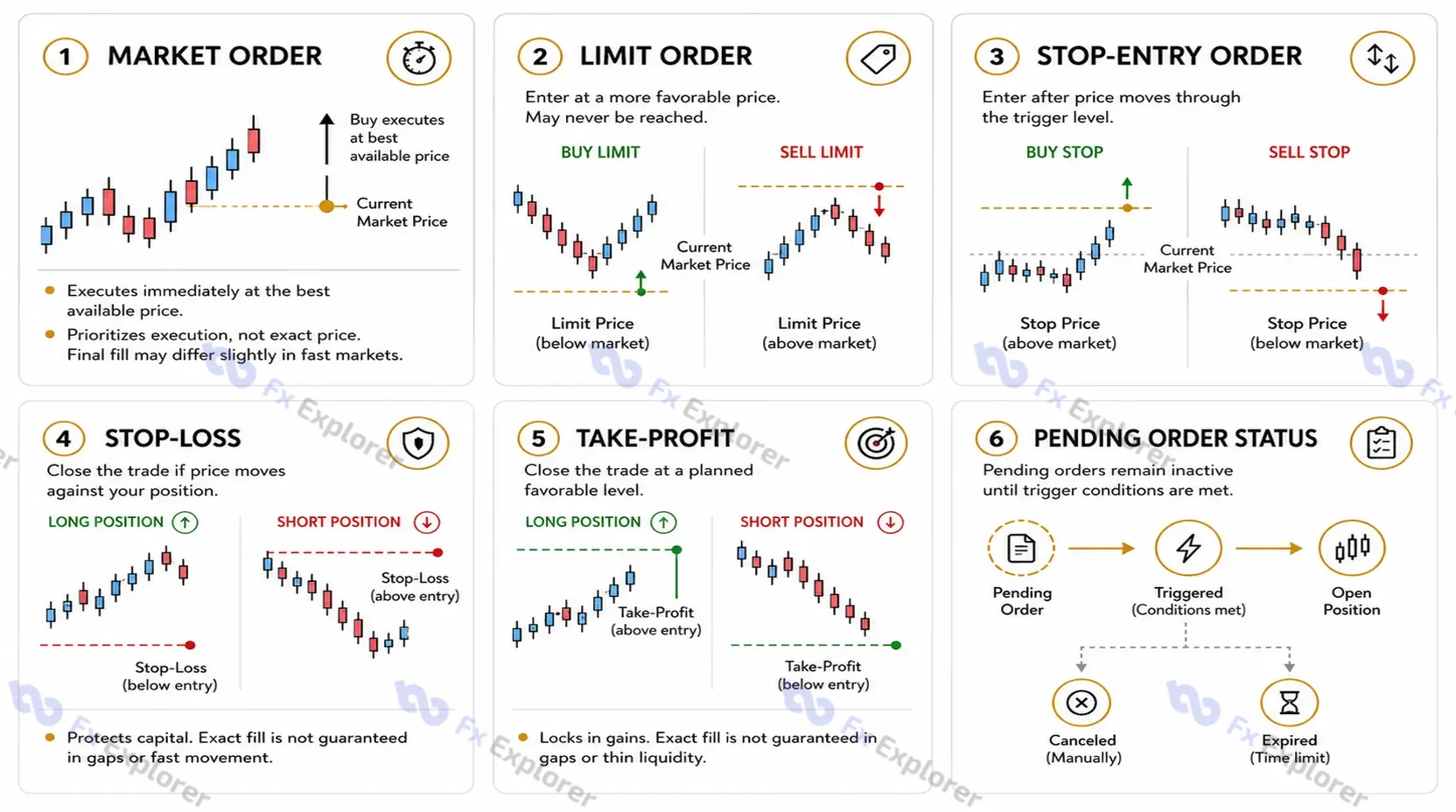
Orders tell the platform when and how to open or close a position.
A market order requests immediate execution at the best available price. It prioritizes execution, not price certainty, so the final fill may differ from the displayed quote during fast movement.
A limit order attempts to enter at a more favorable price than the current market. A buy limit is normally placed below the current price, while a sell limit is placed above it. The market may never reach the order.
A stop-entry order attempts to enter after price moves through a specified level. A buy stop is usually placed above the market and a sell stop below it. It is often used when the trader wants confirmation that price has moved beyond a chosen area, although the move can still reverse after entry.
A stop-loss attempts to close an existing trade when price moves against it. A take-profit order attempts to close the trade at a favorable level. Neither guarantees the exact execution price during gaps, rapid movement or thin liquidity.
A pending order remains inactive until its trigger conditions are met. Depending on the platform, it may stay open until triggered, cancelled or expired.
Reading the Order Ticket
A typical order ticket shows the currency pair, buy or sell direction, volume, order type, entry price, stop-loss, take-profit and estimated margin. Some platforms also estimate the cash result at the stop and target.
Before submitting an order, the trader should confirm the pair, direction and position size first. A volume error can create exposure many times larger than intended. The stop and target should then be checked against the plan, followed by the estimated cash risk, required margin and any approaching economic event.
An order can be rejected when the market is closed, the volume is outside the allowed range, the size does not match the permitted increment, free margin is insufficient, the stop is too close to the current price, the order is being modified inside the freeze level or the requested price is no longer available. Repeatedly resubmitting an order without understanding the rejection can produce an unintended entry at a worse price.
Leverage, Margin, Position Size and Risk
Leverage allows a trader to control a position whose notional value is larger than the cash reserved as margin. It makes trading accessible, but it can also make excessive exposure appear affordable.
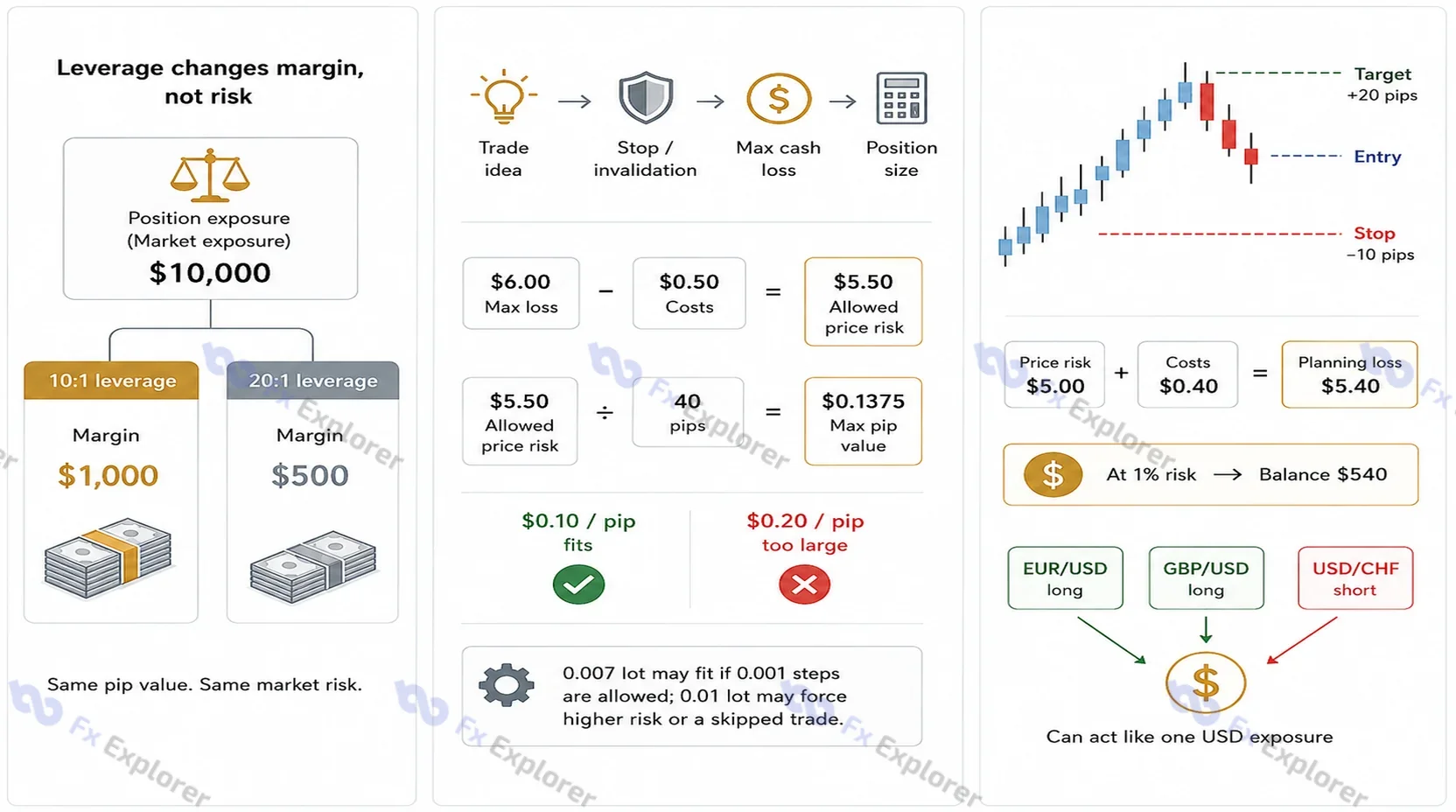
Suppose a position has a notional value of $10,000. At 10:1 leverage, the approximate margin requirement may be $1,000. At 20:1 leverage, it may be $500. The second account uses less margin, but the position still gains or loses the same amount for each pip of movement.
Leverage therefore changes the collateral needed to open the position. It does not change the pip value of that position or make the market risk smaller.
Position Size Should Come After the Stop
A common mistake is choosing a preferred lot size first and then placing the stop according to how much that position can lose. The better sequence is to define the trade idea, decide where it becomes invalid, measure the stop distance, choose the maximum cash loss and calculate the position size that fits that limit.
A practical calculation is:
Suppose the maximum planned loss is $6, estimated costs are $0.50 and the stop is 40 pips away. The allowed price risk is $5.50. Dividing $5.50 by 40 pips produces a maximum pip value of $0.1375. A position worth $0.10 per pip would fit the plan, while a position worth $0.20 per pip would not.
Volume increments also matter. If the calculated size is 0.007 lot, an account that allows 0.001-lot steps may accept it. An account that only permits 0.01-lot steps would force the trader either to exceed the intended risk or skip the trade.
Stops, Targets and Risk-to-Reward
The stop should reflect the point where the trade idea is no longer valid. It may be placed beyond a recent swing, a support or resistance area, a volatility-based distance or another method-defined boundary. Placing a stop too close can expose the trade to ordinary market noise, while moving it farther away after entry increases the loss beyond the original plan.
A target may be based on a previous swing, a key level, a measured objective, a trailing rule or changing market conditions. If a trade risks $10 and has a potential gain of $20, its planned reward-to-risk ratio is 2:1.
A favorable ratio does not guarantee profitability. Results depend on the interaction between win rate, average win, average loss, trading costs and consistency of execution.
Strategies without a visible stop order still need a defined loss boundary. A discretionary, volatility-based or time-based exit should specify the maximum acceptable cash loss or the level at which the trade must be closed. Without that boundary, risk-based position sizing cannot be calculated reliably.
Planning Loss and Portfolio Risk
The amount at risk should include more than the price distance to the stop. A practical planning loss combines price risk, expected spread and commission, and a reasonable execution allowance.
Suppose a trade has $5 of price risk, $0.30 of expected spread and commission, and $0.10 of possible slippage. The planning loss is $5.40. If the account risks 1% per trade, the corresponding risk-based balance is $540.
Risk also needs to be considered across all open positions. A long EUR/USD trade, a long GBP/USD trade and a short USD/CHF trade can all express a similar view on the US dollar. They may look like separate positions but behave like one concentrated exposure during a major dollar move.
Trading Costs, Slippage and Event Risk
A trade can move in the expected direction and still produce a disappointing result after costs. The complete economic round trip may include the spread, opening and closing commission, slippage, overnight financing and currency conversion.
Spread-only pricing is not automatically cheaper than a structure combining tighter spreads with commission. The relevant comparison is the total expected cost for the chosen position size, trading frequency and holding period.
Costs are especially important for very small targets and frequent trading. If a trade has $4 of price risk and $1 of total costs, expenses equal 25% of the price risk. If another trade has $40 of price risk and the same $1 cost, the ratio is only 2.5%. The second trade is not automatically safer, but the example shows why costs can weigh heavily on tight-stop methods.
Spreads can widen around major economic announcements, market openings, abrupt volatility, thin liquidity and the daily rollover period. Slippage occurs when an order executes at a different price from the one requested or expected. It can be favorable, but risk planning should assume that adverse slippage is possible.
Positions held beyond the daily cutoff may incur overnight financing. The amount depends on the pair, direction, product structure and prevailing interest-rate conditions. Swing and position traders should include this cost in their planning rather than treating it as an afterthought.
Before opening a trade, the beginner should check whether a major announcement affects either currency in the pair. If the plan does not specifically cover news trading, remaining flat during the event can be a valid decision. Wider spreads and faster movement can turn an otherwise reasonable setup into a poorly controlled trade.
A Complete Forex Trade Example
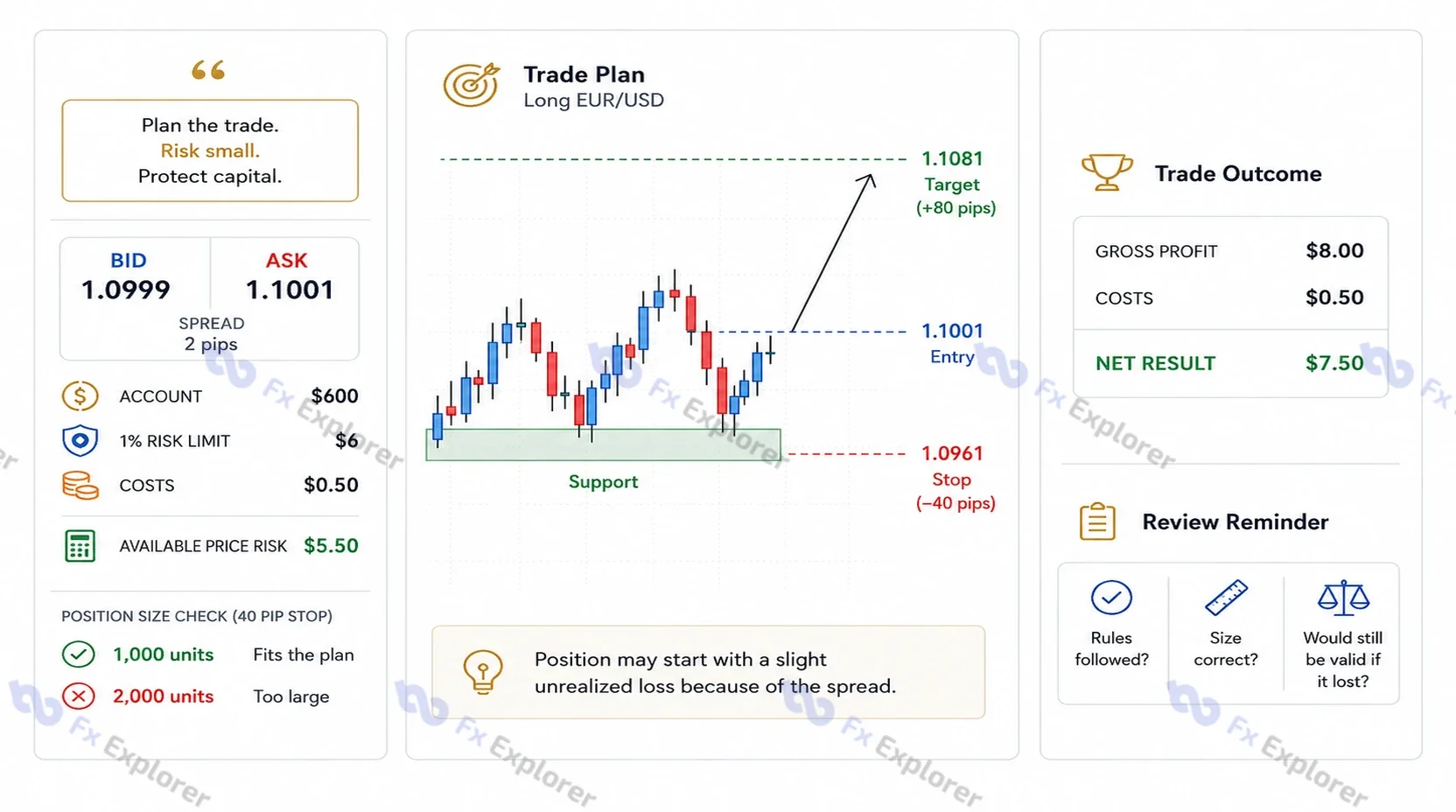
Assume a trader is considering a long EUR/USD position. The bid is 1.0999 and the ask is 1.1001, creating a two-pip spread. The trader believes price may rise after holding above a support area, but the idea is considered invalid if price falls 40 pips below the intended entry.
The account contains $600, and the trader limits the planning loss to 1%, or $6. Expected spread, commission and slippage total $0.50, leaving $5.50 available for price risk.
At roughly $0.10 per pip, a 1,000-unit position would risk about $4 over 40 pips. Including costs, the planning loss would be approximately $4.50, which remains within the $6 limit. A 2,000-unit position would risk about $8 before costs and would therefore be too large.
The trader places a limit order near the planned entry, adds the stop at the invalidation level and sets a target 80 pips above the entry. Before submitting the order, the pair, direction, volume, stop, target, cash risk, margin and economic calendar are checked.
After entry, the position may show a small immediate loss because of the spread. The trader follows the original plan rather than widening the stop in response to normal price movement.
Suppose the position eventually closes with a gross profit of $8 while total costs equal $0.50. The net result is $7.50. The review then focuses on whether the setup met the written rules, whether the position size was correct and whether the same process would still be acceptable if the trade had lost.
How Much Money Do Beginners Need to Trade Forex?
There is no universal starting amount. The required balance depends on the minimum position size, normal stop distance, pip value, trading costs, margin requirement, risk percentage and number of simultaneous positions.
A provider’s minimum deposit only shows the amount needed to fund the account. It does not show whether the account can size trades sensibly. A balance can meet the margin requirement and still be too small for the minimum position to stay within a reasonable risk limit.
Suppose the smallest practical trade creates a $6 planning loss. At a 1% risk limit, the risk-based balance is $600. At 2%, it is $300. The lower balance does not make the trade cheaper; it makes the same loss a larger percentage of the account.
A practical working balance should support ordinary stop distances, realistic costs, accurate position sizing, adequate free margin and a reserve for drawdowns. A small account can still be useful for learning live execution when nano-sized positions are available, but it should not be expected to produce substantial income without excessive risk.
The difference between learning capital and income capital is important. Two percent of $100 is $2, while two percent of $10,000 is $200. Trying to force a small account to generate large cash returns usually means taking exposure that the account cannot survive.
How to Start Trading Forex for Beginners
A sensible forex starter guide should lead from education to controlled practice rather than from account opening directly to live speculation.
1. Learn the Market Mechanics
Start with currency pairs, bid and ask prices, spreads, pips, lots, pip value, leverage, margin and order types. A beginner should be able to explain how a trade makes or loses money before considering a strategy.
2. Choose One General Trading Style
Select a time horizon that suits your schedule and temperament. The aim is not to find a perfect style, but to avoid mixing scalping, day trading and swing trading rules inside the same position.
3. Learn One Clear Trade Process
Define what creates a valid setup, where the idea becomes invalid, how the stop is placed, how position size is calculated and how the trade is exited. The rules should be specific enough to distinguish a planned trade from an impulse.
4. Backtest and Forward Test
Backtesting applies the rules to historical data. Forward testing applies them to new market data as it unfolds. Both help reveal whether the method is clear, practical and sensitive to changing conditions.
Testing can mislead when losing examples are omitted, costs are ignored or rules are repeatedly adjusted to fit the past. The purpose is not to manufacture an attractive result but to understand how the process behaves across wins, losses and different market environments.
5. Practice on a Demo Account
Demo trading should be used to learn platform operation and decision discipline. The trader should be able to enter and close orders without mistakes, calculate position size before entry, place stops and targets correctly, monitor equity and margin, record costs and follow the same written rules on every trade.
Simulated trading does not fully reproduce emotional pressure, all forms of slippage or every liquidity condition. It is still the safest place to correct operational mistakes.
6. Review Readiness, Not Only Profit
A profitable demo period does not automatically prove readiness. More useful measures are whether orders were entered correctly, risk was calculated in advance, rules were followed and losses were accepted without increasing exposure impulsively.
7. Begin Live With the Smallest Practical Exposure
When moving to live trading, use capital that is affordable to lose and the smallest position that allows the plan to be followed. The first objective is to test real execution and emotional discipline, not to produce meaningful income.
Build a Trading Plan and Measure Results
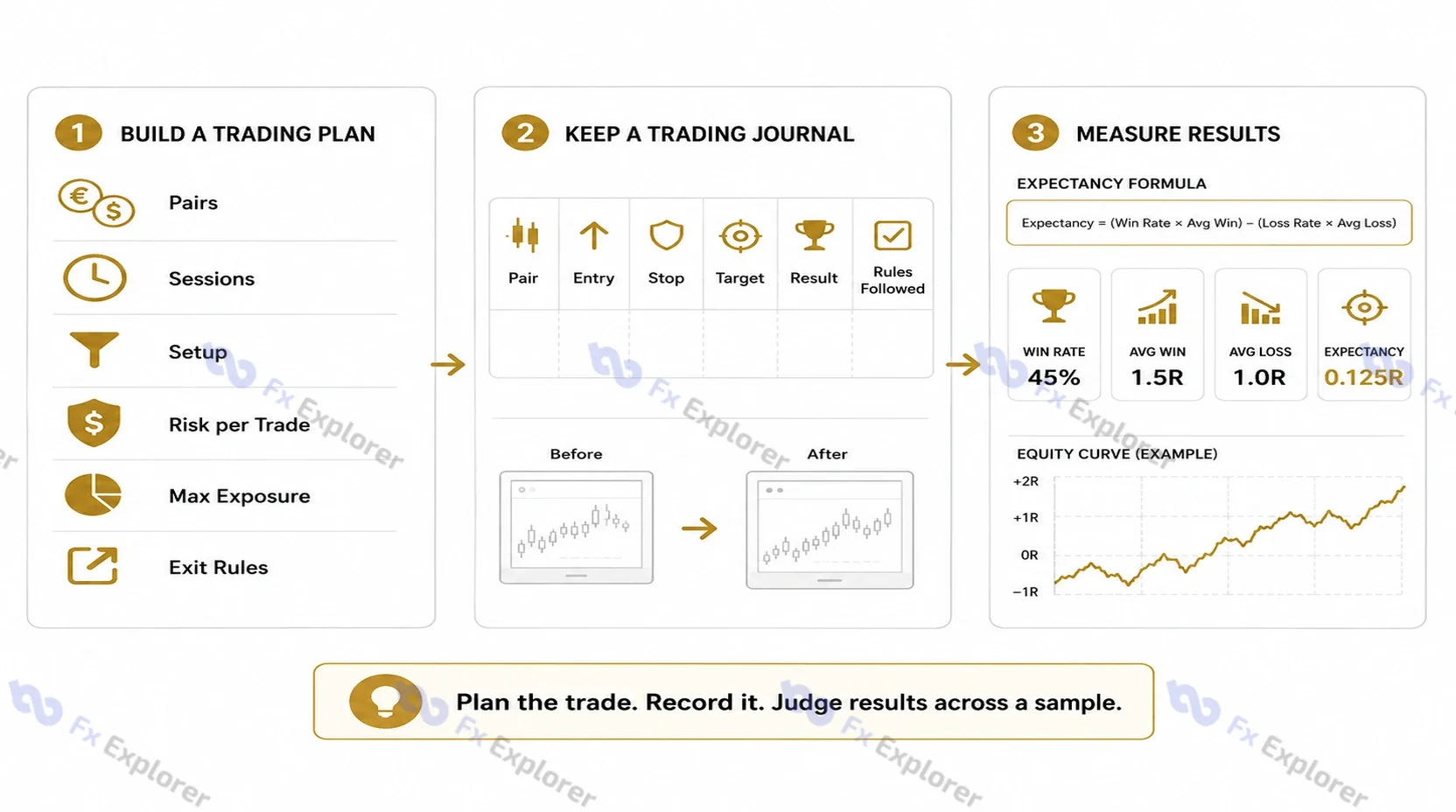
A trading plan turns general knowledge into specific decisions. It should define the currency pairs that may be traded, the permitted sessions, the selected trading style, the setup conditions, the invalidation rule, the position-sizing method, the maximum risk per trade, the maximum combined exposure and the treatment of major news events.
The plan should also explain how trades are exited. A day trade should not become an unplanned swing trade simply because it is losing. If the method uses a time-based exit, trailing stop or changing market condition, that rule should be written before the position is opened.
A trading journal supports the plan. Useful records include the pair, direction, entry, stop, target, position size, planned cash risk, expected costs, actual result and whether the rules were followed. Screenshots taken before entry and after exit can reveal mistakes that are difficult to remember later.
Performance should be judged across a series of trades. Win rate alone is not enough. A method can win frequently and still lose money when the average loss is much larger than the average win.
A simple expectancy calculation is:
Suppose a method wins 45% of the time, gains an average of 1.5 units of risk on winning trades and loses 1 unit on losing trades. Its expectancy before additional costs is 0.125 units of risk per trade. This is an average across a large sample, not a promise for the next trade.
Drawdown also matters. Even a method with positive historical expectancy can experience several consecutive losses or a long flat period. Position size must be small enough for the account and the trader to survive those periods without abandoning the process.
Common Forex Mistakes and When to Stay Out of the Market
The most damaging beginner errors usually involve risk and decision-making rather than chart knowledge.
Using the maximum leverage available is one of the clearest examples. A platform may allow a large position, but that does not mean the account can support its normal price movement. Maximum leverage is an account limit, not a recommended position size.
Other common mistakes include underestimating spread and financing, moving a stop after the original idea has failed, increasing risk to recover a loss, copying trades without understanding them and opening several positions that all depend on the same currency move.
Constantly changing methods also prevents meaningful evaluation. A strategy cannot be judged from a handful of trades, especially when the rules change after every loss.
Not placing a trade is a valid risk decision. A beginner should stand aside when the setup does not meet the written rules, the invalidation point cannot be identified, the smallest available position exceeds the risk limit or the spread is unusually wide.
It can also be sensible to avoid a trade when a major announcement is approaching, several open positions already create similar exposure, available margin is too low or the platform appears unstable.
The trader’s condition matters as well. Fatigue, distraction, frustration and the urge to recover a loss quickly can weaken judgment. Waiting is not a missed opportunity when the alternative is a trade that cannot be explained or controlled.
How to Choose a Forex Broker and Avoid Scams
A beginner should not choose an account based only on a low minimum deposit, high leverage or a narrow advertised spread.
Account and Product Checks
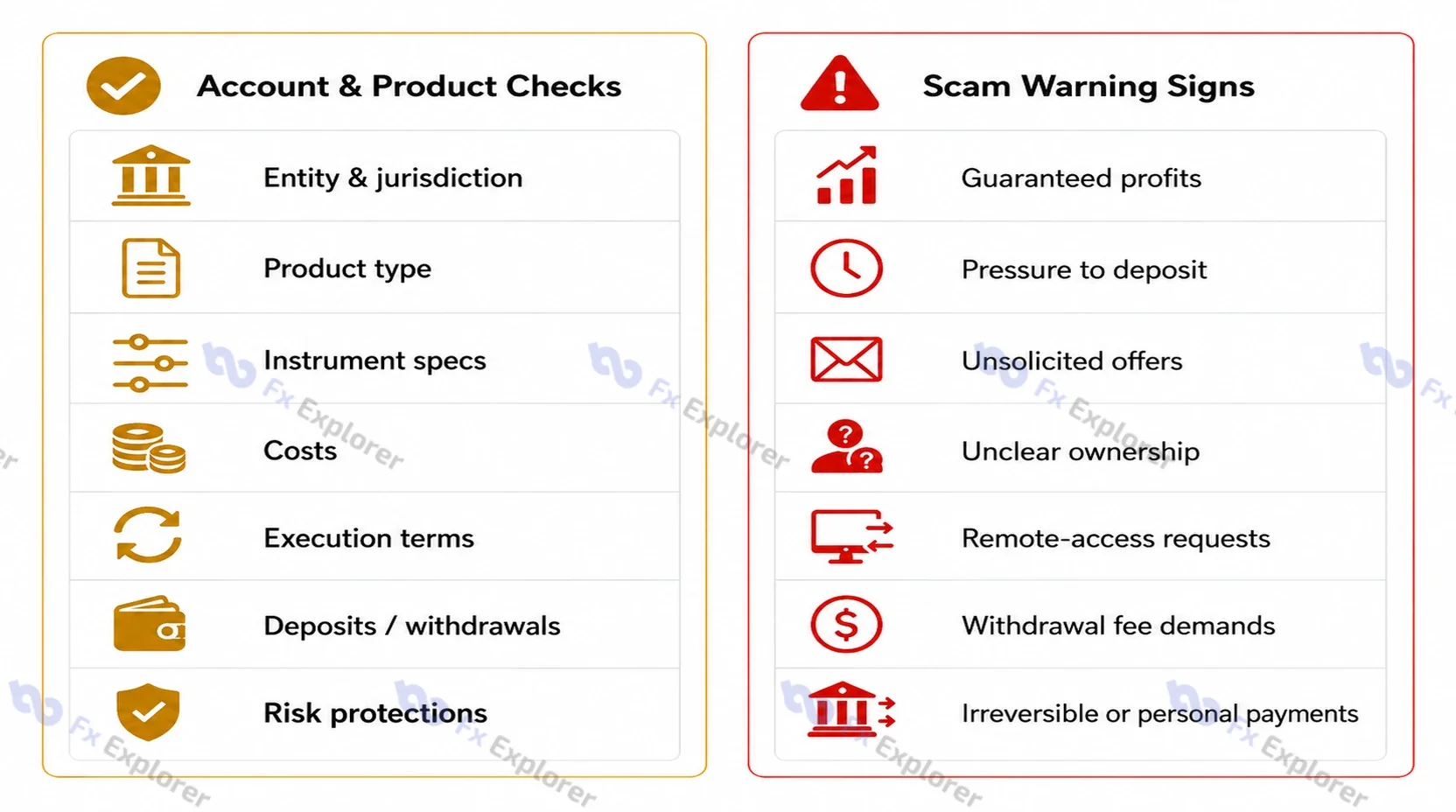
The legal entity and jurisdiction should be clear. A brand may operate through several entities with different products, rules and account protections. The exact product structure should also be understood, including whether the account provides rolling forex, a contract for difference, a future or another currency-linked instrument.
These differences are practical, not merely legal. Maximum leverage, margin closeout rules, negative-balance terms, available order types, financing, client-money arrangements and complaint procedures can vary by product, entity and country. Instructions written for one account should not be assumed to apply to another.
The instrument specifications should show the contract size, minimum and maximum volume, permitted volume increment, margin requirement, trading hours, stops level, freeze level and available order types. Cost information should cover typical and variable spreads, commission, overnight financing and currency conversion.
Execution terms deserve equal attention. The trader should understand how market orders, stop orders and gaps are handled, whether requotes are possible and under what conditions an order may be rejected. Deposit and withdrawal procedures should also be transparent, including verification requirements, processing times and possible charges.
No account feature removes the need to manage risk. Regulation, account protections and negative-balance terms can reduce some forms of harm, but they cannot make an oversized trade safe.
Forex Scam Warning Signs
Forex-related scams often target inexperienced traders with promises of easy income or special access. Treat the following as serious warning signs:
- guaranteed profits, risk-free trading or unusually high fixed returns;
- pressure to deposit immediately or increase the account after a loss;
- unsolicited messages offering managed accounts, secret systems or guaranteed signals;
- unclear company ownership, an unverifiable legal entity or inconsistent contact details;
- requests for remote access to a computer, trading platform or banking application;
- withdrawal delays followed by demands for extra tax, insurance or release payments;
- instructions to send money through difficult-to-reverse methods or to a person rather than the stated account provider.
A legitimate trading arrangement does not require belief in guaranteed results. The legal entity, account terms, payment instructions and withdrawal procedure should be verified before any deposit is made.
Advantages and Risks of Forex Trading
Forex trading appeals to beginners because major pairs can be liquid, the market operates across the working week, long and short positions are available and some accounts support small trade sizes. The technical barrier to opening a platform and placing an order is also relatively low.
Those advantages come with important limitations. Leverage can magnify losses, spreads and slippage can change rapidly, overnight financing can reduce returns and currency prices respond to complex economic forces affecting two countries at once.
Stops may execute at worse prices during gaps or fast markets. Trading can also become psychologically demanding because every open position produces a visible, changing result. Understanding the terminology does not guarantee that a trader will follow the plan under pressure.
The possibility of loss is therefore not a minor warning attached to an otherwise predictable activity. It is a central feature of the market. Responsible beginner forex trading starts with the assumption that losing trades and drawdowns will occur.
First Forex Trade Checklist
Before submitting a first live order, confirm that every important decision can be explained in advance:
- You understand the trading product, currency pair and difference between the base and quote currencies.
- The buy or sell direction matches the written trade idea.
- The bid, ask, spread and likely round-trip costs have been checked.
- The chart timeframe, key level and reason for entry are clear.
- The invalidation point and stop distance are defined before the position size is chosen.
- Pip value, planned cash loss and position size fit the account’s risk limit.
- The selected order type, entry, stop and target are correct and comply with platform distance rules.
- Sufficient free margin remains after the position is opened.
- Upcoming economic events and existing correlated positions have been considered.
- The trade will be recorded and reviewed whether it wins or loses.
If any of these checks cannot be completed, the trade is not ready to be placed.
Building a Responsible Forex Trading Foundation
Trading forex for beginners should be approached as a structured learning process. First understand currency pairs, quotes, pips, lots, charts and orders. Then learn how leverage, margin, costs and position size affect the cash result of a trade.
The next step is to define risk before entry, test one written process and practice it in a simulated environment. Live trading should begin only with affordable capital and the smallest practical exposure.
A beginner does not need to predict every market move. The more important skill is making each decision understandable, measurable and controlled. When the potential loss cannot be calculated or the trade cannot be explained clearly, the correct decision is not to place it.
FAQ
Is Forex Trading Suitable for Beginners?
Beginners can learn forex, but it is not suitable for anyone expecting guaranteed returns or immediate income. A suitable beginner has time to study, affordable risk capital and the discipline to practice before trading live.
Can a Beginner Start Forex Trading With $100?
A $100 account may be useful for limited live practice when very small positions are available. It can be restrictive when the minimum size is 0.01 lot because a normal stop may represent a large percentage of the account.
What Is the Best Currency Pair for a Beginner?
There is no universal best pair. Highly liquid major pairs often have narrower spreads and more consistent activity, but the suitable choice still depends on the trading session, stop distance, account currency and cost structure.
What Is the Best Forex Trading Style for Beginners?
The best fit depends on available time, temperament, cost sensitivity and willingness to hold positions overnight. Scalping is not automatically easier because trades are brief, and swing trading is not automatically safer because trades are less frequent.
Is Forex Trading Available 24 Hours a Day?
Forex operates across the working week as international sessions open and close. It is not normally open throughout the weekend, and liquidity varies by time of day.
Can a Forex Loss Exceed the Planned Stop?
Yes. Gaps, slippage and limited liquidity can cause the final exit to be worse than the requested stop price. A stop defines the intended exit level, not a guaranteed fill.
Can You Lose More Than Your Forex Deposit?
It depends on the product, account agreement, jurisdiction and available protections. Gaps or extreme movement can create losses beyond the intended amount. Some accounts limit the loss to available funds, while others may not provide the same protection.
Is Demo Trading the Same as Live Trading?
No. Demo trading is useful for learning orders, position sizing and platform operation, but it does not fully reproduce live emotions, all forms of slippage or every execution condition.
Is Forex Trading Investing or Speculation?
Leveraged retail forex trading is usually closer to speculation than long-term investing because the trader is taking a directional position in an exchange rate rather than acquiring a productive asset. Longer holding periods do not remove the leverage, financing and market risks involved.
How Long Does It Take to Learn Forex Trading?
Basic terminology can be learned relatively quickly. Building, testing and following a complete process can take much longer, and no amount of study guarantees profitability.
Can Forex Trading Provide a Reliable Income?
Forex does not provide guaranteed or stable income. Results vary, drawdowns occur and a small account cannot safely produce large cash returns without taking substantial risk.

Nella Spencer
Nella Spencer is a financial analyst and reviewer specializing in online brokers and trading platforms. Her work focuses on broker comparisons, pricing and fees, regulatory standards, and platform reliability. She helps readers understand complex financial services information through clear, structured, and practical analysis.