
Learn how much money you really need to start trading forex based on position size, stop-loss distance, trading costs, leverage, margin requirements, and risk per trade. This guide explains how to calculate a practical starting balance, compares common account sizes, and shows why a broker’s minimum deposit may not be enough for effective risk management.
You can open some forex accounts with a very small deposit. That does not mean the same amount is enough to trade in a controlled and repeatable way.
The practical question is not simply how much the account accepts. It is how much capital you need for the smallest valid trade to remain within your risk limit.
That amount depends on the minimum position available, the value of each pip, the distance to a realistic exit, the full cost of entering and closing the trade, and the percentage of account equity exposed to one loss.
Consider a USD-denominated account trading EUR/USD. A 0.01-lot position is worth approximately $0.10 per pip. A 50-pip stop creates about $5 of price risk. After allowing $0.40 for the spread, commission and possible slippage, the total planning loss becomes $5.40.
To keep that loss near 1% of the account, the balance would need to be approximately $540.
That does not make $540 a universal starting amount. An account permitting positions smaller than 0.01 lot could support the same stop with less capital. A method using wider stops, several simultaneous positions or a larger free-margin reserve could require much more.
Three numbers matter:
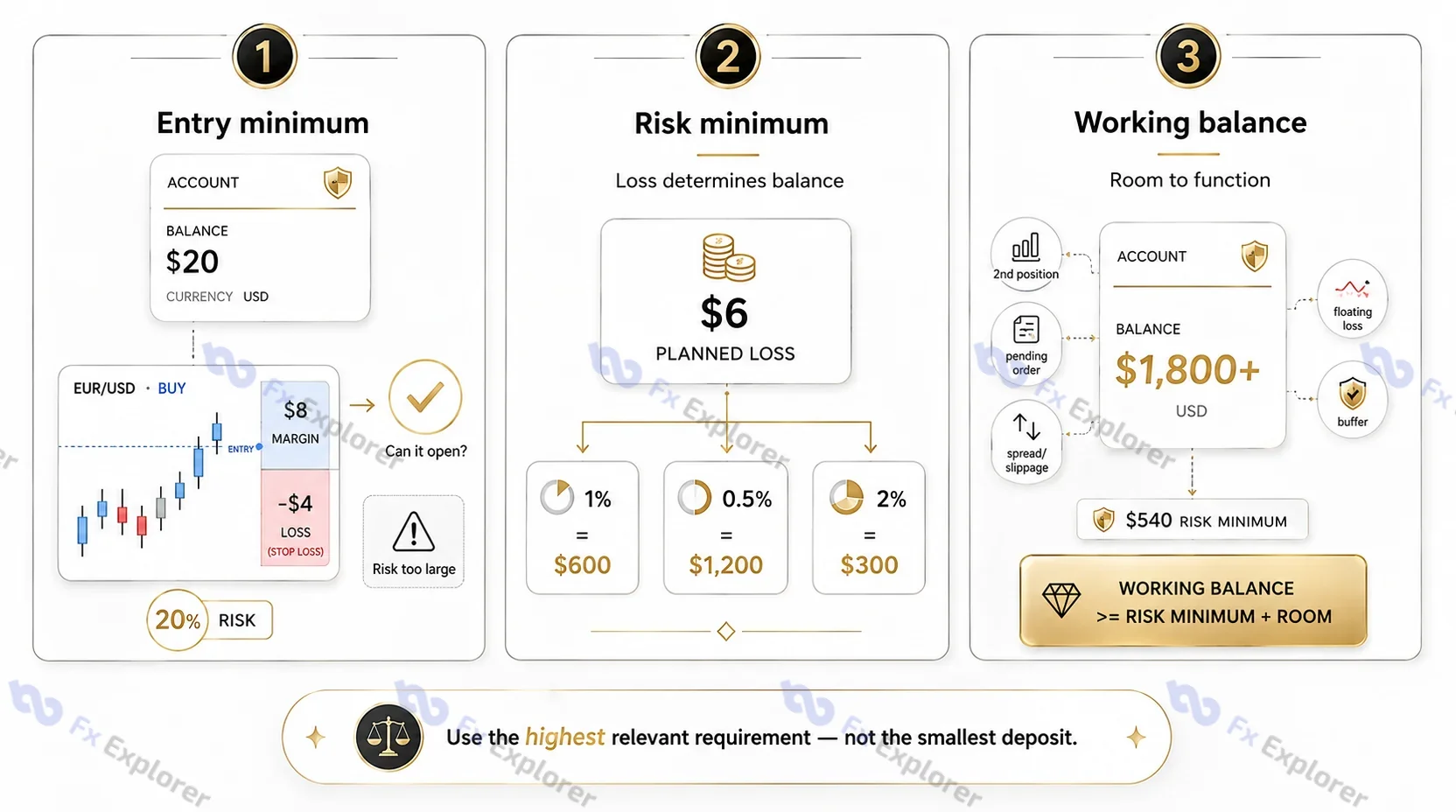
The entry minimum is the higher of the account's funding floor and the amount needed to cover initial margin and immediate costs.
The risk minimum is enough to keep the planning loss within the selected percentage-risk limit.
The working balance is enough to retain free margin, support the full trading plan and continue through normal losses.
A usable account must pass two tests. It must pass the risk gate, meaning the potential loss is proportionate to equity, and the margin gate, meaning enough free capital remains after the trade is opened.
Key Takeaways
- The amount needed to start trading forex is determined by the smallest valid trade and its potential loss, not simply by the minimum deposit an account accepts.
- Calculate the planning loss from position size, pip value, a realistic stop distance and the full expected cost of entering and exiting the trade. Divide that loss by the selected maximum risk percentage to estimate the risk minimum.
- Minimum position size and volume increments can set the practical capital floor. If the account cannot reduce the position enough, the correct response is not to tighten a valid stop or round the trade size upward.
- The account must pass both the risk gate and the margin gate. Higher leverage can reduce required margin, but it does not reduce pip value or the cash loss caused by an adverse price move.
- A realistic working balance should account for simultaneous positions, pending orders, correlated exposure, floating losses, changing costs and operating reserves. Use the higher applicable capital requirement rather than double-counting the same funds.
- There is no universal starting balance such as $100, $500 or $1,000. The appropriate amount depends on the actual account specifications, trading method and exposure the account must support, and it should never exceed capital the trader can genuinely afford to lose.
The Three Numbers Behind Your Forex Starting Balance
The word “minimum” is often used as though it refers to one figure. In practice, it can describe three very different capital requirements.
Entry minimum
The entry minimum is the higher of the account's minimum funding requirement and the amount needed to cover the intended position's margin and immediate costs.
An account may accept a deposit of $20 or $50. The position may also require only a small amount of initial margin. Those conditions establish that the trade is technically possible, but they do not show that the balance is adequate.
Suppose a $20 account can open a position using $8 of margin. If an ordinary stop would produce a $4 loss, one trade exposes 20% of the balance before additional costs. The account passes the entry test while failing any moderate percentage-risk test.
The entry minimum therefore answers one operational question: Can the position be opened?
It does not answer whether the position is sensibly sized.
Risk minimum
The risk minimum begins with the amount that could be lost at the planned exit.
Assume a trade would lose $6, including the cost of opening and closing it. If the loss is intended to represent no more than 1% of account equity, the balance must be approximately $600.
At a 0.5% limit, the same position requires about $1,200. At 2%, it requires about $300.
These percentages are examples, not universal recommendations. The appropriate limit depends on the trading method, expected losing sequences, total open exposure and the amount of loss the trader can tolerate.
The key point is that the risk minimum is connected to the potential loss, whereas the minimum deposit is not.
Working balance
A balance calculated from one isolated trade can still be too small for the way the account will actually be used.
The account may need to hold several positions, support pending orders, absorb floating losses, cover variable costs and remain well above its emergency closeout level. It must also continue functioning after losing trades reduce equity.
The working balance adds those practical demands.
Suppose the risk minimum for one setup is $540. Depositing exactly $540 may leave limited room for a second position, wider spreads or normal adverse movement before the stop is reached. A larger balance may be required even though the original trade already passes the risk test.
The correct starting amount is the highest relevant requirement, not simply the smallest deposit accepted.
How to Calculate How Much Money You Need to Trade Forex
The calculation starts with the planning loss.
Planning loss is the expected cash loss at a valid exit, including estimated trading costs. It should reflect the smallest position you can use without changing the intended setup.
The central formula is:
Planning loss includes the price movement to the exit plus the likely cost of completing the trade.
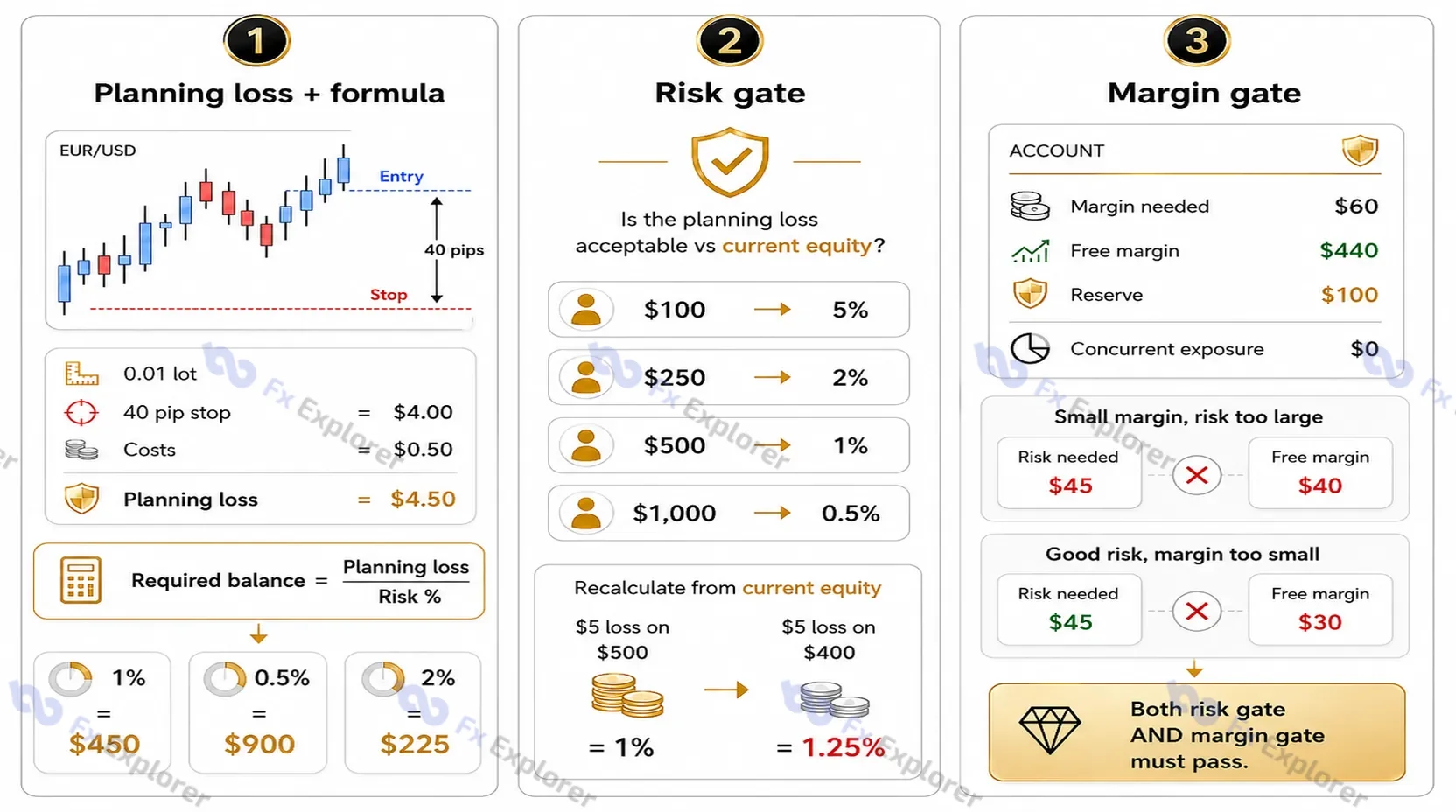
Take a 0.01-lot position worth approximately $0.10 per pip. A 40-pip stop produces $4 of price risk. If the spread, commission and expected slippage add another $0.50, the planning loss is $4.50.
At 1% risk, the balance requirement is $450. At 0.5%, it is $900. At 2%, it is $225.
The position has not changed. The required balance changes because the permitted percentage loss changes.
This is why fixed statements such as “You need $100” or “You must start with $1,000” are incomplete. They assume a particular position size, stop distance, cost structure and risk limit.
The risk gate
The risk gate asks whether the planning loss is acceptable relative to current equity.
A $5 planning loss equals 5% of a $100 account, 2% of a $250 account, 1% of a $500 account and 0.5% of a $1,000 account. The same position can therefore be aggressive in one account and conservative in another.
After trading begins, new positions should be calculated from current equity rather than the original deposit. Closed losses, floating losses and withdrawals change the percentage represented by the same cash risk.
A $5 loss is 1% of $500 but 1.25% of $400. Continuing to size positions from the original $500 deposit would understate the real risk after the drawdown.
The margin gate
Passing the risk gate is not enough. The position must also leave adequate free margin.
The margin gate asks whether the account can support the position, normal adverse movement, expected concurrent exposure and a practical operating reserve.
An account can pass one test and fail the other.
High leverage may make the required margin very small while the planning loss remains too large for the account. In another case, a carefully sized trade may pass the risk test but require more margin than the account can provide.
A practical starting balance passes both gates.
Quick Starting-Capital Calculation
Use the exact specifications of the account, platform and trading method rather than generic assumptions.
Minimum Position Size Sets the Capital Floor
The smallest permitted position often has more influence on starting capital than the advertised leverage.
Forex positions are commonly expressed in lots, although some accounts allow trades to be entered as individual currency units.
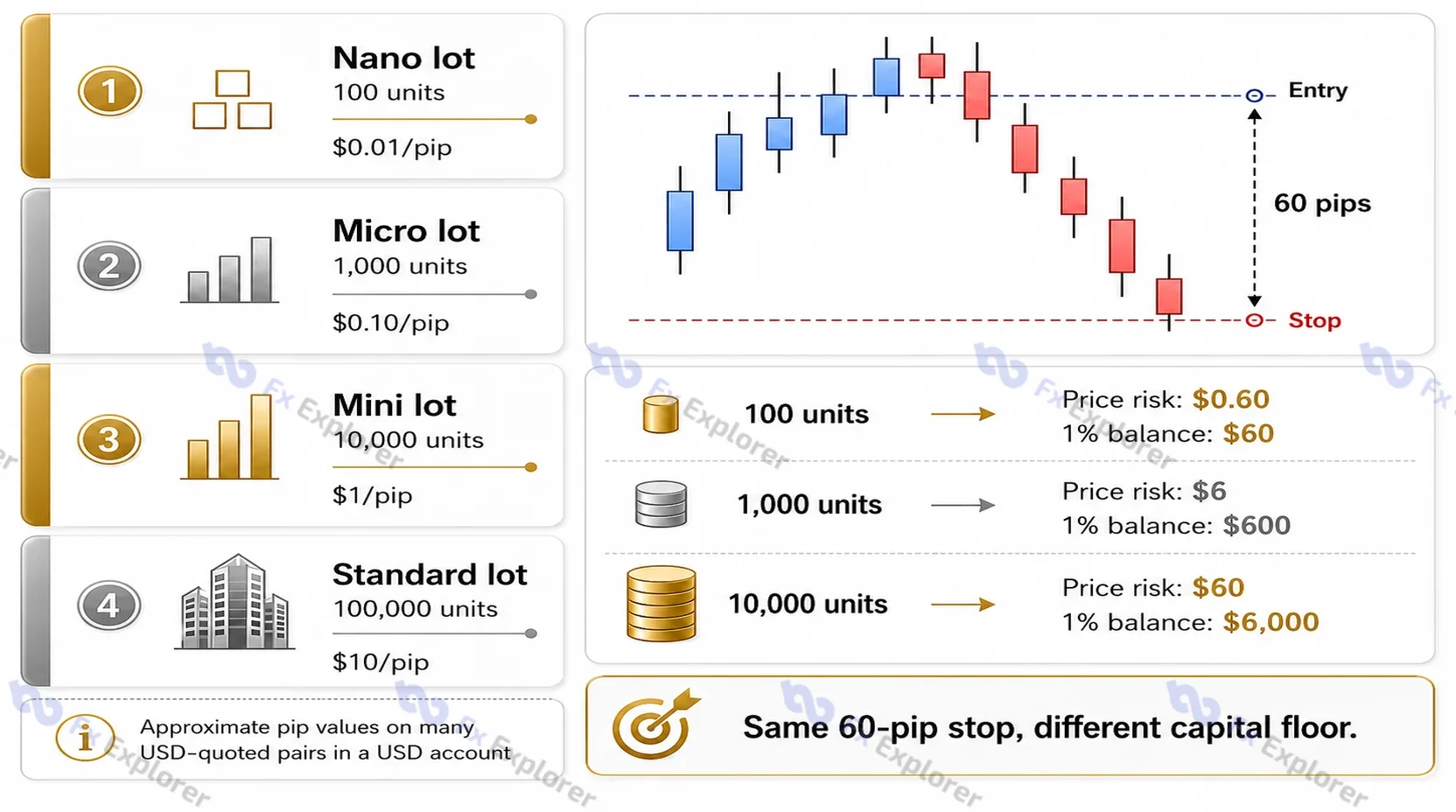
These pip values are approximations. They apply most directly when USD is both the account currency and the pair’s quote currency.
Consider a strategy using a 60-pip stop.
At 100 units, the price risk is approximately $0.60. At 1,000 units, it is about $6. At 10,000 units, it is approximately $60.
At a 1% risk limit, those losses imply balances of roughly $60, $600 and $6,000 before costs.
The stop and strategy are identical. The capital requirement changes because the smallest available position changes.
This explains why a $100 account may be usable for controlled testing on one platform but impractical on another. The first may permit trades of a few hundred units. The second may require at least 0.01 lot, or 1,000 units.
Volume increments affect sizing precision
The minimum trade sets the smallest position. The volume increment determines how precisely that position can be adjusted.
Suppose the calculated position is 0.0074 lot.
A platform permitting 0.001-lot increments may allow the trade to be placed at 0.007 lot after rounding down. A platform accepting only 0.01-lot increments offers no such precision. The choices are to place no trade or use 0.01 lot.
Increasing 0.0074 lot to 0.01 lot raises the position by more than 35%. The loss at the stop rises by the same proportion.
The position should normally be rounded down to the nearest permitted increment. Rounding upward changes the planning loss and invalidates the original calculation.
Standard, micro and cent accounts
Account labels are not standardized.
A standard account may allow micro-lot trading. A micro account may refer to smaller contract sizes, lower volume increments or simply a different pricing structure.
A cent account normally displays the balance in cents. A $100 deposit may appear as 10,000 cents. Some cent accounts also support smaller effective positions, which can improve risk control for limited balances.
The display does not increase the account’s value. Losing 1,000 cents still means losing $10.
Contract size, minimum position and volume increment matter more than the account name. The pricing model, margin rate and closeout terms must also be checked because they affect the final capital requirement.
Stop Distance, Currency Pair and Account Currency
Minimum position size establishes the cash value of each pip. Stop distance determines how many of those pips the account must be able to absorb.
A stop should reflect the point at which the trade setup is no longer valid. It should not be moved closer simply because the account cannot support the correct distance.
The following table assumes a 0.01-lot EUR/USD position in a USD account, an approximate pip value of $0.10 and estimated round-trip costs of $0.40.
The position is unchanged in every row. The wider stop raises the planning loss and therefore the required balance.
A $250 account may support the 20-pip example near a 1% risk limit. It cannot support the 50-pip example at the same percentage if 0.01 lot is the smallest position.
That does not make the wider stop incorrect. It means the position is too large for the balance.
The sensible options are to reduce the position, use finer volume increments, increase the available risk capital or decline the trade. Compressing every stop to fit the account changes the trading method and may place exits inside ordinary market movement.
Use a realistic upper-range stop
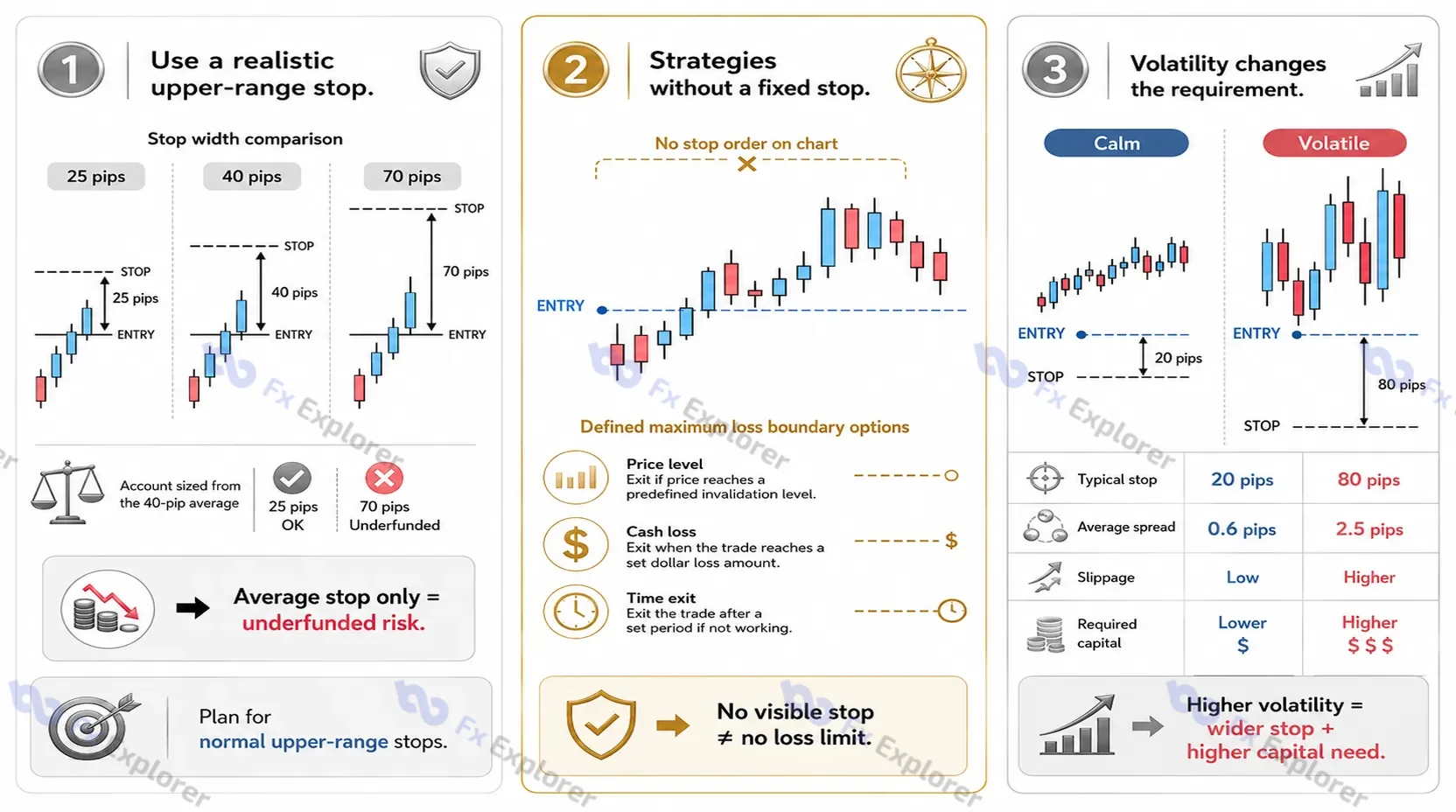
An account planned around the average stop can be underfunded for wider but still valid setups.
Assume a method normally uses stops between 25 and 70 pips, with an average of 40. Funding the account from the 40-pip average leaves it unable to size 60- or 70-pip trades at the same percentage risk.
A more robust calculation can use the widest normal stop in the strategy or a high percentile of historical stop distances. Different setup categories can also be calculated separately.
The purpose is not to prepare for every imaginable market move. It is to ensure that ordinary valid trades do not force the account beyond its sizing limits.
Strategies without a fixed stop
A visible stop order is not required for the strategy to have a defined loss boundary.
Discretionary, volatility-based and time-based exits still need a maximum planned-loss threshold. That threshold may be based on the level where the trade must be closed, the largest acceptable cash loss or a conservative adverse-movement estimate.
Without a defined exit or loss limit, a risk-based starting balance cannot be calculated reliably. The account may have sufficient margin to hold the position, but there is no clear way to determine whether the exposure is proportionate.
Volatility changes the requirement
Market conditions are not constant.
When volatility rises, technically valid stops may need to be wider. Spreads can expand, slippage may increase and fewer simultaneous positions may fit within the same risk limit.
A balance that appears adequate during quiet conditions can become restrictive when volatility returns to a more normal or elevated level.
Starting capital should therefore be tested against a realistic range of conditions rather than one unusually calm period.
Currency-pair differences
Pairs vary in pip value, spread, liquidity, volatility, financing and margin.
A liquid major pair may have a relatively narrow spread and consistent execution. A less liquid cross may cost more to enter and exit or require a wider stop because of its typical price movement.
A balance that supports one pair is not automatically sufficient for another, even when the nominal lot size is identical.
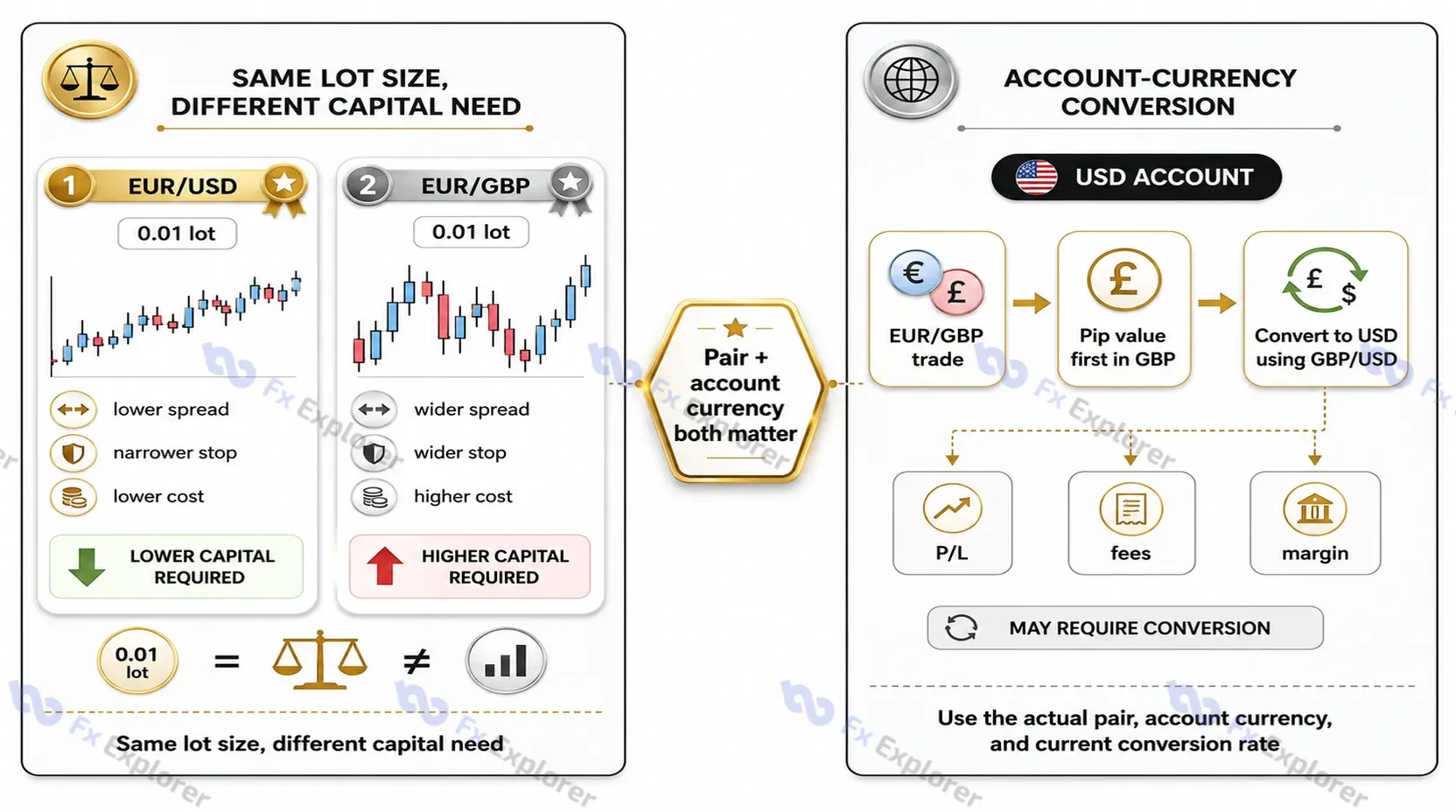
Account-currency conversion
Pip-value calculations are simplest when the account currency matches the pair’s quote currency.
In a USD account, a 0.01-lot EUR/USD position is worth approximately $0.10 per pip because USD is the quote currency.
For a pair such as EUR/GBP, the pip value is first expressed in GBP. A USD account must then convert that value into dollars using the relevant exchange rate. The result changes as that rate moves.
Profit, loss, fees and margin may also require conversion when they are denominated in another currency. Some account structures apply an additional conversion charge.
The effect may be small on one micro-lot trade, but it becomes more relevant with larger volume, frequent trading or significant currency movement. Final position sizing should therefore use the actual pair, account currency and current conversion rate.
Trading Costs Change the Required Balance
Price movement to the planned exit is only part of the possible loss.
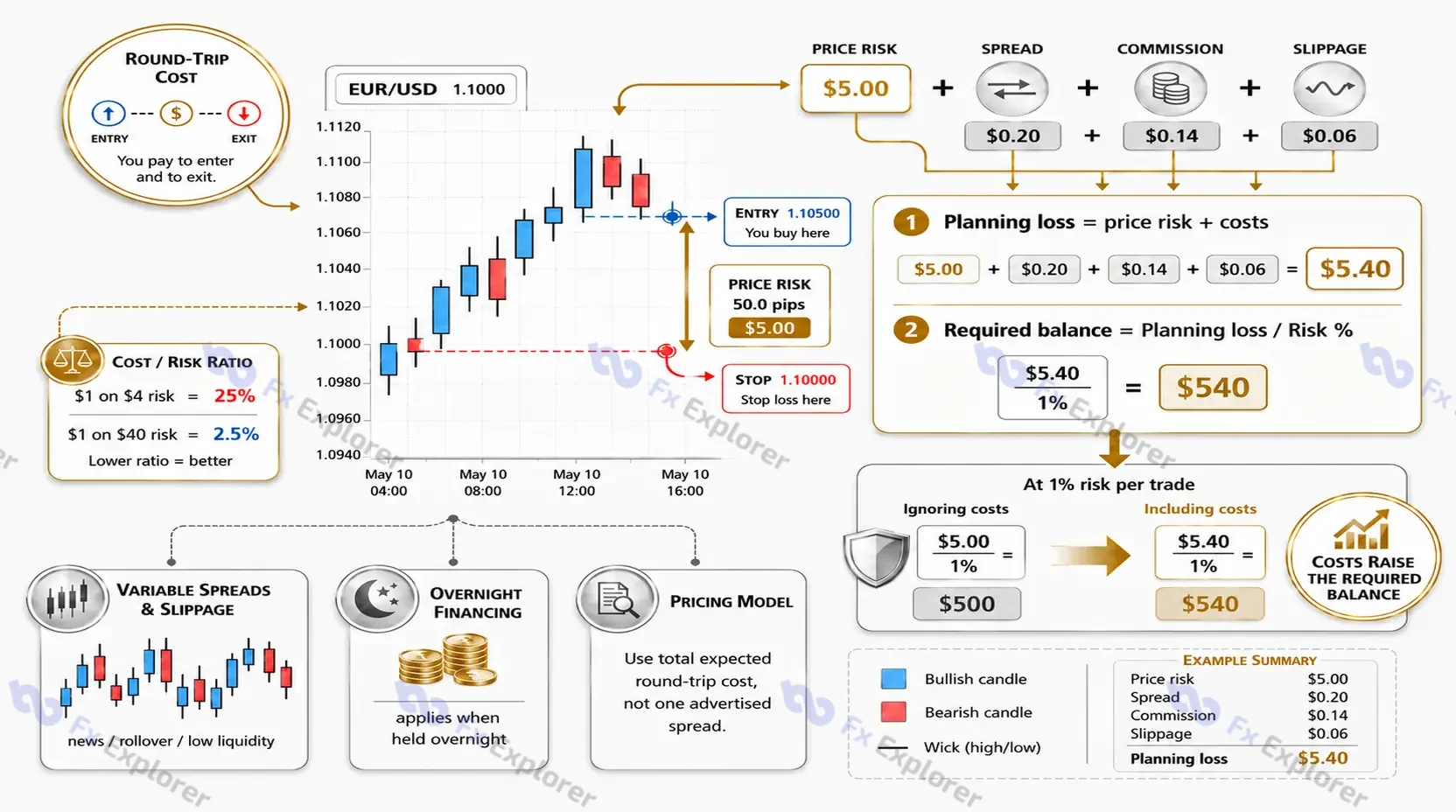
A complete calculation includes the economic cost of opening and closing the position. Depending on the account, this may include the spread, entry and exit commissions, slippage, overnight financing and currency conversion.
Omitting those costs understates the planning loss and the balance required to support it.
Count the complete round trip
Every completed trade has an entry and an exit.
On a spread-based account, much of the cost may be embedded in the difference between the bid and ask. On a commission-based account, a separate fee may be charged when the trade opens and again when it closes.
Take a position with $5 of price risk. Suppose the spread adds $0.20, the complete commission adds $0.14 and a modest slippage allowance adds $0.06.
The planning loss is $5.40 rather than $5.
At a 1% risk limit, the difference raises the required balance from $500 to $540. The dollar adjustment is small, but it matters when the account is funded close to its risk threshold.
Cost-to-risk ratio
Trading costs can also be compared with the amount exposed to price movement.
If a position has $4 of price risk and $1 of costs, expenses equal 25% of the price risk. The trade must overcome a relatively large cost before producing a net gain.
If another position has $40 of price risk and the same $1 cost, the cost-to-risk ratio is 2.5%.
The second trade is not automatically safer. The comparison shows why costs can weigh heavily on very small positions, tight-stop methods and frequent trading.
Variable spreads and slippage
The spread available in live conditions may be wider than the lowest figure shown for the instrument.
Spreads often expand around major economic announcements, abrupt volatility, low-liquidity periods, market openings and the daily rollover window.
A standard stop order also does not guarantee the final execution price. When price moves rapidly or liquidity is limited, the trade may close at a worse price than the stop level.
A strategy exposed to news, gaps or thin trading periods needs a larger execution allowance than one operating during consistently liquid conditions.
Overnight financing
Positions held beyond the account’s daily cutoff may incur financing charges or credits.
The amount varies with the pair, trade direction and prevailing interest-rate conditions. Several days of financing may sometimes be applied together because of weekends or settlement timing.
A method that regularly holds positions overnight should include realistic financing in its planning loss. A method closing all trades within the same session may avoid most rollover but still pays spread, commission and slippage.
Pricing models
A spread-only account is not automatically cheaper or more expensive than one combining tighter spreads with a separate commission.
The better structure depends on position size, trading frequency, holding period and the prices actually received.
Capital calculations should use the complete expected round-trip cost under the selected pricing model rather than relying on one advertised spread figure.
Leverage, Margin and Free Capital
Leverage reduces the initial margin required to control a position. It does not reduce the cash value of each pip.
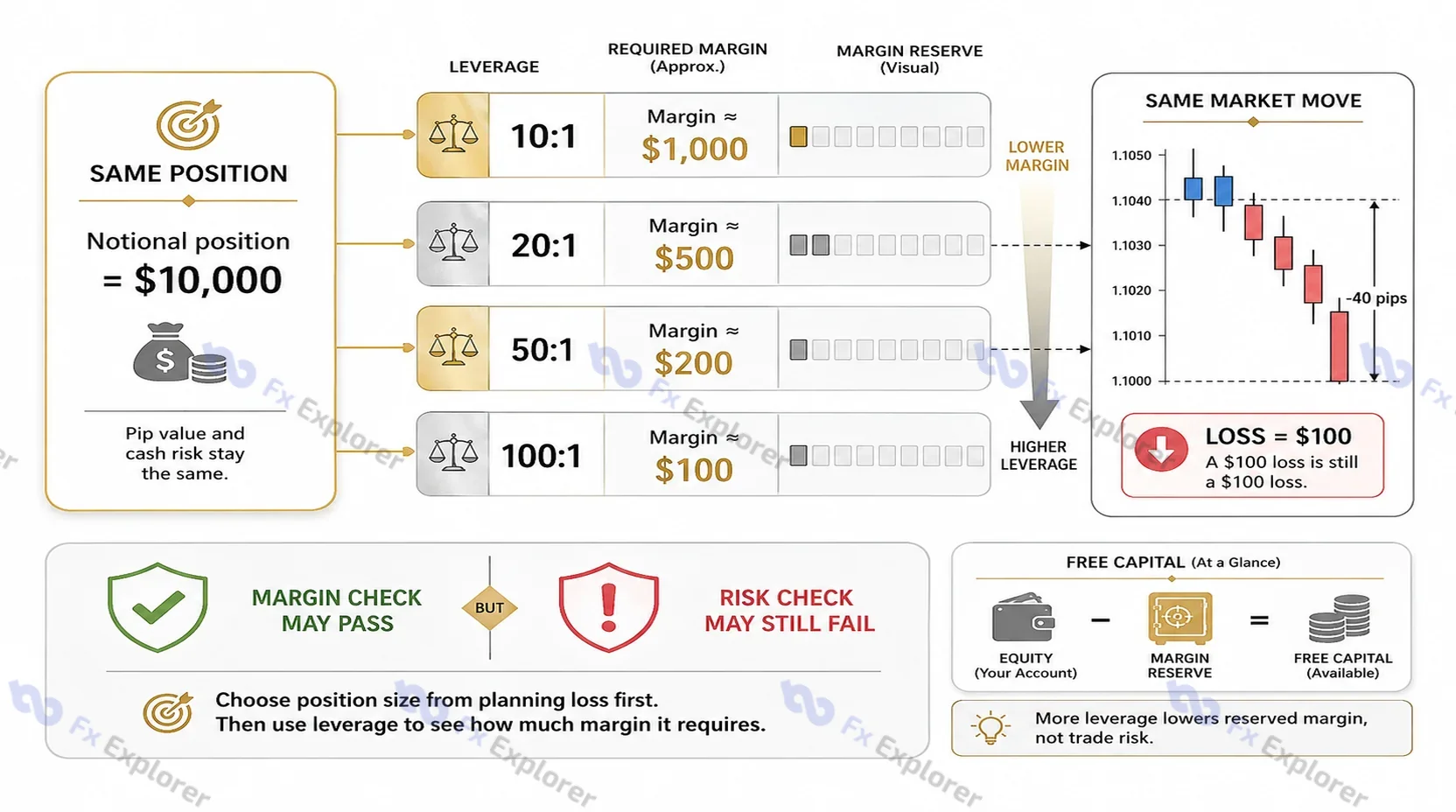
Consider a position worth $10,000. At 10:1 leverage, approximately $1,000 may be reserved as margin. At 20:1, the margin is about $500. At 50:1, it is approximately $200. At 100:1, it falls to roughly $100.
The notional position remains $10,000 in every case.
If the market movement creates a $100 loss, the account loses $100 regardless of whether the broker reserved $1,000 or $100.
Higher leverage can lower the entry minimum while leaving the risk minimum unchanged. This creates a common mismatch: the trade passes the margin check but fails the percentage-risk test.
Position size should therefore be chosen from the planning loss first. Leverage is then used to determine how much margin the selected position requires.
Balance, equity, used margin and free margin
The balance usually reflects deposits, withdrawals, completed trades and charges that have already been posted.
Equity includes the unrealized profit or loss of open positions.
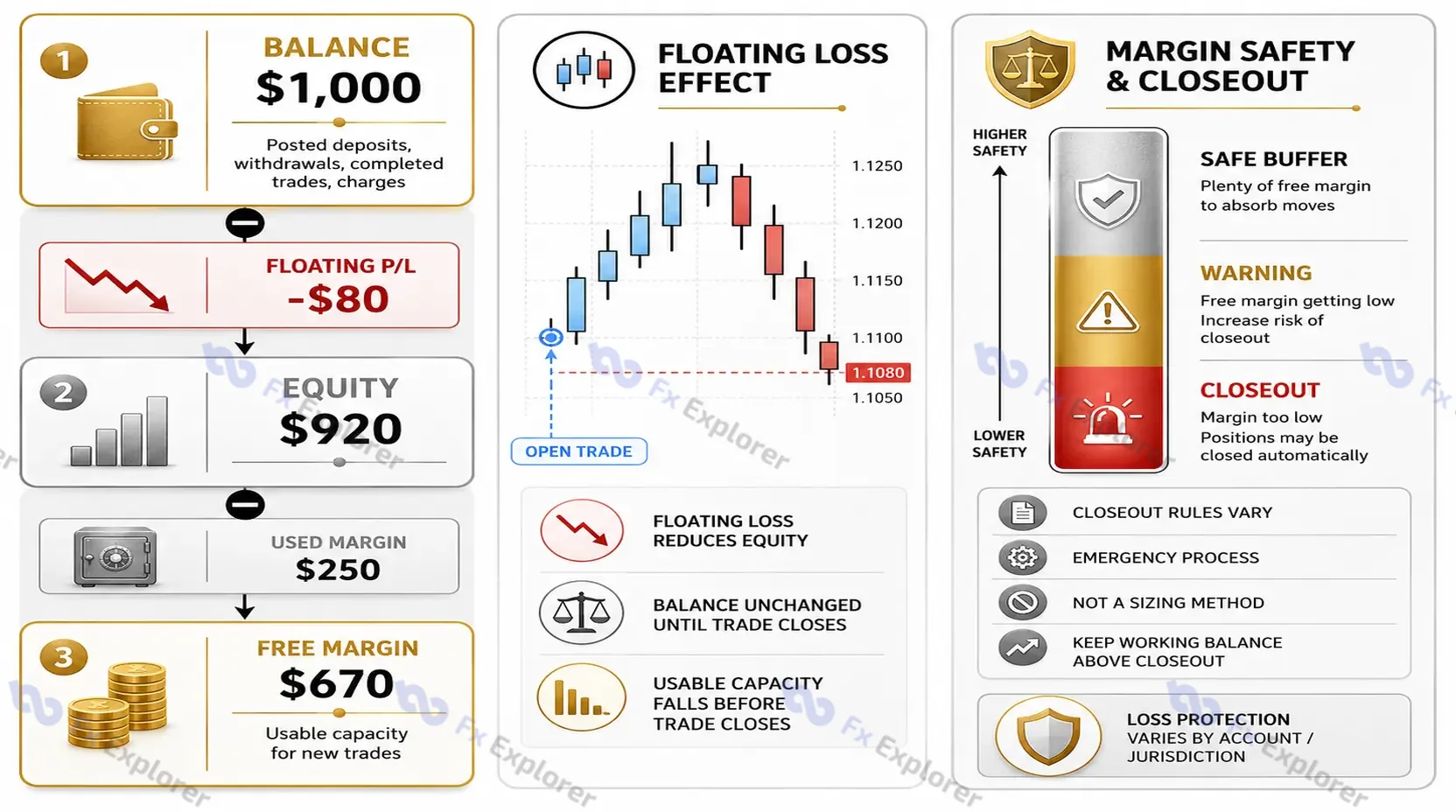
A $1,000 account with an $80 floating loss has approximately $920 of equity.
Used margin is the amount reserved to support open trades. Free margin is the remaining equity after used margin is deducted.
If the same account has $250 of used margin, free margin is approximately $670.
An account can therefore lose usable capacity before a trade closes. Floating losses reduce equity and free margin even while the recorded balance remains unchanged.
Funding the account with only enough money to meet initial margin leaves little room for ordinary price fluctuation or additional positions.
Margin closeout and loss protection
Margin-call, closeout and loss-protection rules vary by account, product and jurisdiction.
Some accounts issue warnings when available equity becomes low. Others begin closing positions automatically once equity falls below a defined relationship to required margin.
Automatic closeout is an emergency process designed to limit further deterioration. It is not a position-sizing method and should not replace a planned exit.
Some account structures prevent the balance from falling below zero. Others may allow losses beyond the original deposit under extreme market conditions or particular contractual terms.
The exact closeout threshold and loss-protection provisions should be checked before funding. The working balance should remain comfortably above the emergency closeout level.
Product Structure Can Change the Calculation
Forex exposure may be offered through rolling spot arrangements, contracts for difference, spread-based products or exchange-traded currency contracts.
Contract size, margin, financing, closeout procedures and loss protections can differ between these structures. The capital calculation must therefore use the specifications of the exact product being traded, not assumptions taken from another account type or market.
From One Trade to a Working Account
Capital calculated for one trade may not be enough for the complete strategy.
A usable account may need to hold several positions, accommodate pending orders, survive a losing sequence and preserve free margin while trades fluctuate.
Concurrent positions
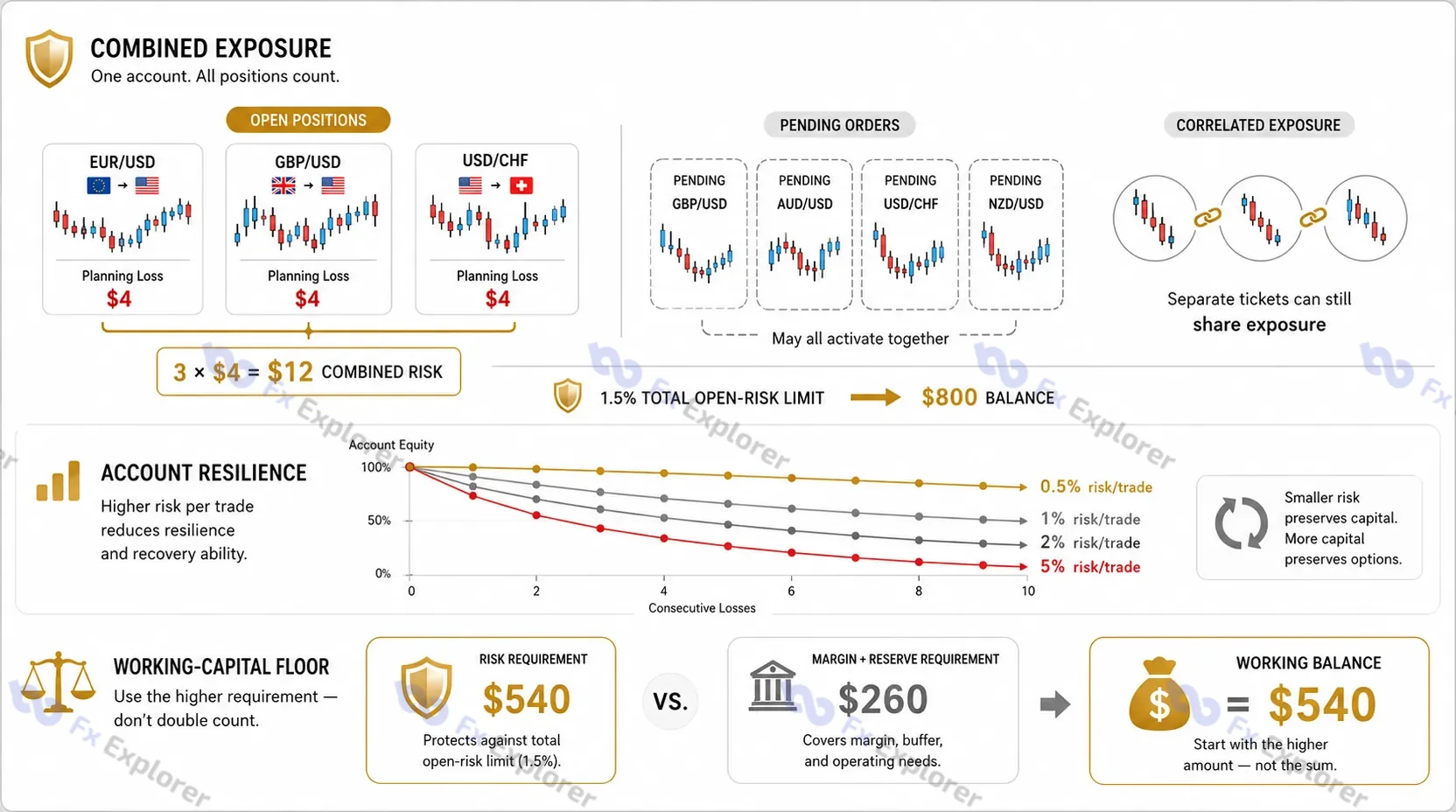
Suppose three trades each have a planning loss of $4. The combined planning loss is $12.
If total open risk is limited to 1.5% of the account, the required balance is $800.
Evaluating each trade separately against a $400 account would make every $4 loss appear to equal 1%. Opening all three at once creates approximately 3% of combined risk.
Starting capital must therefore reflect the maximum realistic group of simultaneous positions rather than one trade in isolation.
Pending orders
A pending order may not use margin before activation, but it can still create future exposure.
An account with one open position and several pending entries can move from moderate exposure to excessive risk if those orders activate together.
The calculation should include the combinations of active and pending trades that could realistically coexist.
Correlated exposure
Different currency pairs can express similar underlying views.
A long EUR/USD position and a long GBP/USD position both include exposure to a weaker dollar. A long EUR/USD trade combined with a short USD/CHF position may create a similar concentration.
The relationships between pairs change over time, so the trades are not identical. They may still lose together when the shared currency moves sharply.
Several separate trade tickets should not automatically be treated as independent risks. The account should be able to withstand the plausible combined loss when related positions move adversely at the same time.
Drawdown capacity
A trading method can experience several losses in succession without being invalid.
At 0.5% risk per trade, ten consecutive losses leave approximately 95.1% of the account. At 1%, about 90.4% remains. At 2%, the account retains roughly 81.7%. At 5%, only around 59.9% remains.
The higher the percentage risk, the more difficult the recovery.
A decline from $1,000 to about $600 requires a gain of roughly 67% on the remaining balance to return to $1,000.
A small account is not automatically fragile. It becomes fragile when the minimum position forces a large percentage loss on every trade.
Building an operating reserve
The risk minimum and the margin-and-reserve requirement should be calculated separately so that the same capital is not counted twice.
Suppose the risk calculation produces a minimum balance of $540. Separately, the account requires $80 of margin, $50 for ordinary floating losses, $30 for cost variation and $100 for an additional setup. The margin-and-reserve requirement is $260.
Because $540 is higher than $260, the risk minimum remains the starting floor. The two amounts should not automatically be added together.
When several positions can be open at once, their combined planning loss should be recalculated under the portfolio-risk limit. The working balance is then the higher of the portfolio risk requirement and the margin-plus-reserve requirement.
This approach builds the reserve from identifiable demands without inflating the estimate through double counting.
Worked Starting-Capital Examples
The following examples demonstrate the calculation. They are not universal deposit recommendations.
Example 1: A small unit-based position
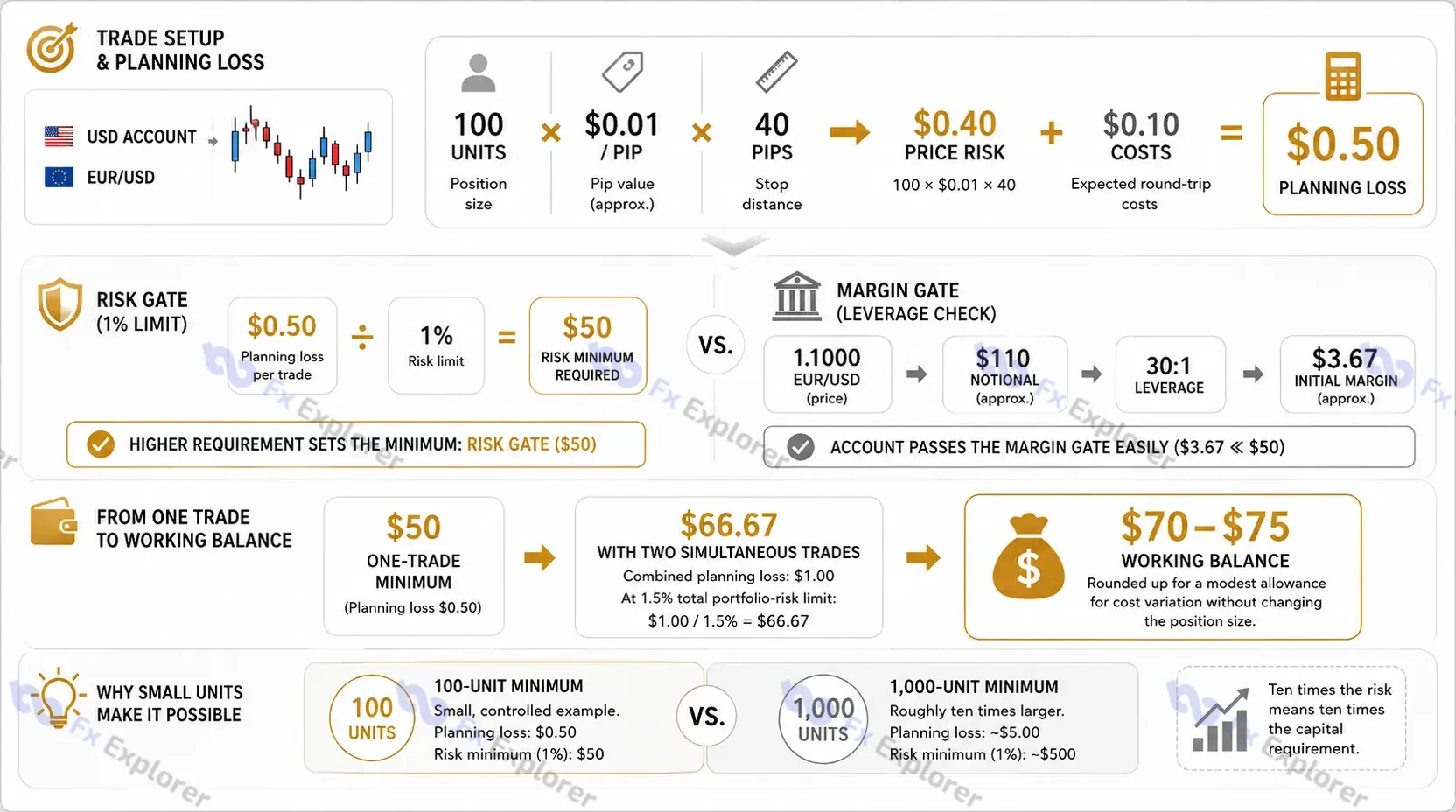
Assume a USD account trades EUR/USD using 100 currency units. The pip value is approximately $0.01. The stop is 40 pips away, and expected round-trip costs are $0.10.
A 40-pip move creates $0.40 of price risk. Adding costs produces a planning loss of $0.50.
At a 1% risk limit, the risk minimum is $50.
If EUR/USD is trading near 1.1000, the position has a notional value of approximately $110. At 30:1 leverage, the initial margin is about $3.67.
The account passes the margin gate easily. The risk gate sets the higher requirement.
Rounding the working balance upward to about $70-$75 provides a modest allowance for cost variation without changing the position size.
This example is possible only because the position can be reduced to 100 units. If the minimum were 1,000 units, the price risk and required balance would be roughly ten times larger.
Example 2: A 0.01-lot minimum
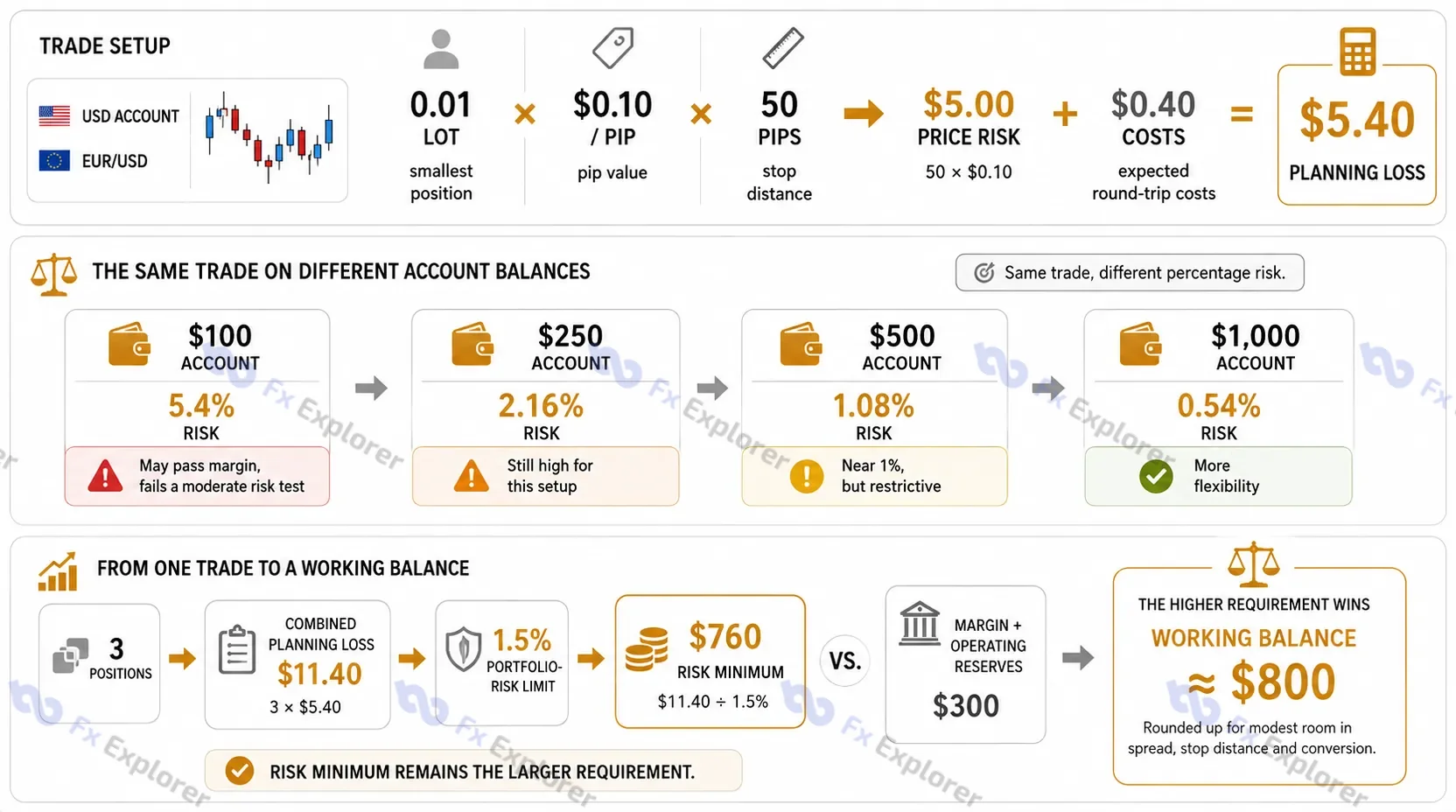
Now assume the smallest available position is 0.01 lot. On EUR/USD in a USD account, the pip value is approximately $0.10.
A 50-pip stop creates $5 of price risk. After adding $0.40 of expected costs, the planning loss is $5.40.
On a $100 account, that loss represents 5.4%. On a $250 account, it is 2.16%. On a $500 account, it is 1.08%. On a $1,000 account, it is 0.54%.
The $100 balance may satisfy the initial margin requirement, but it fails a moderate percentage-risk test for this setup.
A $500 balance places the trade near 1% risk. It remains restrictive if the strategy sometimes uses a wider stop or holds several positions at once.
A $1,000 balance provides more flexibility without changing the trade.
Suppose the plan may hold three positions whose combined planning loss is $11.40. At a 1.5% portfolio-risk limit, the risk minimum becomes $760.
If expected margin and operating reserves total $300, the risk minimum remains the larger requirement. Rounding the working balance toward $800 creates room for modest changes in spread, stop distance and conversion.
Round capital upward, not position size
A result such as $537.80 should not be treated as an exact threshold.
Spreads, slippage, pip-conversion rates, financing and valid stop distances can change. Rounding the capital requirement upward allows for those variations.
Rounding the position upward increases the planning loss. The trade size should remain at or below the calculated amount.
What $100, $500 and $1,000 May Support
The usefulness of a particular balance depends heavily on the smallest available position.
These ranges are illustrations rather than fixed recommendations.
A $100 account can be useful when positions can be reduced to a few hundred currency units. The same balance may be unsuitable when 0.01 lot is the minimum and normal stops are 40 to 100 pips wide.
A $500 balance can support some micro-lot setups near 1% risk. Wider stops, higher costs or several related positions raise the requirement.
A $1,000 account gives the same micro-lot trade more room and lowers its percentage risk. It does not make the method profitable by itself.
Larger balances improve sizing flexibility and allow the same cash loss to represent a smaller share of equity. They do not create a trading advantage.
Trading Style Changes the Inputs, Not the Formula
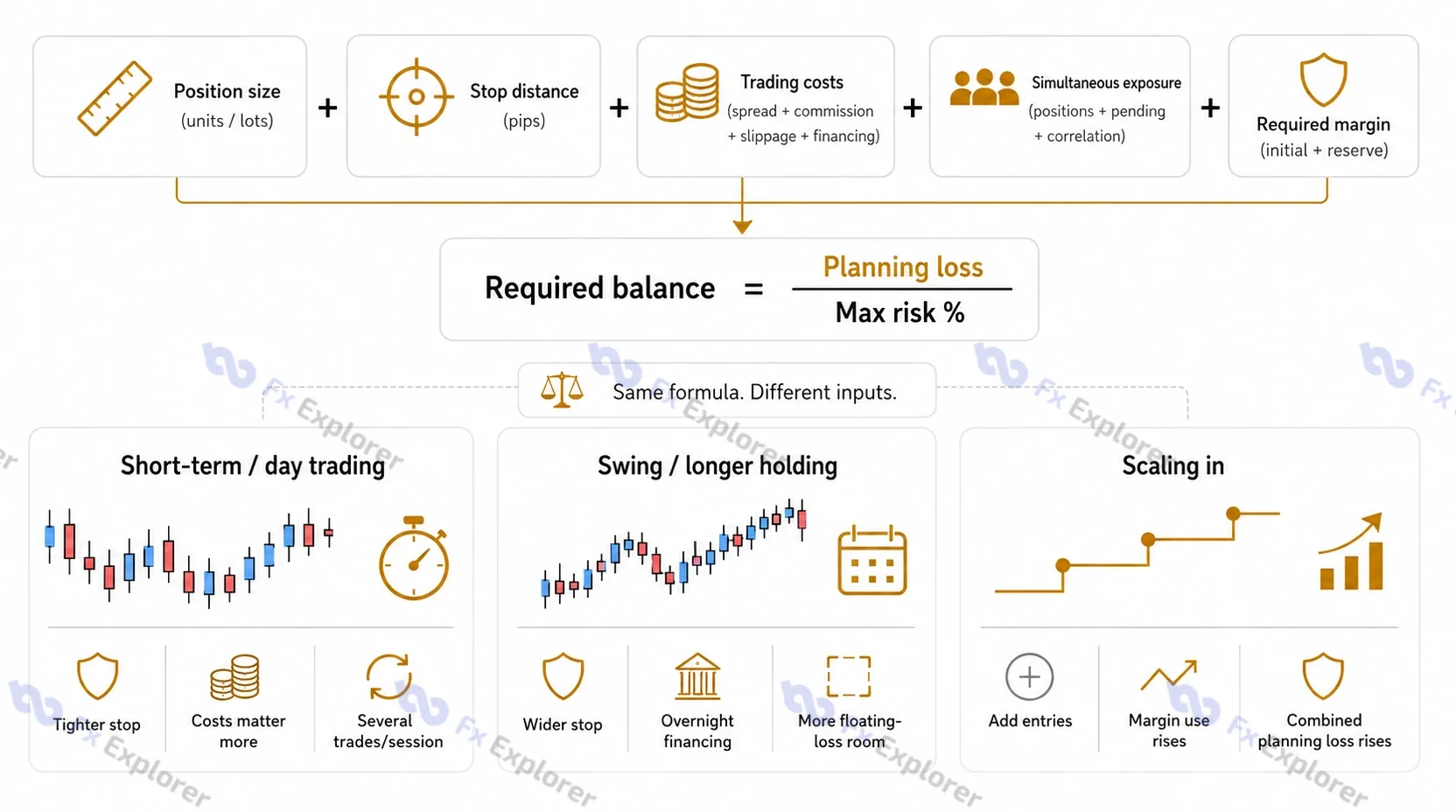
Different trading styles do not have fixed capital requirements. They change the variables used in the same calculation.
A short-term method may use relatively tight stops, but it pays spreads and commissions more frequently. When the intended price movement is small, costs can consume a substantial part of the risk budget.
A longer-term method may trade less often but require wider stops and greater tolerance for floating losses. Positions held overnight can also incur financing and gap exposure.
Day trading may avoid most overnight costs while requiring enough capital for several positions during one session. Swing trading may involve fewer entries but wider stops. Scaling into a trade increases both margin use and combined planning loss.
The relevant inputs remain position size, stop distance, full trading cost, simultaneous exposure and required margin.
Learning Capital, Income Capital and Withdrawals
A small account can be useful without being large enough to produce meaningful income.
Live trading exposes the trader to real spreads, order fills, commission, financing, slippage and the consequences of position-sizing decisions. That experience can be valuable even when the dollar result of each trade is small.
Income capital is a separate issue because cash outcomes are tied directly to account size.
A 2% change in a $100 account is $2. On $500, it is $10. On $1,000, it is $20. On $10,000, it is $200. On $50,000, it is $1,000.
These figures are arithmetic, not a forecast that 2% can be earned consistently.
A $500 account may be adequate for testing live execution under suitable sizing conditions. It is not a realistic base for substantial recurring withdrawals unless the trader pursues unusually high percentage returns or accepts excessive risk.
Withdrawals also change the risk of the next trade.
A planning loss of $5.40 represents 0.54% of a $1,000 account. After a $500 withdrawal, the same trade represents 1.08%.
The position has not changed. The equity supporting it has been halved.
Regular withdrawals should therefore be planned from the balance expected to remain in the account, not the balance immediately before money is removed.
How Much Should You Personally Deposit?
The trading plan determines how much capital it requires. Personal finances determine whether that amount should be deposited.
Trading funds should be separate from housing costs, household expenses, emergency savings, debt payments, taxes, education costs and other near-term obligations.
Suppose the method requires a $1,000 account, but only $200 is genuinely affordable to lose. Higher leverage does not close that gap. It merely makes an oversized position easier to open.
The practical choices are to use finer position increments, remain on a demo account, adopt a method with a smaller planning loss or postpone live trading until more risk capital is available.
The deposit should be treated as loss-capable capital. This does not mean expecting the account to fail. It means that a complete loss would not interfere with essential financial commitments.
Adding more money should not be used to compensate for uncontrolled sizing, repeated rule violations or an untested method. A larger balance increases capacity; it does not correct the way that capacity is managed.
Calculate and Verify Your Starting Balance
A reliable estimate must use the exact account, platform and trading method you intend to use.
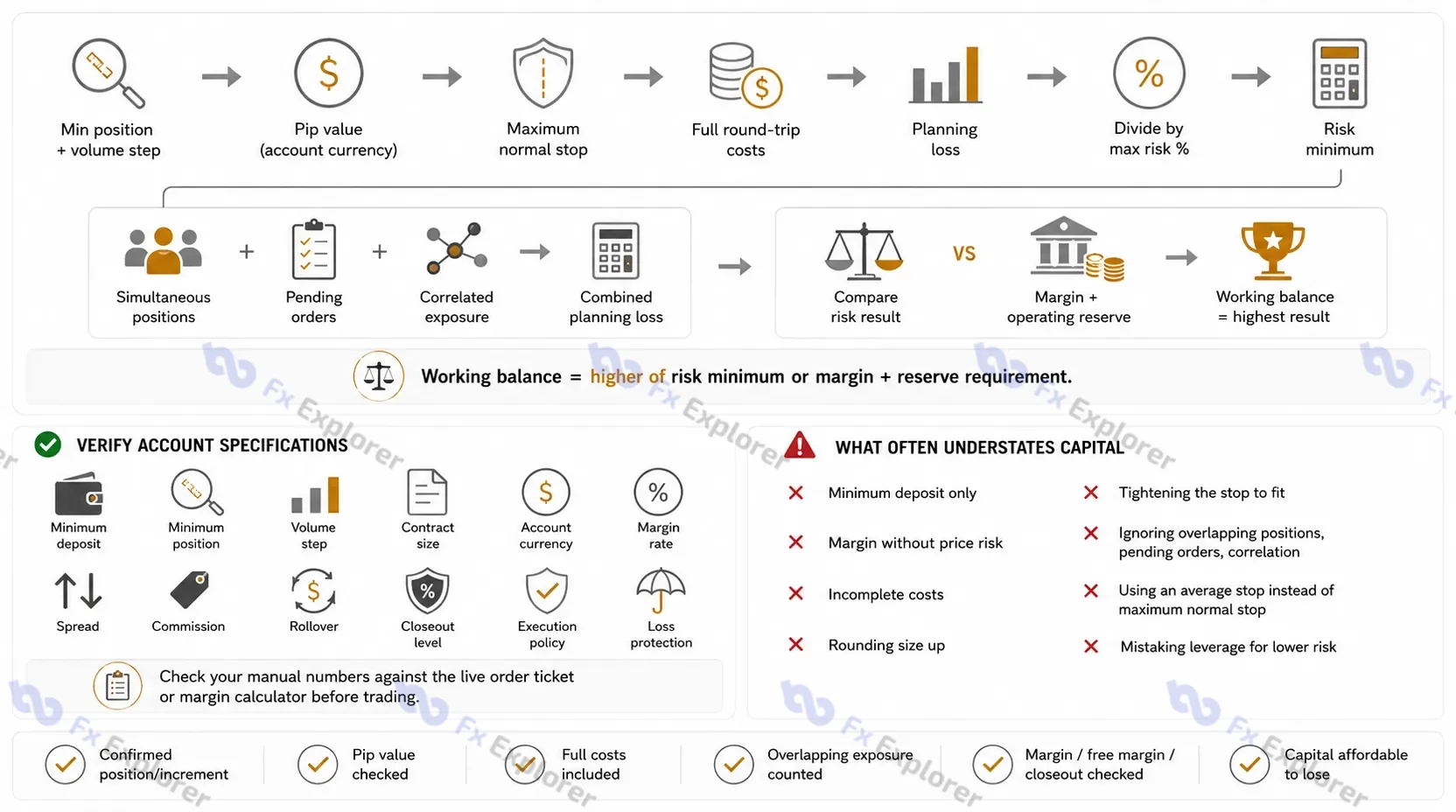
Begin with the minimum position and permitted volume increment. Determine the pip value in the account currency. Use the maximum normal stop required by the strategy rather than the tightest recent example.
Add the likely spread, full entry-and-exit commission, reasonable slippage, overnight financing where relevant and any currency-conversion charge. The result is the planning loss for one trade.
Divide that planning loss by the maximum percentage risk.
Next, calculate the combined planning loss for every position that may be open at the same time. Include pending orders that could activate together and consider whether several pairs depend on the same underlying currency movement.
Compare the risk result with the total margin requirement. Add an operating reserve for floating losses, changing costs, another valid setup and sufficient distance from the emergency closeout level.
The highest relevant result is the working-balance estimate.
Verify the account specifications
The calculation depends on accurate contract information.
Confirm the minimum deposit, minimum position, volume step, contract size, account currency, margin rate, spread, commission, rollover method, closeout level, execution policy and loss-protection terms.
The same provider may offer different conditions on different platforms or account structures. One platform may permit unit-based sizing while another requires fixed lot increments. One account may include most costs in the spread, while another combines a narrower spread with a commission.
Before submitting a trade, compare the manual calculation with the live order ticket or margin calculator. Check the proposed volume, current spread, margin requirement, stop distance, cash risk and remaining free margin.
Any unexplained difference should be resolved before the position is opened.
Common ways starting capital is underestimated
The most common error is treating the minimum deposit as usable trading capital. Funding eligibility does not measure the loss at the planned exit.
Another frequent mistake is calculating margin while ignoring price risk. A position can require little margin and still expose a large percentage of the account.
Costs are often understated by counting only the spread or opening commission. The complete trade may also involve closing commission, slippage, financing and conversion.
Position size may be rounded upward when the exact calculated volume is unavailable. That makes the real planning loss larger than intended.
Some traders move a valid stop closer to make the position fit the account. The trade then no longer follows the original setup.
Others calculate only one position even though several trades or pending orders may overlap. Correlated pairs can increase combined exposure further.
Using an average stop can also understate the capital requirement when wider exits are a normal part of the method.
Finally, leverage is often mistaken for risk reduction. It lowers margin, not pip exposure.
Final Capital Check
Before funding the account or placing the first trade, confirm that:
- The minimum position, contract size and permitted volume increment have been confirmed.
- Pip value has been calculated in the account currency for the actual pair being traded.
- The exit is valid for the setup, and the planning loss includes the complete round-trip cost.
- Concurrent positions, pending orders and correlated currency exposure have been counted.
- Required margin, remaining free margin and the emergency closeout level have been checked.
- The working balance can be lost without affecting essential financial obligations.
Conclusion
The amount needed to start trading forex is not the smallest deposit an account accepts.
Calculate the planning loss of the smallest valid trade, including the full cost of entering and closing it. Divide that loss by the permitted risk percentage, then confirm that enough free margin remains for simultaneous positions, ordinary fluctuations and a practical operating reserve.
The higher requirement is the working balance your trading plan needs - and it should never exceed the capital you can genuinely afford to lose.
FAQ
Can you start forex trading with $100?
Is $500 enough to trade forex?
What is the technical minimum for forex trading?
Does higher leverage mean you can start with less money?
How does lot size affect starting capital?
Is a cent account useful for a small deposit?
How much should a beginner risk per trade?
Do several positions require more capital?
Can a small forex account generate meaningful income?

Amelia Benedetti
Amelia Benedetti is a forex broker reviewer focused on clear, practical evaluations of online trading platforms. She analyzes broker fees, regulation, account types, trading tools, execution quality, and user experience to help traders compare providers more confidently. Her reviews emphasize transparency, platform reliability, usability, and trader protection, offering balanced insights for both beginners and experienced traders.