


Forex risk management is about more than setting a stop-loss or risking 1% per trade. This comprehensive guide explains how traders can protect their capital by connecting trade-level decisions with account-wide and portfolio-level risk. It covers stop placement, position sizing, pips and pip value, leverage, margin, margin levels, stop-outs, drawdown, risk-to-reward, expectancy, correlation, event risk, slippage, hedging, and losing-trade management. The article also provides practical formulas, examples, risk-management checklists, and a framework for building rules around trade risk, total exposure, margin capacity, session losses, and drawdown. The central principle is simple: size positions according to where the trading idea becomes invalid and ensure the account can survive plausible losing sequences—not just average ones.
Forex risk management is the process of controlling how much capital is exposed to a trade, how that exposure affects the trading account, and how losses are prevented from becoming large enough to threaten the account as a whole.
It matters especially in forex because currencies are commonly traded with leverage. Leverage allows a trader to control a currency position whose full market value is larger than the cash committed as margin, the collateral required to support that leveraged exposure. Used sensibly, leverage improves capital efficiency. Used aggressively, it can make ordinary currency movements produce disproportionately large account losses.
A sound risk process therefore begins before the order is placed:
A trade thesis is the reason for entering a position. Invalidation is the price level or market condition that makes that reasoning meaningfully weaker or no longer valid.
The order matters. Choosing a large lot size first and then forcing the stop into whatever distance produces an acceptable loss reverses the logic. Market structure should determine where the idea fails; position size should adapt to that distance and the amount of capital the account can afford to lose.
Risk management also does not mean eliminating losses. Losing trades are unavoidable. Its purpose is to prevent one bad position, one correlated group of trades, one volatile event or one period of poor decision-making from causing disproportionate damage.
It cannot create a profitable strategy either. A trading method still needs positive expectancy, meaning a positive average result over a sufficiently meaningful sample after trading costs. Risk management controls the consequences of uncertainty; it does not manufacture an edge.
Key Takeaways
- A stop should come from market invalidation. Position size should then be calculated from that stop and the monetary risk allowed by the trading plan.
- Leverage, margin, position size and actual trade risk are related, but they are not the same thing.
- Account health depends on more than one position. Total open risk, correlation, free margin, margin level, session losses and drawdown all matter.
- Hedging, additional deposits and promotional credit can change account capacity, but none repairs an invalid trade thesis.
- Win rate and risk-to-reward should be evaluated together through expectancy rather than judged separately.
- A complete framework protects three things at once: the individual trade, the account and the trader’s ability to keep operating after a difficult losing period.
What Forex Risk Management Really Means
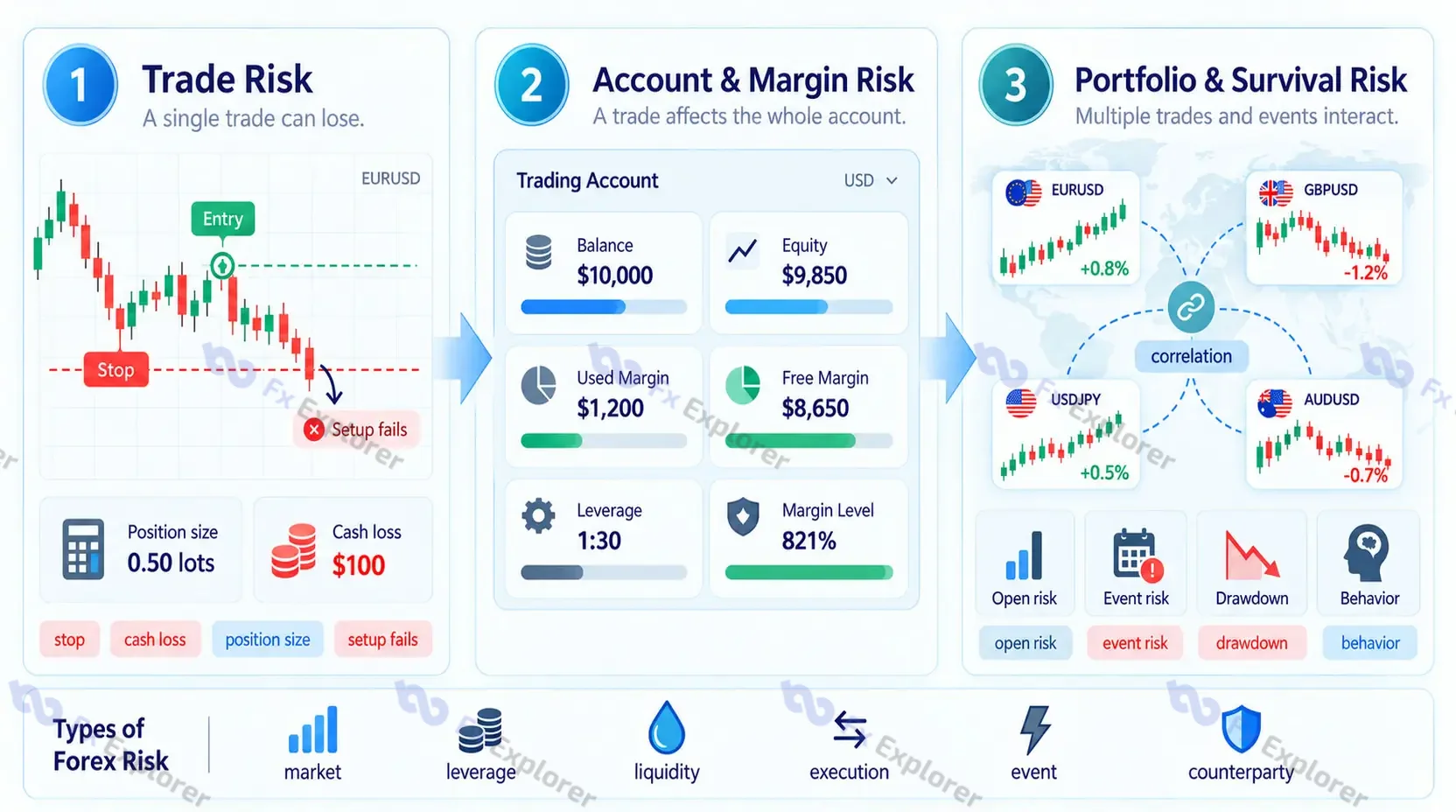
Forex risk management works at three connected levels.
Trade risk concerns an individual position: where the setup fails, where the stop belongs, how much money can be lost and what position size fits that loss.
Account and margin risk concerns the trading account itself: balance, equity, used margin, free margin, leverage, margin level and the capacity remaining to absorb adverse movement.
Portfolio and survival risk concerns what happens when positions and decisions overlap: correlated currency exposure, total open risk, event risk, losing streaks, session limits, drawdown and behavioral mistakes.
These layers cannot be evaluated independently. A carefully sized 0.5% trade may still contribute to excessive risk if several similar positions are already open. Likewise, a high margin level may make an account appear comfortable even while the underlying strategy continues to lose money.
A stop loss does not mean that a trade should never lose. It is simply a predefined response to the possibility that the idea is wrong. The same principle applies to daily loss limits, partial position reductions and drawdown circuit breakers. These controls do not remove uncertainty; they decide how much damage uncertainty is allowed to cause.
That distinction becomes especially important after several losing trades. Trying to recover every loss immediately often creates a second problem on top of the first: larger positions, wider stops, emotional averaging down or additional trades opened after decision quality has deteriorated.
A controlled loss is therefore not necessarily evidence that risk management failed. In many cases, it means the process worked as intended.
Forex traders also face several different kinds of risk at the same time. Market risk is the possibility that price moves against the position. Leverage risk appears when total economic exposure becomes too large relative to account equity. Liquidity risk arises when it becomes harder or more expensive to trade near the expected price, while execution risk includes wider spreads, delayed fills and slippage, the difference between the expected execution price and the price actually received.
There is also event risk from scheduled or unexpected developments, correlation risk when multiple positions depend on the same underlying currency move, and behavioral risk from actions such as revenge trading, oversizing or moving stops.
Operational and counterparty risk matter as well. Counterparty risk is the possibility that the financial party through which a trade is held or executed cannot meet its obligations. Connectivity problems, order-handling rules, withdrawal restrictions and account terms can therefore affect risk even when the market analysis itself is sound.
The objective is not to eliminate every possible risk. That is impossible. The objective is to identify which risks can be controlled and decide what will happen before pressure appears.
How a Forex Trading Account Works
A beginner cannot manage forex risk properly without first understanding the figures shown on the trading account.
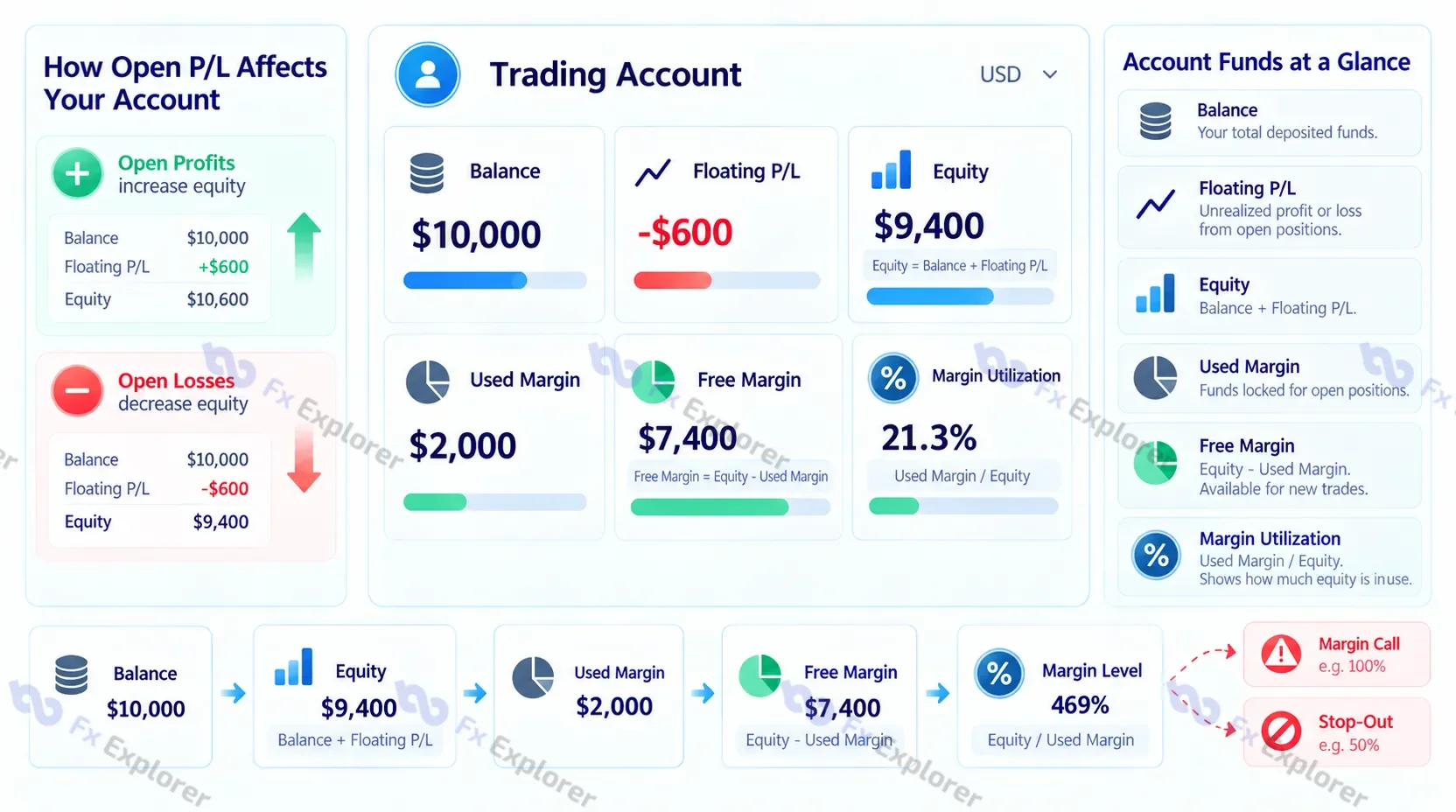
Balance is the account value after completed transactions and closed trading results have been recorded. If an account starts with $10,000, a closed winning trade adds $300 and a closed losing trade removes $150, the new balance is $10,150, ignoring other transactions.
Open positions are handled differently. Their changing value appears as floating profit and loss, commonly shortened to floating P/L. If an AUD/USD position currently shows a $240 unrealized loss, that loss is floating because the position remains open. When the trade is closed, the result becomes realized and is incorporated into the balance.
Equity is the account’s current value after floating P/L is included:
For a $10,000 balance with $600 in floating losses:
If the same open positions instead show a $600 unrealized profit, equity becomes $10,600.
Equity therefore gives a more current picture of account condition than balance alone. That distinction matters because floating gains can disappear. A large unrealized profit may temporarily make an account appear capable of carrying more exposure, but increasing position size aggressively against temporary floating gains can create a fragile account if the market reverses.
Used margin is the amount of capital currently committed as margin for open leveraged positions. It is not the same thing as maximum loss. One position may require $1,000 in margin but risk only $100 at its stop, while another may use similar margin but expose substantially more capital because its stop distance or position size is larger.
Free margin is the portion of equity that is not currently committed as used margin:
If equity is $8,000 and used margin is $2,000:
Free margin gives the account room to absorb adverse movement and may allow additional positions to be opened. It should not, however, be treated automatically as “money available for the next trade.” Keeping a deliberate margin buffer leaves unused capacity for normal volatility, wider spreads, changing margin requirements and simultaneous losses.
A related measure is margin utilization:
With $8,000 of equity and $2,000 of used margin:
Not every platform displays this metric, but the concept is useful because rising utilization means a larger portion of current equity is committed as collateral.
These account figures form a logical chain:
When open positions move against the account, floating losses increase and equity falls. Free margin generally declines at the same time. As the relationship between equity and used margin deteriorates, margin-call or automatic liquidation rules can eventually become relevant.
Understanding this sequence is much more useful than memorizing isolated definitions.
Margin Level, Leverage and Account Capacity
Margin level compares current equity with used margin:
Assume a USD/CAD account has $6,000 of equity and $1,500 of used margin.
The account currently has four times as much equity as used margin.
Margin level is best understood as an account-capacity indicator. It answers a practical question:
It does not measure trading skill, strategy quality or profitability. A margin level of 800% can coexist with a strategy that consistently loses money.
To see how floating losses affect the metric, hold used margin constant at $1,500 for a simplified example:
- At $6,000 equity, margin level is 400%.
- At $4,500 equity, it falls to 300%.
- At $3,000 equity, it becomes 200%.
- At $1,500 equity, it reaches 100%.
A live account can be more complicated because used margin itself may change with price movement, account-currency conversion or a tiered margin schedule, where the percentage of margin required changes as position size or total exposure increases.
If there are no open positions and used margin is zero, the margin-level formula would require division by zero. Platforms therefore commonly display margin level as not applicable or an equivalent status when no margin is in use.
There is also no single percentage that should be described as universally safe. The appropriate buffer depends on the account’s liquidation rules, position volatility, correlation, gap risk, total exposure and the trader’s own limits.
The more useful question is:
Leverage and Required Margin
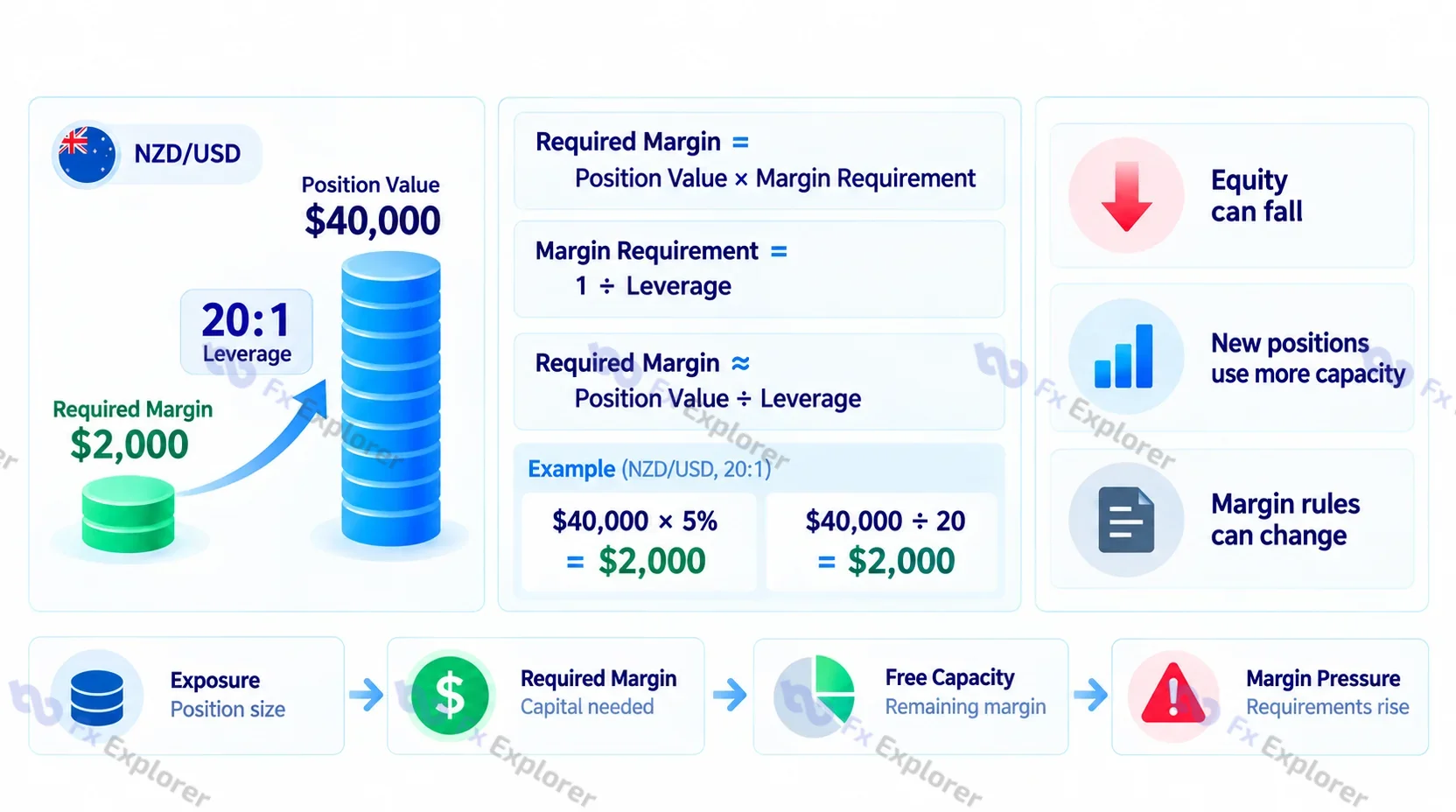
Leverage describes how much economic exposure can be supported relative to the capital committed.
The notional value of a position is its full market value before considering leverage or the smaller amount posted as margin.
If $2,000 of margin supports a $40,000 currency position, the relationship is equivalent to 20:1 leverage.
A useful margin relationship is:
With a $40,000 position and a 5% margin requirement:
Where a simple fixed leverage ratio applies:
and therefore:
For a NZD/USD position with $40,000 in notional exposure at 20:1 leverage:
Actual requirements can differ because of account currency, conversion rates, exposure size or changing margin schedules.
Meeting the margin requirement when a position is opened does not mean the account will continue satisfying it indefinitely. Equity can decline, new positions can consume more capacity and margin rules can change while exposure remains open.
When Leverage Helps—and When It Becomes Dangerous
Leverage can improve capital efficiency because it allows currency exposure without funding the entire notional position value.
That is useful when the position has already been sized from a valid stop and a sensible monetary-risk limit.
The problem begins when maximum available leverage becomes a target.
More notional exposure makes price movement more significant in monetary terms and consumes more margin. If several positions move against the account together, the remaining cushion can deteriorate quickly.
Maximum leverage should therefore be viewed as a ceiling rather than a suggested operating level.
A more informative measure is effective leverage:
If total notional exposure is $60,000 and equity is $20,000:
The account may technically permit much more, but actual exposure is only three times equity.
The key distinctions are:
Confusing these concepts is one of the most common causes of poor forex risk decisions.
Margin Calls, Stop-Outs and Account Protections
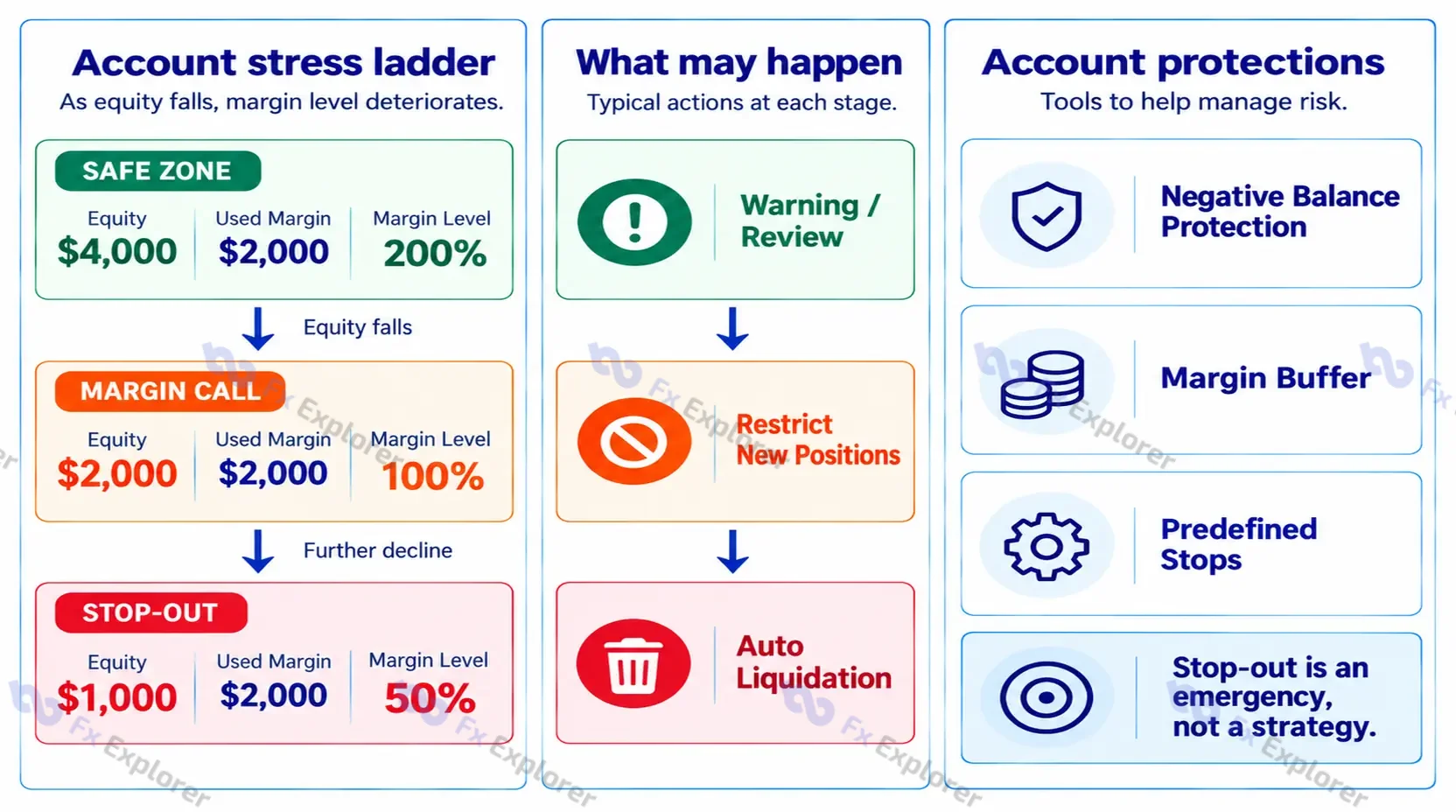
A margin call level is an account-defined threshold at which deteriorating margin conditions may trigger a warning, restrictions on new positions, a request for more capital or another account action.
A stop-out level is the threshold at which automatic reduction or liquidation of positions may begin because the account no longer satisfies the applicable margin conditions.
For illustration only, imagine an account with:
- Margin-call level: 100%
- Stop-out level: 50%
- Used margin: $2,000
A 100% margin level would correspond to $2,000 of equity, while a 50% margin level would correspond to $1,000.
These numbers are examples, not standard thresholds.
The order in which positions are liquidated can vary as well. Forced closure should not be assumed to follow trade age, current P/L or any other intuitive sequence unless the relevant account rules say so.
Margin close-out is the broader account-level process through which exposure is reduced when applicable margin requirements are breached. In some account structures, the terminology overlaps with stop-out. The important distinction is that a voluntary stop on an individual trade is a planned risk action, while margin close-out is an emergency account mechanism.
That is why stop-out should never be treated as a trading strategy. If forced liquidation is the primary mechanism controlling losses, earlier layers of risk management have already failed.
A useful stress test is to understand the distance between the current account condition and applicable liquidation rules. Suppose equity is $4,000 and used margin is $2,000, giving a 200% margin level. If an illustrative stop-out threshold were 50%, equity would need to fall to $1,000 to reach it.
That does not mean the account has $3,000 of acceptable loss capacity. Trade, session and drawdown rules should normally intervene long before forced liquidation.
Negative Balance Protection and Account Classification
Negative balance protection can limit liability so that covered losses do not leave the account owing more than the protected funds.
It is a last-resort safeguard, not permission to use excessive leverage.
Margin close-out and negative balance protection operate at different stages. Margin close-out attempts to reduce exposure as the account deteriorates. Negative balance protection, where applicable, can act as a later backstop if extreme price movement or execution conditions push losses beyond available funds.
Protections can also differ by account or client classification. A rule available to one retail account should not automatically be assumed to apply to a professional or differently classified account.
Bonuses, Promotional Credit and Withdrawals
A trading bonus or promotional credit can represent withdrawable cash, non-withdrawable credit, margin-support credit or another conditional benefit.
Those forms should not be treated as economically identical.
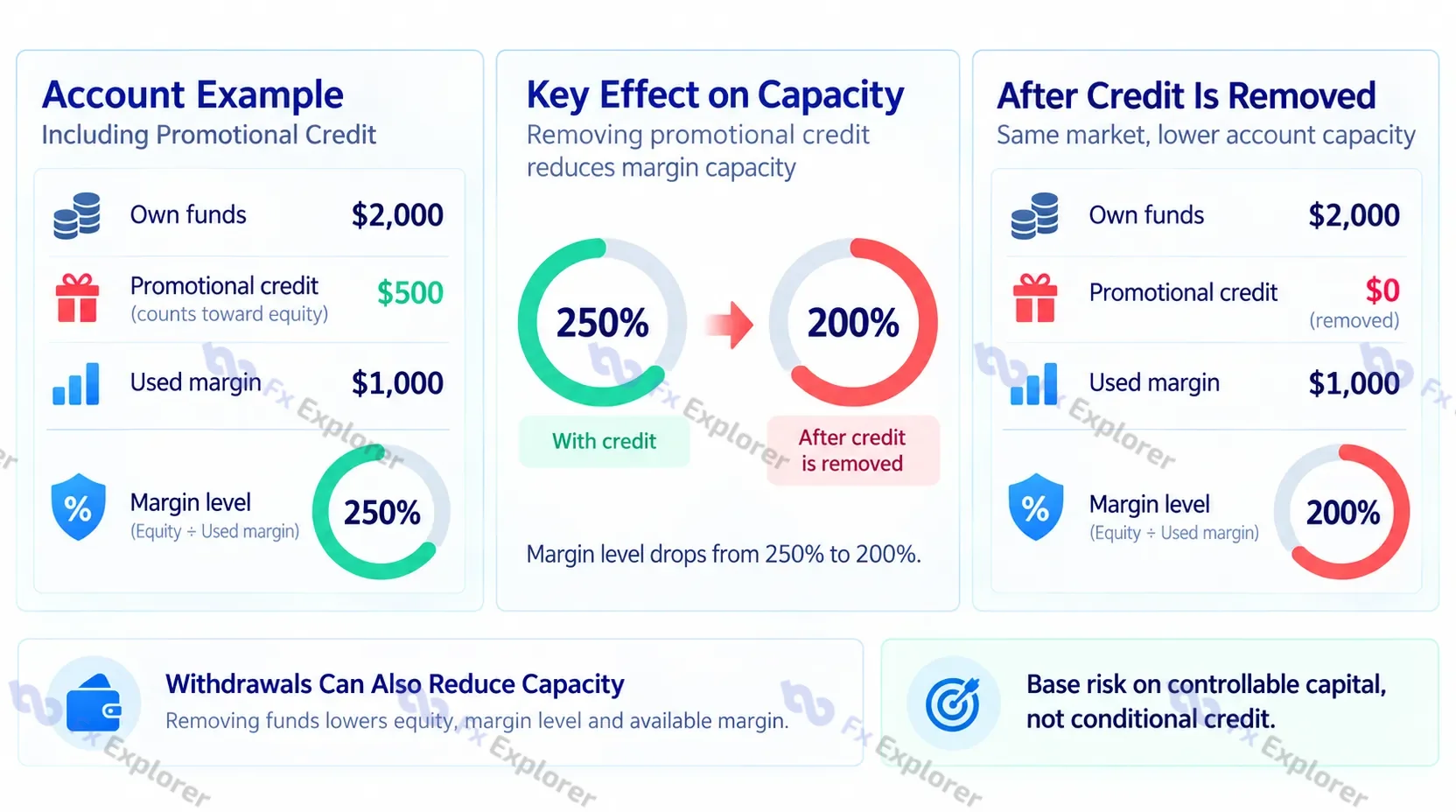
Assume an account contains:
Own funds: $2,000
Promotional credit counted toward equity: $500
Used margin: $1,000
If the credit counts toward equity, margin level is:
If the $500 credit is removed under the promotion’s terms, equity falls to $2,000 and margin level becomes:
The market has not moved, yet account capacity has weakened.
A bonus can therefore provide a temporary margin cushion under some conditions, but it can also create several risks: it may encourage larger positions, distort the perception of true account capital, disappear after a withdrawal or come with trading-volume requirements that promote unnecessary turnover.
The safest general principle is simple:
Withdrawals create a related issue. Removing funds while positions remain open can reduce equity, free margin and margin level. Account capacity should therefore be checked before assuming that all apparent balance is safely withdrawable.
Pips, Lots and Pip Value
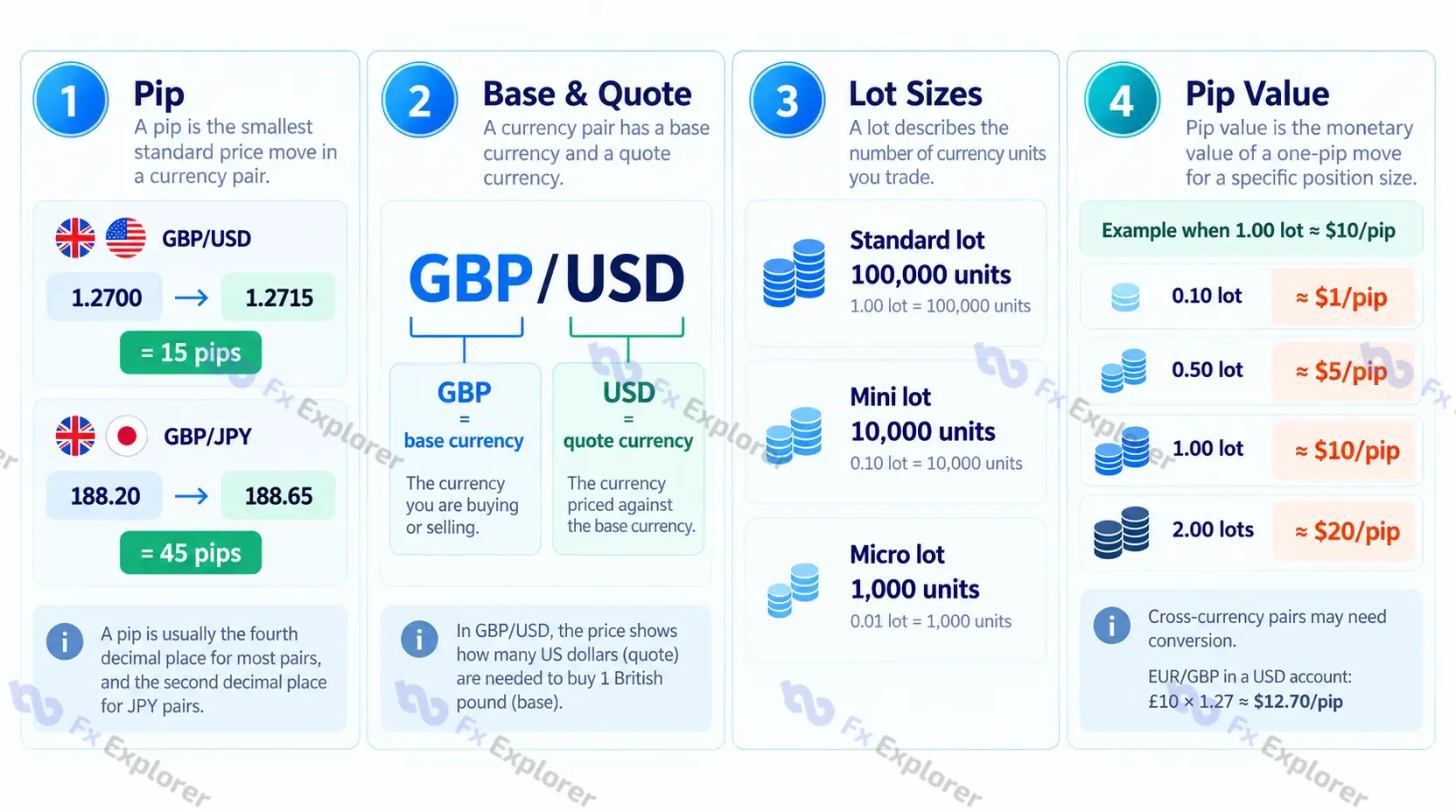
A pip is a conventional unit used to measure movement in a currency pair.
For many pairs, one pip is 0.0001. If GBP/USD moves from 1.2700 to 1.2715, the move is 15 pips.
JPY-denominated pairs commonly use 0.01 as one pip. A move in GBP/JPY from 188.20 to 188.65 is therefore 45 pips.
The first currency in a pair is the base currency and the second is the quote currency. In GBP/USD, GBP is the base currency and USD is the quote currency.
A lot describes position quantity. Common conventions are:
- Standard lot: 100,000 units
- Mini lot: 10,000 units
- Micro lot: 1,000 units
Lot size itself is not inherently good or bad. It determines how strongly a given market movement affects the account.
Pip value is the monetary value of a one-pip movement for a specific position size.
For a standard 100,000-unit position in many pairs where USD is the quote currency, pip value is approximately $10 per pip. That shortcut does not apply universally.
For a 100,000-unit GBP/JPY position:
If the account uses another currency, that amount must then be converted.
Consider a EUR/GBP position in a USD-denominated account. For 100,000 EUR, one pip is approximately £10. If GBP/USD is assumed to be 1.27 for illustration:
Because exchange rates change, converted pip values change too.
This is why calculators are useful, but the underlying relationship should still be understood.
If one standard lot of a particular pair is approximately $10 per pip:
- 0.10 lot ≈ $1 per pip
- 0.50 lot ≈ $5 per pip
- 1.00 lot ≈ $10 per pip
- 2.00 lots ≈ $20 per pip
The same 20-pip move can therefore have radically different monetary consequences.
The word volume can also cause confusion. Market or tick volume describes trading activity shown by a data feed, whereas a trader’s own trading volume refers to how much is personally transacted through lots, turnover or trade count.
Higher personal trading volume is useful only when a tested strategy genuinely produces more valid opportunities. Otherwise, more transactions simply create more spread, commission, slippage opportunities and decision fatigue.
Stop Placement, Risk Per Trade and Position Sizing
A stop should represent the point where the trade thesis becomes meaningfully weaker.
It should not be chosen merely because a convenient number of pips produces an acceptable monetary loss.
Imagine a USD/CHF long setup that depends on support holding above a recent swing low, a visible local low from which price previously moved higher. If price breaks decisively below that structure, the original reasoning may no longer be valid. A structural stop can therefore sit beyond that failure point while allowing some room for ordinary market movement.
Some systems also use volatility when defining stop distance. ATR, or Average True Range, measures the size of recent price ranges. Higher ATR indicates that the market has recently been moving through larger distances. ATR does not need to be an entry signal; it can simply prevent a stop from being placed unrealistically close in volatile conditions.
Arbitrary pip stops often reverse the correct logic. If a setup requires 25 pips before the market structure becomes invalid, a blanket “10-pip maximum stop” may sit inside normal fluctuation.
The answer is not necessarily to accept 2.5 times more monetary risk.
It is to reduce position size.
Calculating Monetary Risk and Position Size
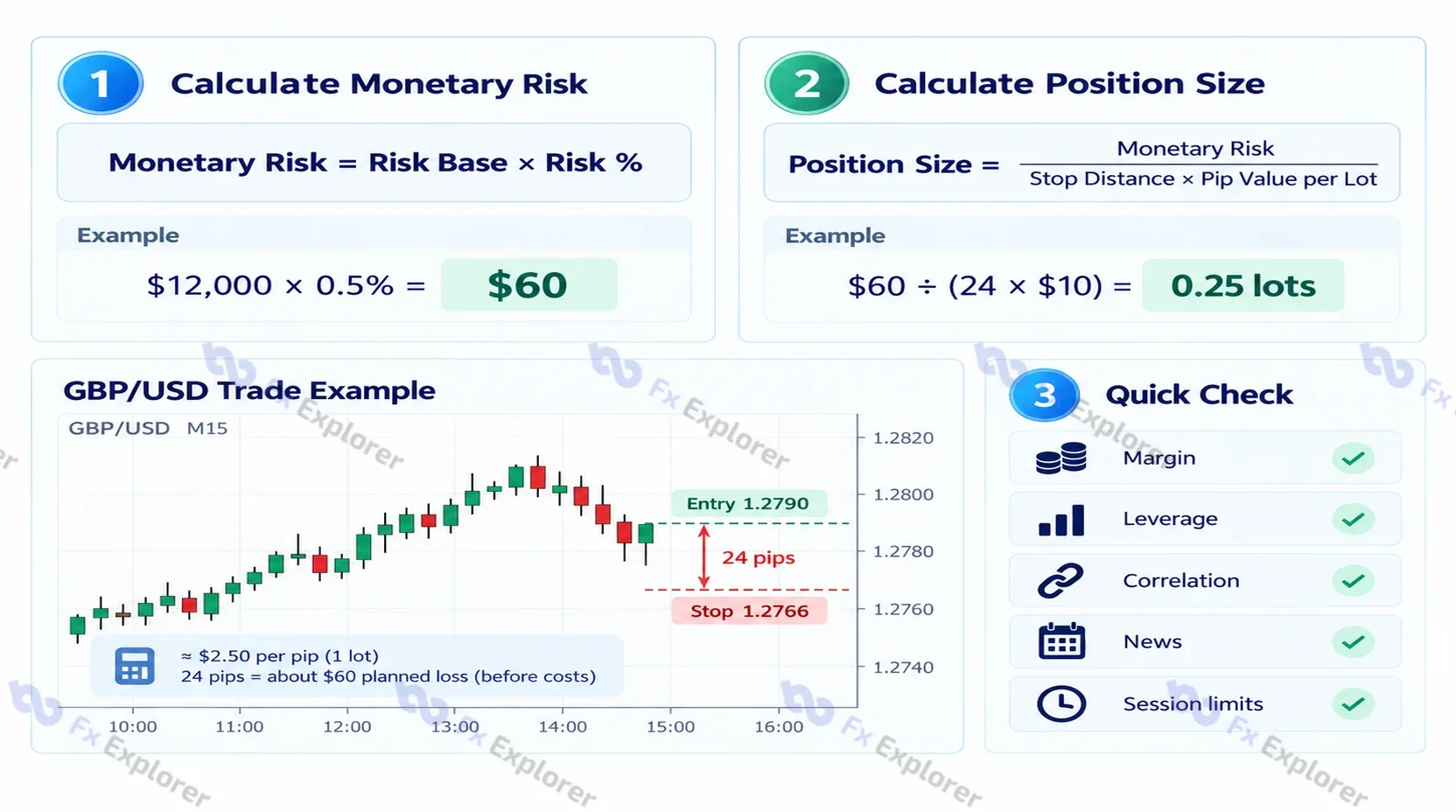
The first calculation is the amount of money that may be lost:
The risk base might be balance or equity, depending on the written plan.
If current equity is $12,000 and the chosen risk is 0.5%:
Position size can then be estimated using:
For a GBP/USD setup with a 24-pip stop and an approximate $10 pip value per standard lot:
At roughly $2.50 per pip, a 24-pip adverse move produces about $60 of planned loss before costs and execution differences.
The calculation is not the end of the risk decision. Before entry, the account context still needs to be checked:
- How much margin will the position consume?
- What will effective leverage become?
- Are correlated positions already open?
- What will total open risk become?
- Is major economic news approaching?
- Does the trade remain within session and drawdown limits?
A mathematically correct position size can still be unsuitable when viewed across the whole account.
How Much Should Be Risked Per Trade?
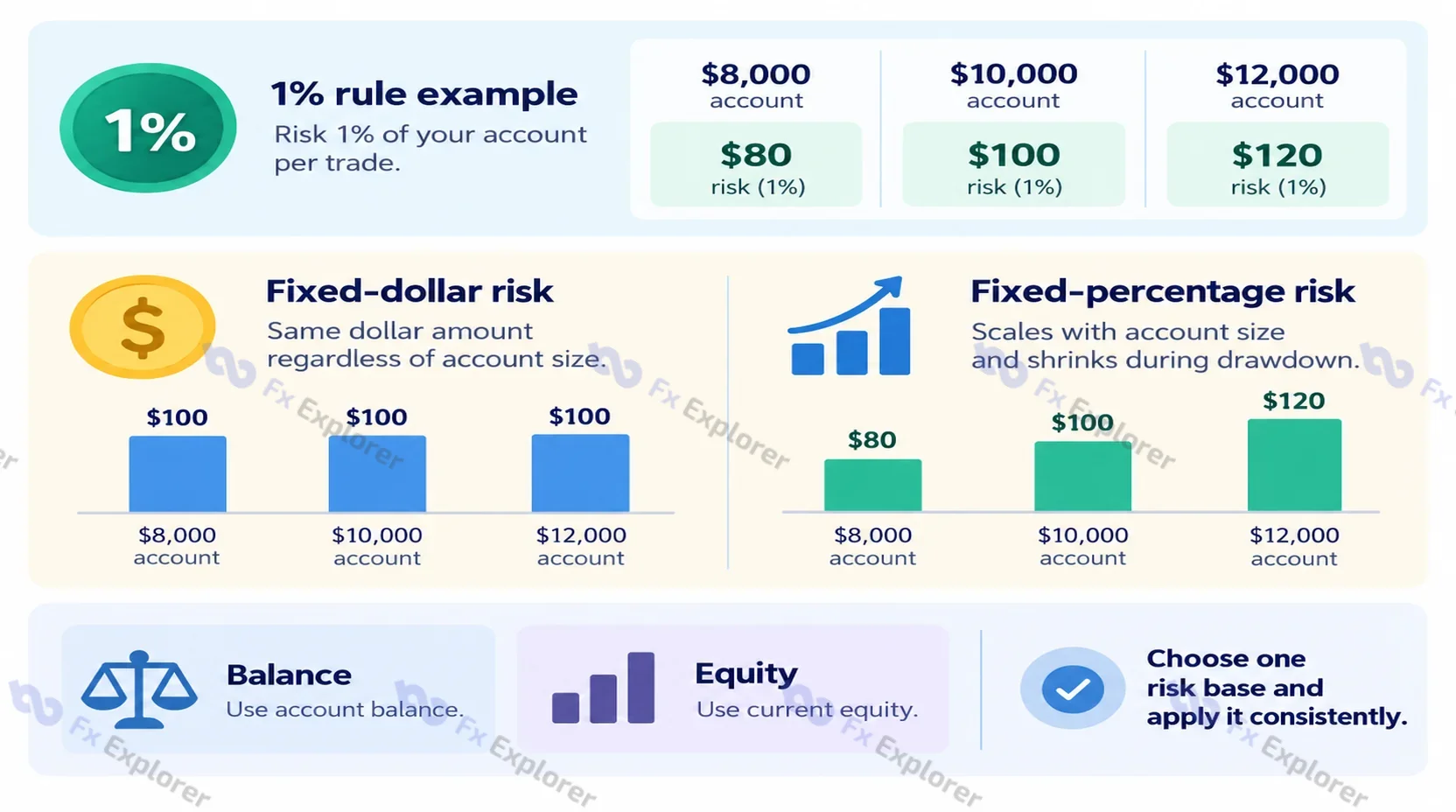
The commonly cited 1% rule suggests limiting planned loss on one trade to around 1% of account value.
It can be a useful reference point, but it is not a universal safe level.
A system taking one position at a time has a different risk profile from one opening many intraday trades or several correlated positions. Strategy variability, expected losing streaks, trade frequency and account objectives all matter.
With fixed-dollar risk, the same monetary amount is risked even when the account changes. With fixed-percentage risk, monetary risk scales with account size.
At 1%:
- $10,000 account → $100 risk
- $8,000 account → $80 risk
- $12,000 account → $120 risk
Fixed-percentage sizing therefore reduces dollar exposure automatically during drawdown.
The risk calculation can also use either balance or current equity. Balance ignores floating P/L until trades close, whereas equity reflects the current unrealized state of the account. The important point is not to claim that one method is universally correct; it is to define the method before trading and use it consistently.
Losing Streaks Are Part of the Distribution
A profitable system can still lose several times consecutively.
If a hypothetical strategy loses 40% of its trades, the probability that one specified five-trade sequence consists entirely of losses is:
Over a long trading history there are many opportunities for such sequences to occur.
Risk therefore needs to be small enough that an ordinary bad streak does not become an account crisis.
Planned Risk vs Realized Risk
Position-sizing formulas assume an exit occurs near the intended stop price.
Real markets are less precise.
The spread is the difference between bid and ask prices and represents an immediate trading cost. Some account structures also charge an explicit commission.
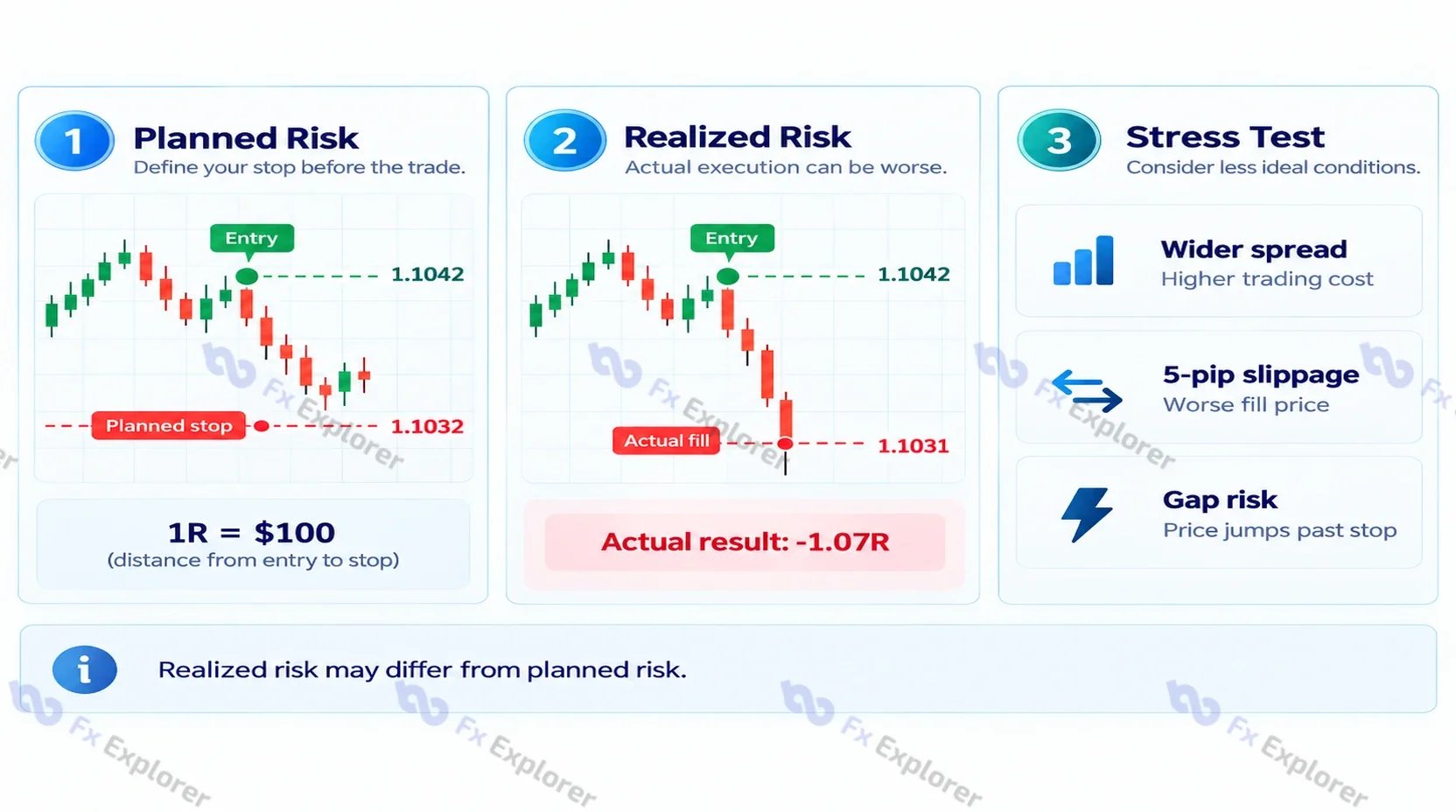
Slippage occurs when an order executes at a different price from the one expected. It may be favorable or unfavorable, but adverse slippage can turn a planned −1R loss into something larger.
A gap occurs when price jumps from one level to another without continuously trading through every price in between. If a gap moves through a stop, execution can occur at the next available price rather than at the intended level.
Positions held beyond certain times may also incur or receive swap, rollover or financing adjustments.
These costs create an important difference between planned R and realized R.
If $100 is the initial planned loss:
A perfectly executed stop might produce approximately −1R.
After spread, commission and unfavorable slippage, the actual result could be −1.07R or worse.
Tracking this gap is useful because a strategy that appears profitable under idealized assumptions may perform differently when real execution is included.
Before entry, it can therefore be helpful to stress-test the stop:
- What happens if the exit occurs five pips beyond the planned level?
- What if the spread widens materially?
- What if the market gaps after a weekend closure?
A position that remains acceptable under modest execution stress is more robust than one that only works under perfect conditions.
Different stop types also carry different execution characteristics. A standard stop-loss order attempts to close the trade after its trigger is reached but may execute at another price. A guaranteed stop, where available, can provide stronger protection against price gaps under specific terms and may involve an extra cost. A trailing stop moves in the favorable direction according to predefined rules, while a mental stop relies on manual action and therefore introduces attention, discipline, connectivity and execution risk.
Whatever the order type, the stop should come from the thesis rather than from the desire to avoid realizing a loss.
Risk-to-Reward, R-Multiples and Expectancy
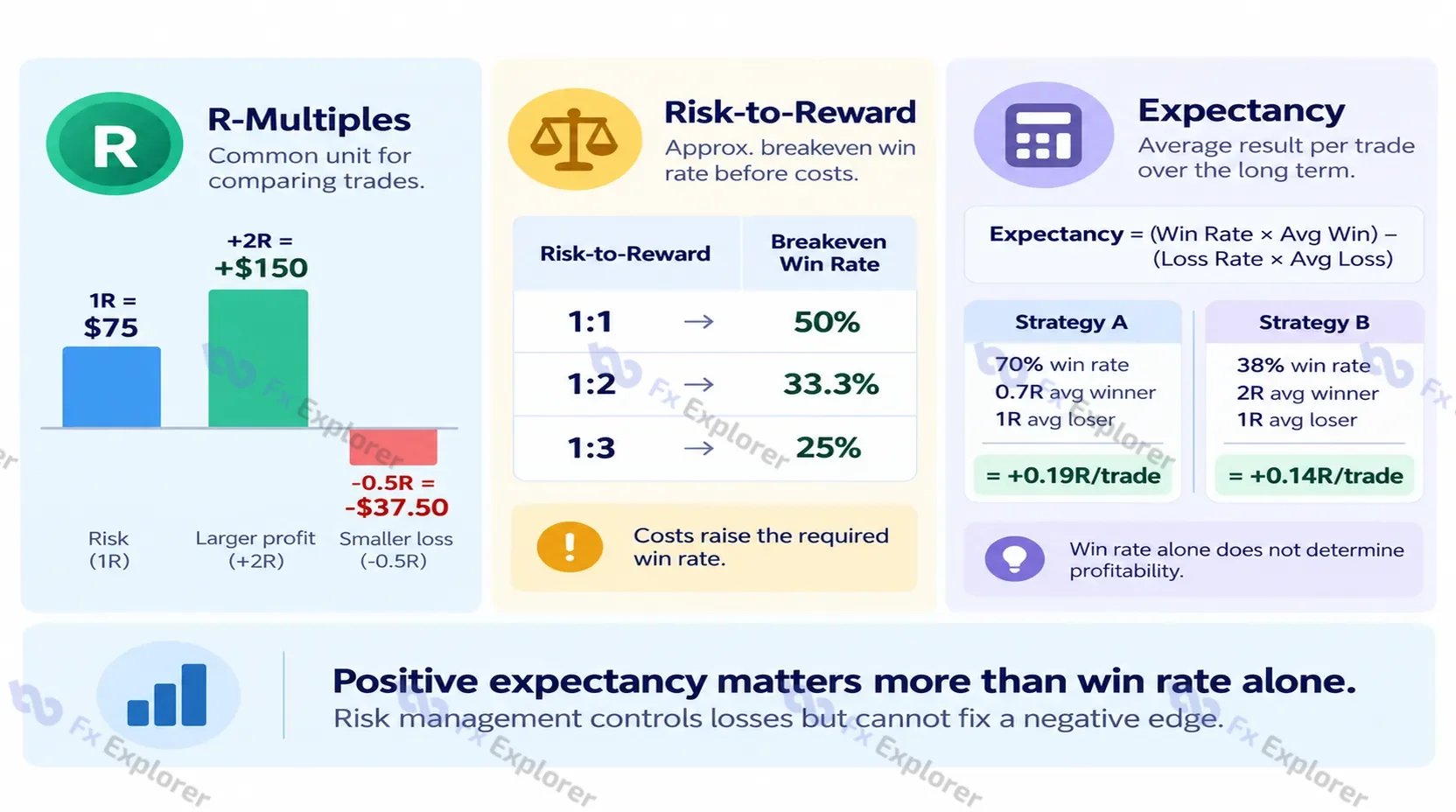
1R represents the amount initially planned to be at risk.
If monetary risk is $75:
A $150 gain equals +2R, while a $37.50 loss equals −0.5R.
R-multiples make trades with different pairs, account sizes and stop distances easier to compare.
A trade risking 1R to target 2R has a 1:2 risk-to-reward ratio.
That ratio does not automatically make the setup attractive. Risk-to-reward only becomes meaningful when considered together with win rate and trading costs.
Ignoring costs, approximate breakeven win rates are:
Trading costs raise the practical performance required.
The broader measure is expectancy:
Consider Strategy A:
Win rate = 70%
Average winner = 0.7R
Average loser = 1R
Strategy B has:
Win rate = 38%
Average winner = 2R
Average loser = 1R
Strategy A wins more frequently but earns less when it wins. Strategy B loses more often but makes more on its winners.
Both can have positive expectancy.
This is why neither win rate nor risk-to-reward proves profitability on its own.
Risk management also cannot repair negative expectancy. Smaller positions may slow the decline, stops may prevent catastrophic losses and session limits may reduce emotional damage, but none of those controls transforms a losing strategy into a profitable one.
Account-Wide Risk and Currency Correlation
Individual trade risk is only one part of the account’s exposure.
Risk per trade is the planned loss on one position. Risk per trading idea considers positions that express substantially the same underlying market view, while total open risk estimates how much could be lost if all current positions reached their stops.
For example:
Long AUD/USD
Long NZD/USD
Both positions may depend heavily on USD weakness.
If each risks 0.75%, it may be misleading to treat them as two entirely independent 0.75% ideas.
Another example is:
Long EUR/JPY
Long GBP/JPY
Both contain material exposure to JPY weakness.
Currency relationships also change over time, so correlation should be treated as a risk indicator rather than a permanent rule.
A more useful account-level question is:
Five separate tickets can still represent one concentrated market view.
Session Limits and Pending Exposure
A session or daily loss limit restricts how much damage can be allowed during a specified trading period.
Its purpose is both financial and behavioral. Repeated losses can reduce decision quality, and a predefined limit can prevent an ordinary losing session from turning into revenge trading.
There is no universal daily-loss percentage. A suitable threshold should reflect the strategy’s tested variability and the account’s tolerance for drawdown.
Pending orders matter too. Several orders can activate during the same strong move. If that is realistically possible, their combined potential exposure belongs in the risk calculation before they trigger.
Combined Margin Pressure
Correlation can damage an account in two ways at once: related positions can lose together while continuing to consume margin.
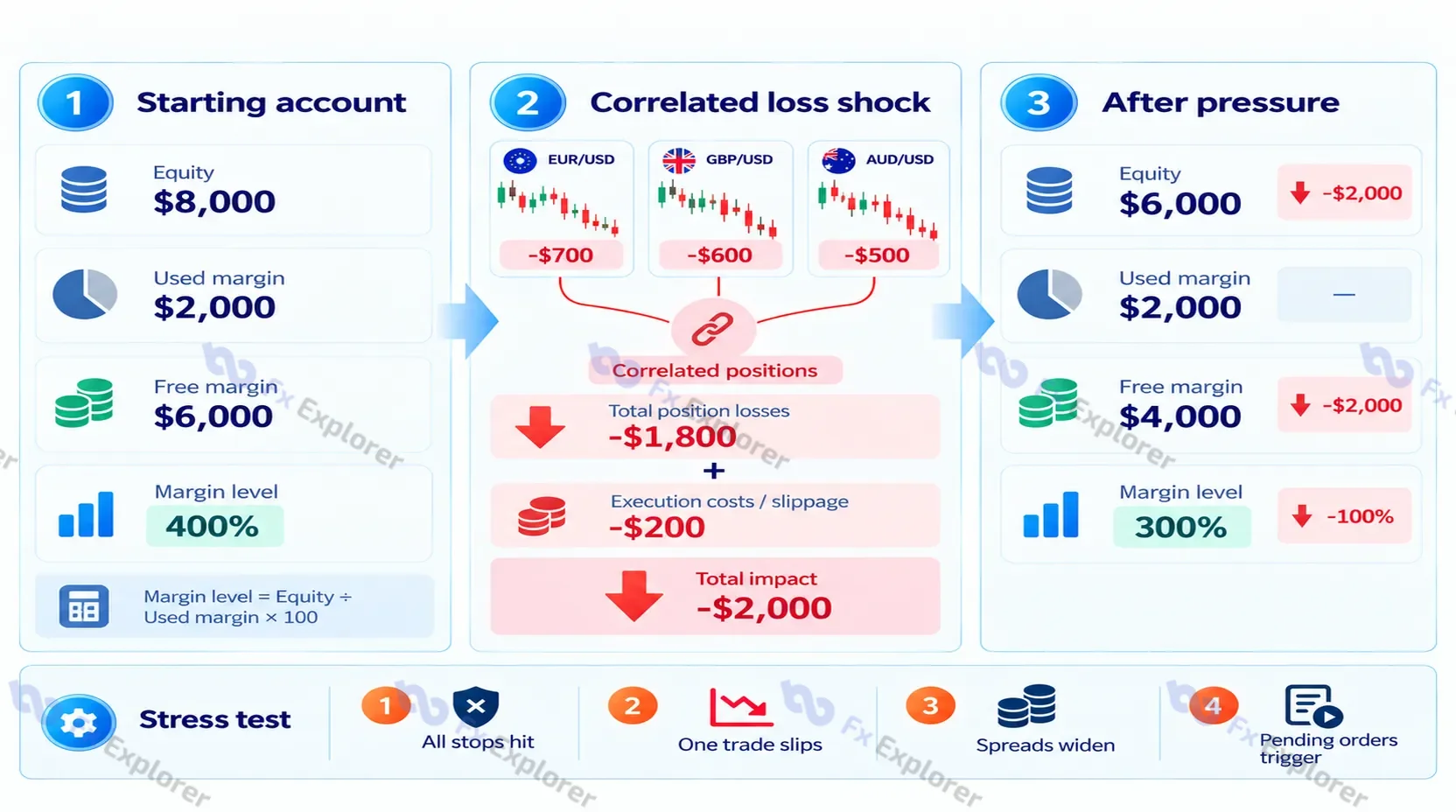
Assume:
Equity = $8,000
Used margin = $2,000
Initial margin level:
Now suppose correlated positions collectively lose $1,800 and unfavorable execution adds another $200.
New equity:
Holding used margin constant for this simplified example:
Free margin:
Margin level:
The lesson is not that 300% is safe or unsafe. The important point is how simultaneous losses, execution costs and margin usage feed into the account at the same time.
A useful stress test asks what would happen if:
- every current stop were hit;
- one trade slipped beyond its stop;
- spreads widened simultaneously;
- pending orders also activated.
The account should be evaluated against plausible combinations of bad outcomes, not only one isolated textbook loss.
News, Liquidity and Event Risk
Some positions lose because the underlying market idea is wrong. Others become unexpectedly expensive because execution conditions deteriorate.
Inflation releases, employment data, central-bank decisions and other major scheduled events can increase volatility rapidly. A USD/JPY position around a major U.S. or Japanese policy announcement, for example, may experience much faster movement and wider spreads than during an ordinary period.
A risk plan does not necessarily need to prohibit all news exposure. It needs a written rule describing how such exposure will be handled.
Liquidity conditions can change even without major news. Spreads may widen around rollover, session transitions, market opens or unusually quiet periods. A tight-stop strategy can therefore behave very differently even when the directional analysis remains unchanged.
Weekend positions introduce gap risk because the next available market price may be materially different from the previous close.
Volatility itself also changes over time. A stop model calibrated during a quiet period may become unsuitable during a high-volatility regime. Risk parameters should therefore be reviewed rather than assumed to remain valid forever.
Managing a Losing or Margin-Stressed Account
A losing trade, a drawdown and a margin-stressed account are different problems.
A losing trade is simply one position currently below its entry price. Drawdown is a decline from a previous account-equity peak. Margin stress occurs when equity, free margin or margin level deteriorates enough that account restrictions or forced liquidation become relevant.
The correct response depends on which problem actually exists.
A Six-Step Account-Rescue Framework
- Check whether the original trade thesis is still valid. If the reason for the trade has failed, additional money or another position does not repair it.
- Check whether current risk remains inside the written plan. Review individual trade risk, total open risk, correlation and session limits.
- Assess margin pressure. Look at equity, used margin, free margin and margin level.
- Identify the exposure creating the problem. An invalid position, excessive lot size, duplicated currency exposure, pending orders or upcoming event risk may be the main issue.
- Choose an action that actually reduces risk. This could mean closing a position, reducing size, cancelling pending orders, hedging under a predefined plan or adding funds for a clearly understood account-management purpose.
- Respect session and drawdown limits. If a limit has already been reached, opening additional recovery trades may violate the plan regardless of how attractive the next setup appears.
This sequence prevents every difficult account situation from being reduced to either “add more money” or “open a hedge.”
Closing or Reducing a Losing Position
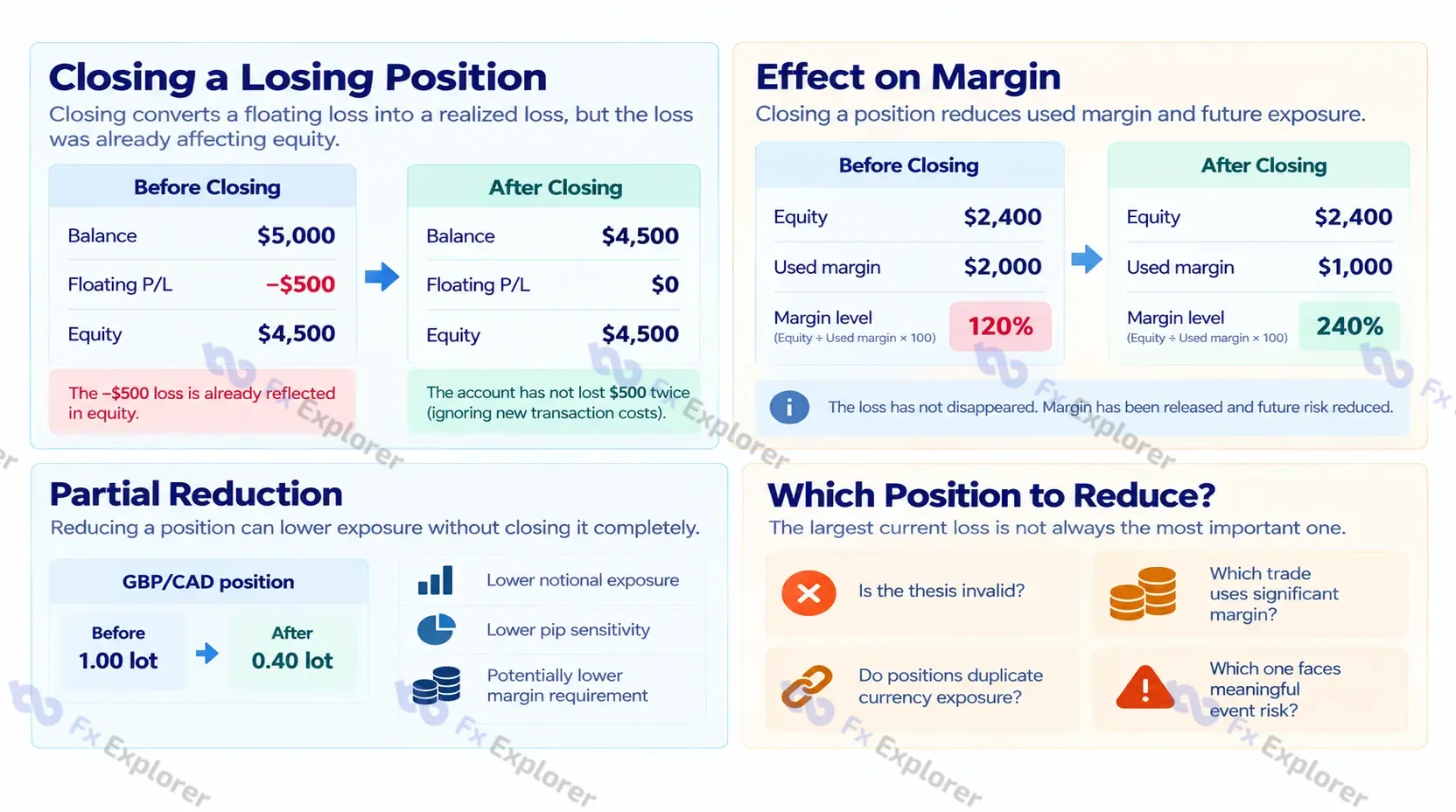
Closing a losing trade converts floating loss into realized loss, but the loss was already affecting equity before closure.
Suppose:
Balance = $5,000
Floating P/L = −$500
Equity = $4,500
After closing near the same market price:
Balance ≈ $4,500
Floating P/L = $0
Equity ≈ $4,500
Ignoring new transaction costs, the account has not suddenly lost the same $500 twice.
What changes materially is future exposure and used margin.
If equity is $2,400 and used margin is $2,000:
If a position is then closed and used margin falls to $1,000 while equity remains approximately $2,400:
The loss has not disappeared. Margin has been released and future risk has been reduced.
Partial reduction can achieve something similar without closing the entire position. Reducing a GBP/CAD trade from 1.00 lot to 0.40 lot lowers notional exposure, pip sensitivity and potentially the margin requirement.
The largest current loss is not necessarily the most important position to reduce. More useful questions are whether the thesis is invalid, which trade consumes substantial margin, which positions duplicate currency exposure and which one faces significant event risk.
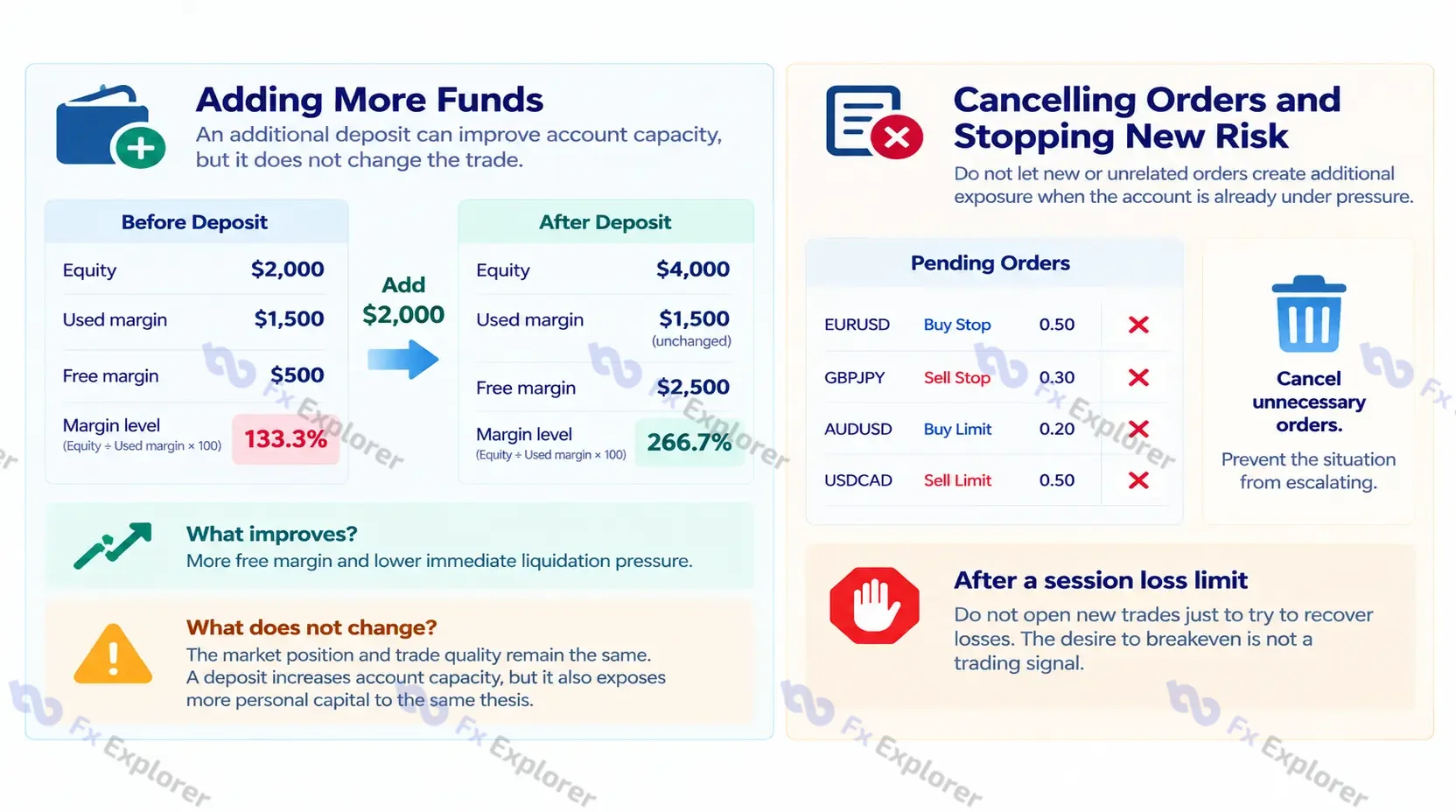
Adding More Funds
Additional deposits can improve account capacity.
With:
Equity = $2,000
Used margin = $1,500
Margin level is approximately:
Adding $2,000 raises equity to $4,000.
If used margin remains unchanged:
Free margin also increases.
That can reduce immediate liquidation pressure, but the market position has not improved.
A deposit changes account capacity, not trade quality.
The possible downside is that more personal capital becomes exposed to the same thesis.
Cancelling Orders and Stopping New Risk
An account already under pressure should not automatically allow unrelated pending orders to create new exposure.
Cancelling unnecessary orders can prevent a difficult situation from escalating.
The same logic applies after a session loss limit has been reached. The desire to recover the account to breakeven is not, by itself, a trading signal.
Can Hedging Help Manage Forex Risk?
Hedging means adding another position intended to reduce part of the future exposure from an existing trade.
It can alter risk.
It does not erase losses that have already occurred.
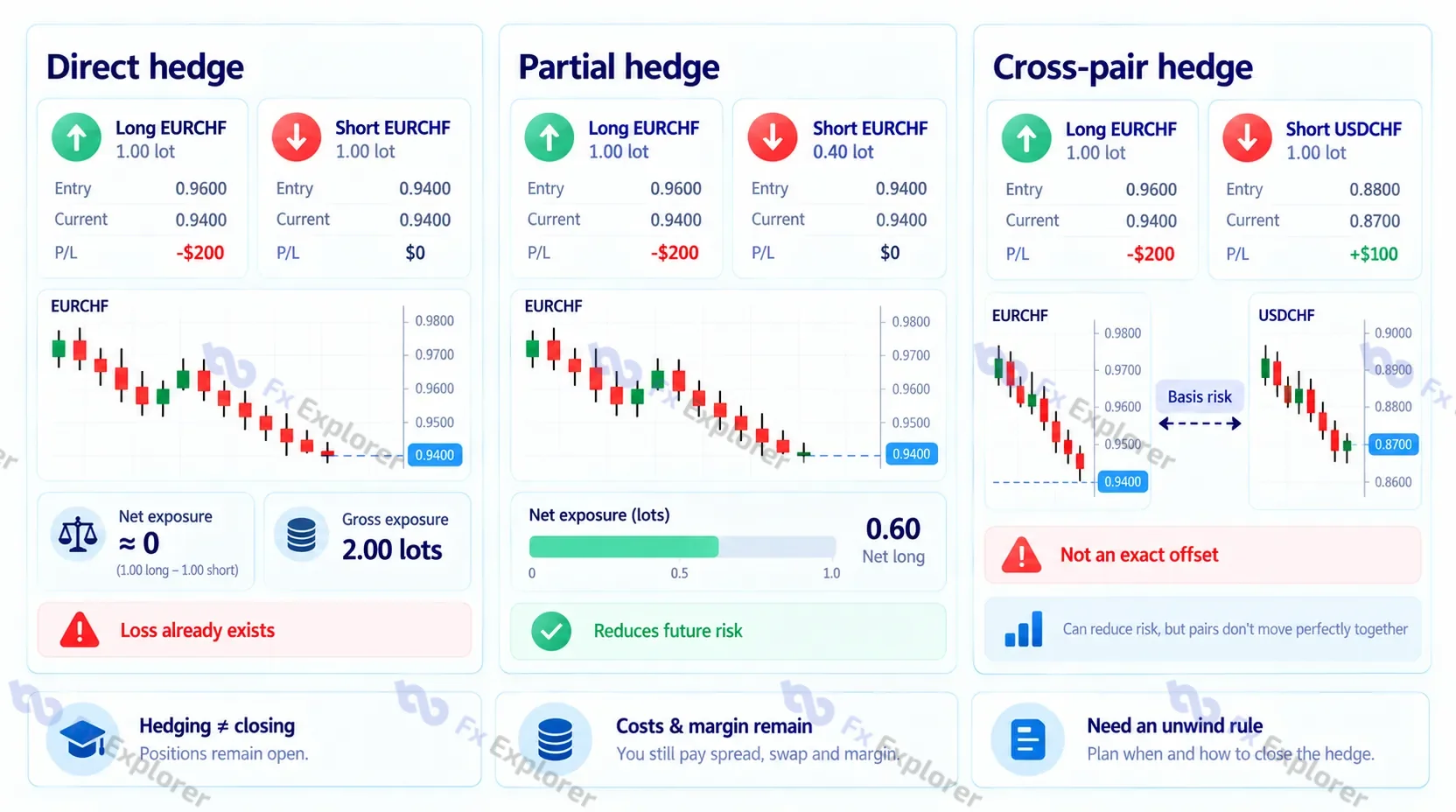
A direct hedge might involve holding a 1.00-lot long EUR/CHF position and opening an equal short EUR/CHF position where the account structure allows both sides to remain open. Net directional exposure may become approximately neutral, but transaction costs, financing, margin treatment and the original loss remain relevant.
A partial hedge reduces rather than removes directional exposure. A 1.00-lot long combined with a 0.40-lot short leaves approximately 0.60 lot of net directional exposure before costs and other implementation effects.
A cross-pair hedge uses a related currency pair instead. This introduces basis risk, the risk that the hedge and original position do not move closely enough to offset one another as expected.
It is also important to distinguish net exposure from gross exposure.
Long 1.00 lot EUR/CHF
Short 1.00 lot EUR/CHF
may create close to zero net direction, but gross exposure remains two one-lot positions.
Costs, financing, margin and operational complexity can therefore remain substantial even when directional exposure is reduced.
Closing and hedging solve different problems. Closing removes the position and realizes the loss. Hedging keeps the original exposure and adds another position intended to offset it.
Neither is automatically superior.
A hedge should also have a predefined unwind rule describing when and how one or both sides will be removed. Without that rule, a simple losing trade can become a more complex unmanaged position.
Risk-Reduction Mistakes That Can Make a Losing Account Worse
Several actions that appear to “save” a trade actually increase account risk.
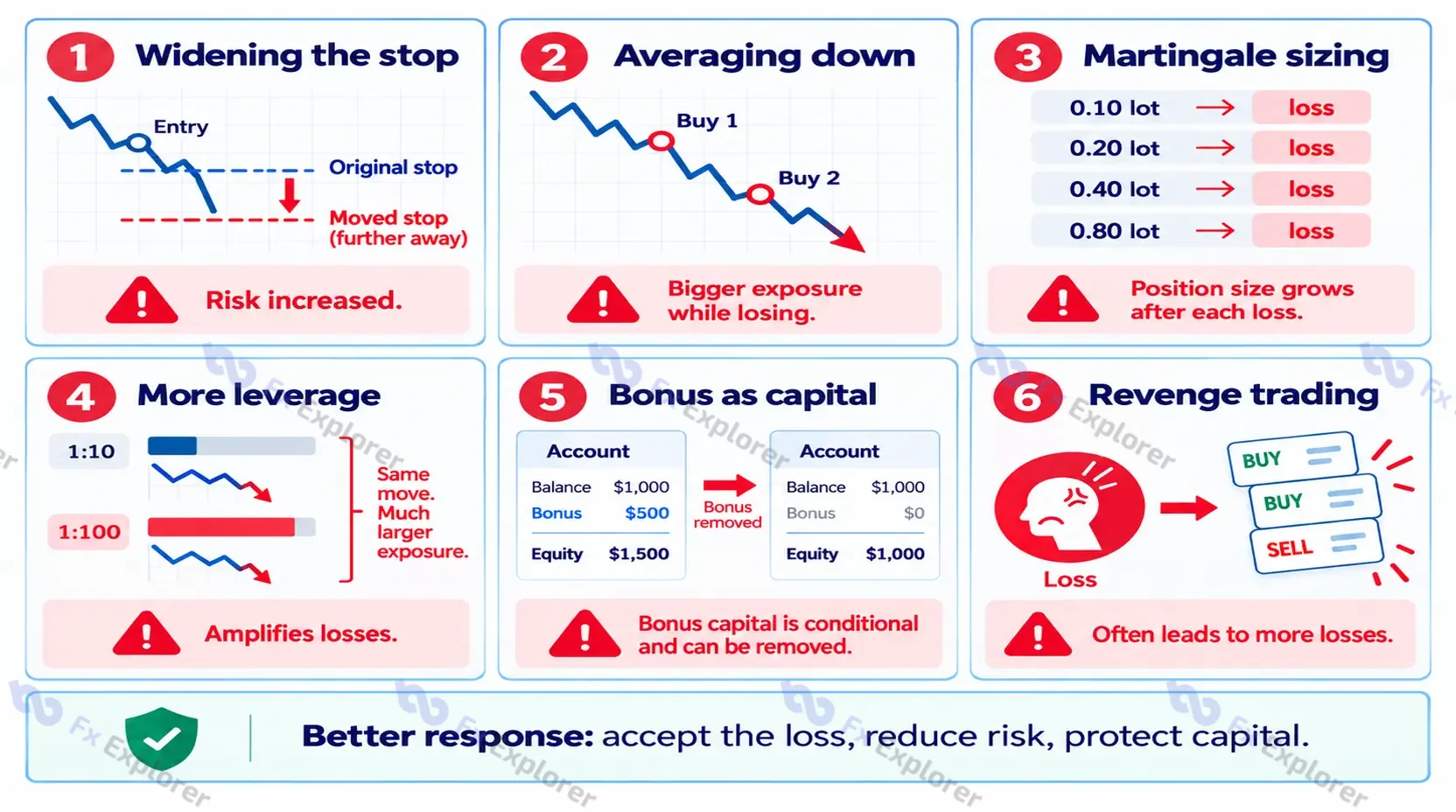
Widening the stop after entry is one example. A position entered with a 20-pip invalidation level but later given a 50-pip stop simply to avoid realizing the loss now carries more monetary risk than the original plan allowed.
Averaging down without a predefined scale-in plan creates a similar problem. Planned scaling can be legitimate when the combined maximum risk is calculated before the first entry. Adding size only because a position is losing increases exposure while evidence against the trade may be accumulating.
A more extreme version is martingale-style sizing, where exposure increases after each loss:
0.10 lot → loss
0.20 lot → loss
0.40 lot → loss
0.80 lot → loss
Capital may be shrinking at the same time that trade size is increasing, which can make a long losing sequence particularly destructive.
Increasing leverage to recover faster has the same flaw. Larger exposure may accelerate gains if the next trade wins, but it accelerates further losses just as effectively.
Treating promotional credit as permanent capital can also leave the account oversized if the credit is later removed.
Finally, revenge trading occurs when new positions are opened primarily to recover previous losses rather than because they satisfy the strategy. It is often accompanied by FOMO—fear of missing out—or the belief that one more trade can repair the session.
Sometimes the correct risk decision is simply to accept the loss. If the thesis has failed, the strategy has exceeded its tested drawdown, rules have been broken or additional capital would expose more money than intended, reducing or closing the position may be the best capital-preservation decision.
Risk management is not about keeping every trade alive. It is about keeping the account capable of participating in future valid opportunities.
Drawdown, Risk of Ruin and Trading Psychology
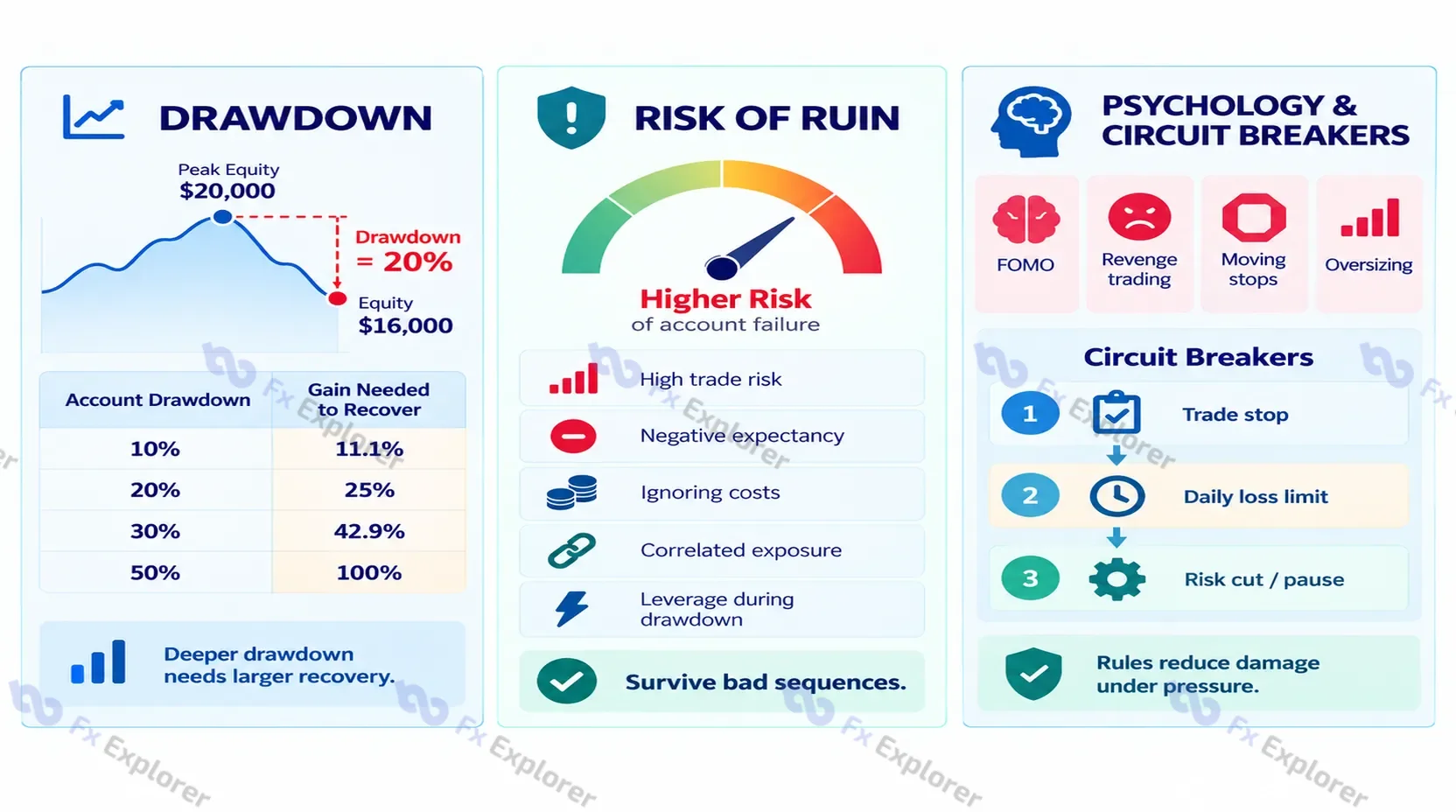
Drawdown is the decline from a previous account-equity peak.
If equity reaches $20,000 and later falls to $16,000:
Drawdown = $4,000
Percentage drawdown:
Recovery becomes progressively harder as drawdown deepens:
A 50% account decline does not require a 50% gain to recover. The remaining account must double.
Some tested systems therefore reduce position risk after predefined drawdown levels. The purpose is not to predict when the strategy will recover, but to slow further deterioration while its behavior is reviewed.
There is no universal drawdown schedule. The thresholds should come from testing rather than being invented during a losing period.
Risk of ruin is the possibility that losses become large enough that the account can no longer continue operating as intended.
It rises when expectancy is weak or negative, individual trade risk is large, losing streaks are underestimated, costs are ignored, correlated exposure is concentrated or leverage is increased during drawdown.
The mathematics can become complex, but the practical principle is simple:
A useful safeguard is a hierarchy of circuit breakers. These can operate at trade level through the stop, at session level through a daily-loss limit, or at strategy level through risk reduction or suspension after a predefined drawdown.
Psychology becomes a risk-management issue whenever emotion changes exposure. Moving a stop, oversizing because of FOMO, revenge trading after a loss or continuing to trade while decision quality has deteriorated all alter the account’s risk profile.
That is why written rules are more useful than vague advice to “stay disciplined.” They reduce the number of decisions that need to be made when pressure is highest.
Building a Complete Forex Risk Management Plan
A complete risk plan should convert these principles into rules that can actually be followed.
At minimum, it should define:
- Risk calculation base: whether position risk is calculated from balance or equity.
- Maximum trade risk: the amount or percentage that may be lost on one position.
- Invalidation and stop logic: how the market determines where the idea fails.
- Position-sizing method: how monetary risk, stop distance and pip value determine lot size.
- Risk per idea: how correlated positions are grouped.
- Maximum total open risk: how much unresolved account risk may exist at one time.
- Margin rules: how much unused margin capacity should remain.
- Event rules: how major news, weekends and rollover are handled.
- Session limits: when no additional positions may be opened.
- Drawdown response: when position risk is reduced or the strategy is suspended.
- Hedging rules: whether hedging is permitted and how any hedge will eventually be unwound.
- Promotional-credit policy: whether conditional credit is excluded from permanent risk capital.
- Review process: how planned risk, realized risk and rule adherence are evaluated.
An example framework might look like this:
The table is intentionally generic. The actual numbers should reflect strategy volatility, trade frequency, expected losing streaks and account objectives rather than universal internet rules.
Integrated Example: From One Trade to Account-Wide Risk
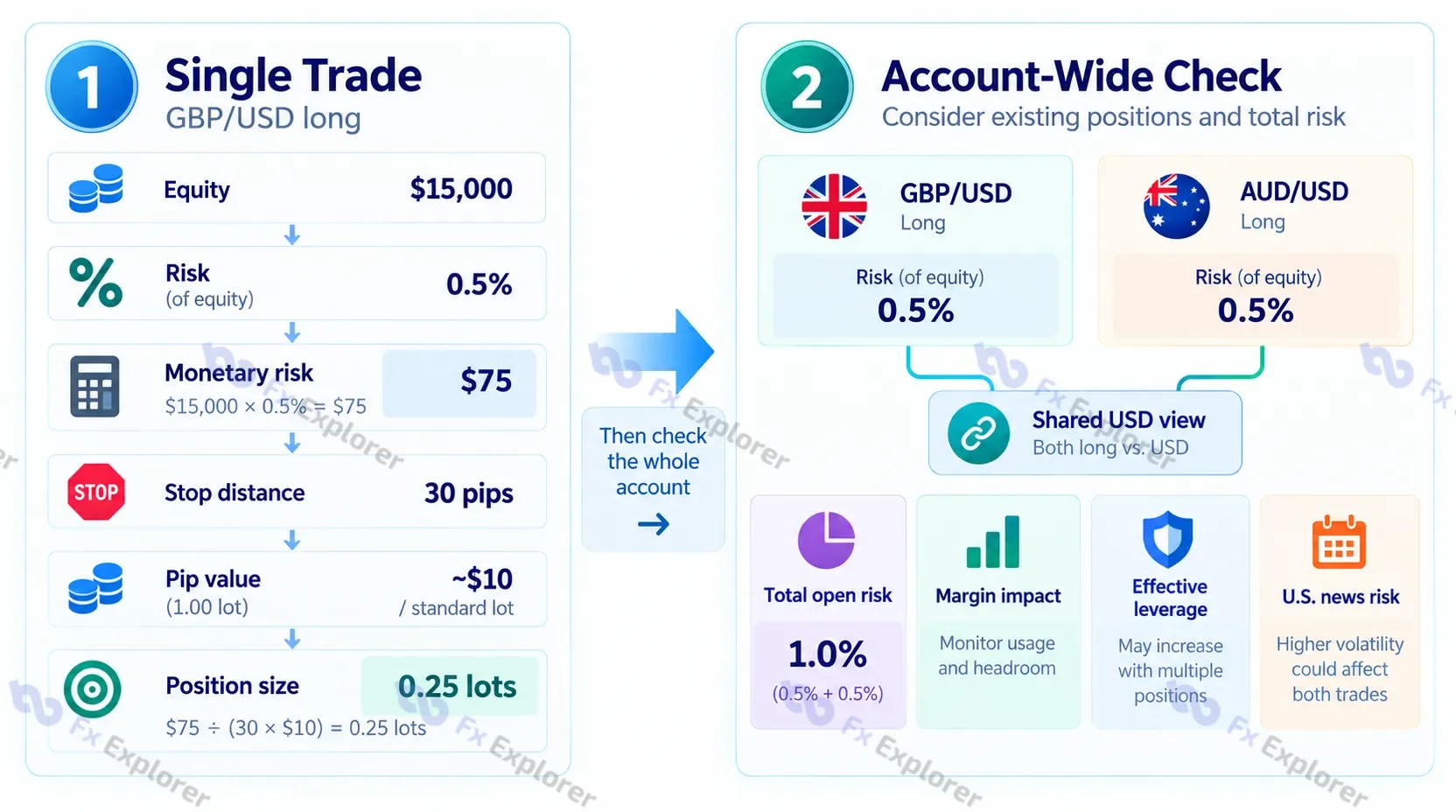
Assume a hypothetical GBP/USD long setup with:
Account equity = $15,000
Planned trade risk = 0.5%
Structural stop = 30 pips
Approximate pip value per standard lot = $10
Monetary risk:
Position size:
At the individual-trade level, the calculation is straightforward.
Now add the rest of the account.
An AUD/USD long position is already open and risks another 0.5%. Because both trades may benefit from USD weakness, they share some underlying currency exposure.
The decision therefore cannot stop at “0.25 lot is mathematically correct.” The account also needs to answer whether USD exposure is becoming too concentrated, how much total risk will be open, how much additional margin will be consumed, what effective leverage will become and whether major U.S. data is approaching.
The strongest risk process always moves from the individual position to the account as a whole.
Reviewing Whether the Risk Rules Are Working
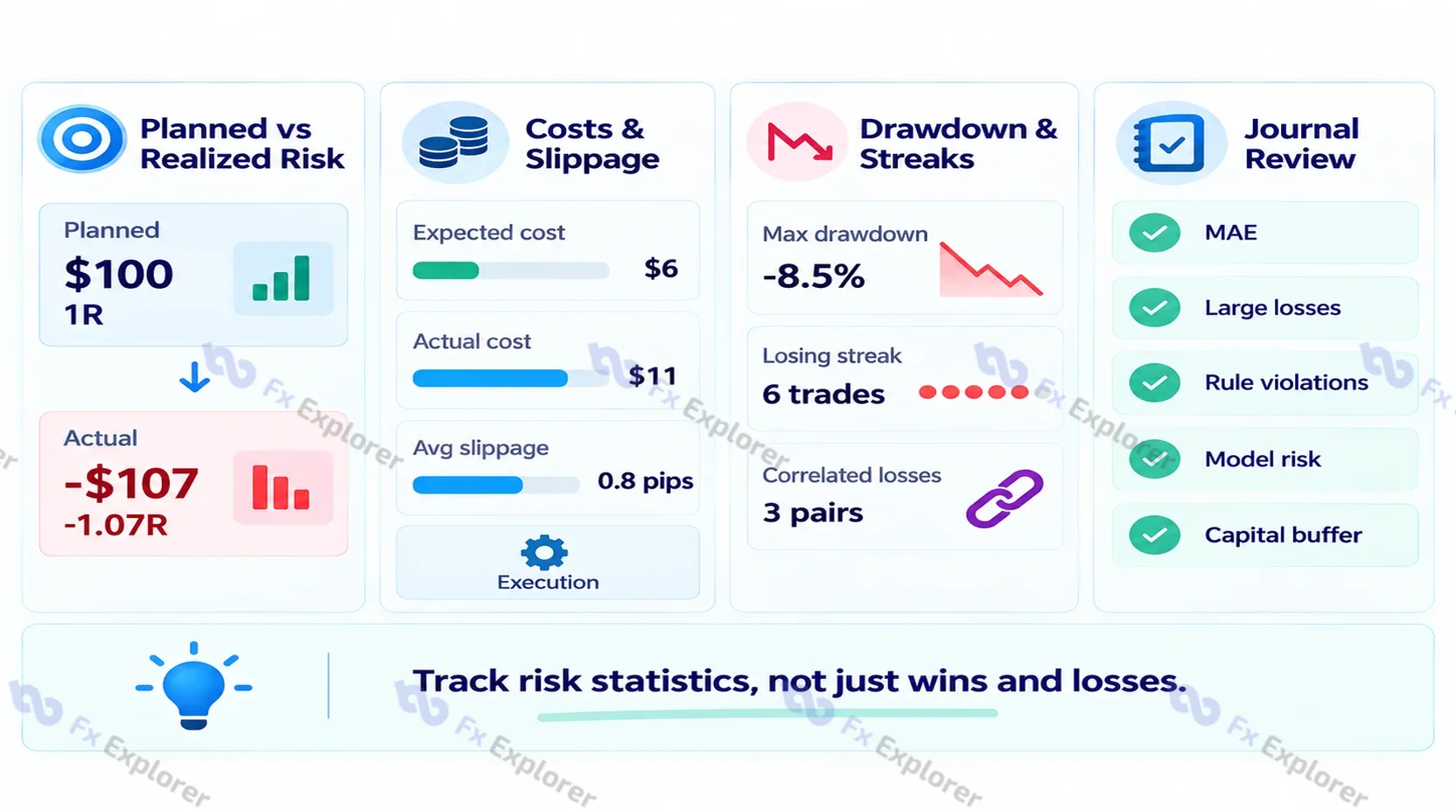
A useful trading journal should record more than entries and exits.
Risk review should track:
- planned monetary risk versus realized monetary risk;
- planned R versus realized R;
- expected costs versus actual costs;
- maximum drawdown and losing streaks;
- correlated losses;
- average slippage;
- unusually large losses;
- risk-rule violations.
Maximum adverse excursion, or MAE, measures how far a position moved against its entry before it was eventually closed.
For a winning trade, MAE can help reveal whether stops are consistently too tight or unnecessarily wide. It should not be used to redesign the strategy so perfectly around historical trades that every old winner survives. That would create overfitting, where rules are tailored too closely to past data and may not generalize well to future markets.
Planned and realized R also deserve close attention. If a system expects an average loser of −1R but actual losses average −1.15R, the difference may come from spread expansion, slippage, commissions, late exits or stop movement.
Historical statistics themselves also contain uncertainty. Win rate, average loss, drawdown and correlation are estimates, not permanent constants. This is model risk: the possibility that assumptions derived from past data prove too optimistic.
One practical response is to maintain enough capital and margin capacity for outcomes worse than the historical average.
The Risk Dashboard
At any point, the following figures should be understandable:
The goal is not to monitor numbers for their own sake.
It is to make hidden risk visible before the account is forced to react.
Common Forex Risk Management Mistakes
The most damaging mistakes usually reverse the correct decision sequence:
- choosing lot size before determining invalidation;
- assuming the 1% rule is automatically safe;
- confusing margin with maximum possible loss;
- confusing available leverage with appropriate exposure;
- holding correlated positions without recognizing common currency risk;
- ignoring total open risk and pending-order exposure;
- moving stops farther away after entry;
- averaging down without a predefined combined-risk plan;
- increasing size after losses;
- assuming a hedge removes an existing loss;
- depositing more capital without reassessing the original thesis;
- treating promotional credit as permanent capital;
- relying on negative balance protection or stop-out instead of proper sizing;
- ignoring spread expansion, slippage and gaps;
- forcing every strategy into a fixed 1:2 risk-to-reward target;
- increasing risk to recover drawdown;
- continuing to trade simply to recover a losing session.
A strong risk plan replaces these reactions with decisions made before they are emotionally difficult.
Forex Risk Management Checklist
Before entering or adding to a position, the following questions should have clear answers:
- What is the trade thesis?
- Where is the idea invalid?
- What is the stop distance?
- What monetary amount is at risk?
- What lot size produces that risk?
- What spread, commission and financing costs are likely?
- How much margin will the position require?
- What will free margin and margin level look like afterward?
- What effective leverage will the account be using?
- Do existing positions share the same currency exposure?
- What will total open risk become?
- Could pending orders add further exposure?
- Is important news, rollover or thin liquidity approaching?
- Is the account already near a session or drawdown limit?
- If the trade loses, is the response already defined?
If those questions cannot be answered before entry, the risk is not yet fully understood.
Conclusion
Forex risk management is most effective when it operates as a layered system rather than as a single percentage attached to each trade.
At the trade level, the process begins with the thesis and invalidation point. That determines the stop distance, which then determines the appropriate position size for the amount of capital being risked.
At the account level, leverage, margin, free margin, margin level and effective leverage show how the trade interacts with available capital. At the portfolio level, correlation, total open risk, event exposure, session limits and drawdown controls determine whether a difficult period remains manageable.
The complete sequence is:
When those decisions are made before market pressure appears, leverage becomes a tool rather than a target, margin becomes an account-management metric rather than an emergency warning, and individual losses remain manageable parts of the trading process instead of threats to the survival of the account.
FAQ
What is forex risk management?
Forex risk management is the process of controlling how much capital is exposed to individual trades, leverage, correlated positions, execution problems, losing streaks and account drawdowns. It includes stop placement, position sizing, margin management, leverage control and account-wide loss limits.
What is the 1% rule in forex?
The 1% rule is a commonly cited guideline suggesting that the planned loss on one trade should be limited to around 1% of account value. It is a heuristic, not a universally safe threshold. Suitable trade risk depends on strategy variability, losing streaks, trade frequency, correlation and total exposure.
How do you calculate forex position size?
What is margin in forex?
Margin is the capital required to support a leveraged position. It is collateral and should not be confused with trade risk or maximum possible loss.
What is margin level, and what is a good margin level?
What is the difference between a margin call and a stop-out?
A margin call generally represents an account-warning or restriction threshold. A stop-out is associated with automatic reduction or liquidation of positions. Exact thresholds and procedures vary by account.
What is negative balance protection?
Negative balance protection can limit liability so that covered losses do not leave the account owing more than the protected funds. Availability depends on the account type and applicable rules.
Does higher leverage automatically mean higher risk?
Higher available leverage does not automatically create a larger planned loss if position size remains modest. It does, however, make much larger notional exposure possible and can therefore make excessive margin usage and account risk easier.
What is a good risk-to-reward ratio?
There is no universally best risk-to-reward ratio. A 1:2 trade can still have negative expectancy if the win rate is too low after costs, while a strategy with smaller average winners can remain profitable if it wins often enough.
Can hedging rescue a losing forex trade?
Hedging can reduce or modify future exposure, but it does not erase losses already incurred. It may also add spread, commission, financing, margin usage and operational complexity.
Can depositing more money rescue a forex account?
Additional funds can improve equity, free margin and margin level, potentially reducing immediate liquidation pressure. They do not improve the underlying trade thesis and expose additional capital to future losses.
Can risk management make an unprofitable strategy profitable?
No. Risk management can control loss size, drawdown and the probability of catastrophic account damage. The strategy still needs positive net expectancy after trading costs.

Maya Renn
Maya Renn is a forex and CFD market reviewer specializing in broker analysis, trading platforms, fees, regulation, and user experience. Her work helps traders compare providers with greater clarity, focusing on transparency, reliability, and the practical details that matter to both new and experienced traders.